


General public knowledge, attitudes, and practices about rabies and associated factors in Gomma district of Jimma zone, southwestern Ethiopia
- PMID: 39401195
- PMCID: PMC11472934
- DOI: 10.1371/journal.pntd.0012551
General public knowledge, attitudes, and practices about rabies and associated factors in Gomma district of Jimma zone, southwestern Ethiopia
Abstract
Background: Rabies is a disease of warm-blooded animals that affects the central nervous system and is almost invariably fatal once clinical signs develop. It is one of the most neglected tropical diseases in several areas of the world, including Ethiopia. Additionally, the burden of the disease is estimated to be high in Ethiopia, and public awareness contributes to prevention.
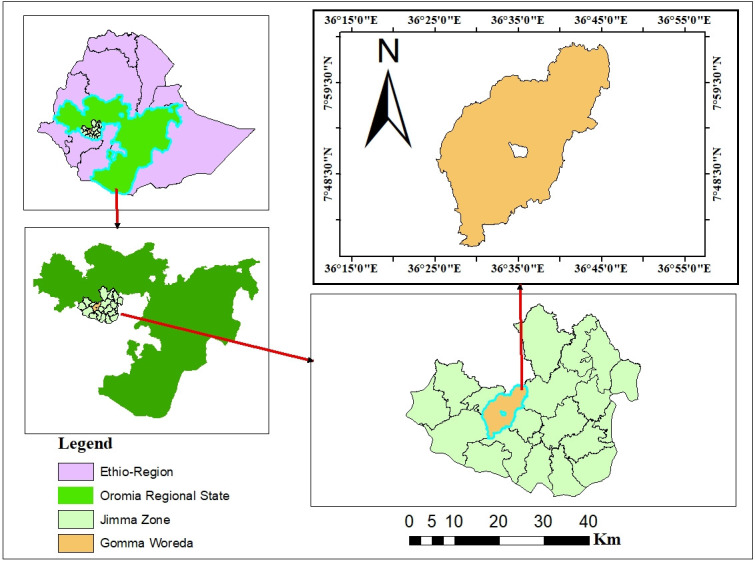
Methods: A community-based cross-sectional study design was conducted from June-August 2023 in the Gomma district, Jimma zone, Oromia regional state, Ethiopia, to assess the knowledge, attitudes, and practices of communities towards rabies and associated risk factors using a structured questionnaire survey. A multi-stage sampling technique was used for the selection of the sampling units and a total of 140 participants were interviewed. The questionnaire parts included socio-demographics information, knowledge, attitudes, and practices of the community's respect for rabies management and control. The data was analyzed by Statistical Package for Social Science (SPSS) Version 20. Descriptive analyses were employed and multivariable logistic regression was used to calculate the association between independent and dependent variables (Knowledge, Attitudes, and Practice scores).
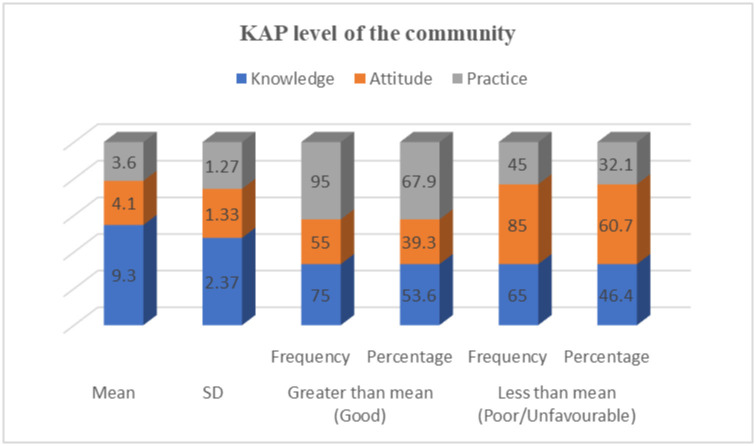
Results: About 134 (95.7%) respondents had heard about rabies. Likewise, 75 (53.6%), 55 (39.3%), and 95 (67.9%) of the respondents had good knowledge, favorable attitudes, and good practices, respectively. Christians were more likely to have higher knowledge scores than Muslims (AOR = 6.876, CI = 1.750-27.016, p = 0.006). Respondents who knew someone's exposure had a higher knowledge score than those who did not (AOR = 6.208, CI = 2.750-14.012, p = 0.000). Moreover, Muslims were found to have a more favorable attitudes than Christians (AOR = 5.518, CI = 1.199-25.391, p = 0.028). Those who knew someone's exposure to rabies were found to have a more favorable attitudes than those who did not (AOR = 2.367, CI = 1.157-4.839, p = 0.018). Respondents who had favorable attitudes towards rabies were found to have more good practices than unfavorable attitudes (AOR = 3.267, CI = 1.391, 7.730, p = 0.005).
Conclusions: The study revealed a gap in knowledge among communities in the study area. Thus, rabies control activity and community awareness should be implemented with stakeholders.
Copyright: © 2024 Kebede et al. This is an open access article distributed under the terms of the Creative Commons Attribution License, which permits unrestricted use, distribution, and reproduction in any medium, provided the original author and source are credited.
Conflict of interest statement
The authors have declared that no competing interests exist.
Figures
References
-
- Bilal A. Rabies is a zoonotic disease: a literature review. Occup. Med. Health Aff. 2021;9 (2).
-
- Dietzschold B, Schnell M, Koprowski H. Pathogenesis of rabies. The world of rhabdoviruses. 2005. Jan 1: 45–56. - PubMed
-
- Ali A, Mengistu F, Hussen K, Getahun G, Deressa A, Yimer E, Tafese K. Overview of rabies in and around Addis Ababa, in animals examined in EHNRI zoonoses laboratory between, 2003 and 2009. Ethiopian Veterinary Journal. 2010;14 (2): 91–101.
MeSH terms
LinkOut - more resources
Full Text Sources
Medical
Miscellaneous
