


Determinants of meconium-stained amniotic fluid among women delivered at southwestern referral hospitals, Southwest Ethiopia: a multi-center case-control study
- PMID: 39402457
- PMCID: PMC11479555
- DOI: 10.1186/s12884-024-06867-4
Determinants of meconium-stained amniotic fluid among women delivered at southwestern referral hospitals, Southwest Ethiopia: a multi-center case-control study
Abstract
Background: Meconium-stained amniotic fluid (MSAF) is a condition in which meconium is present in the uterus during ante-natal and complicates 10-15% of all live births. Scanty information is known about the determinants of meconium-stained amniotic fluid. Hence, this study aimed to identify determinants of meconium-stained amniotic fluid among women delivered at southwestern referral hospitals in southwest Ethiopia, in 2024.
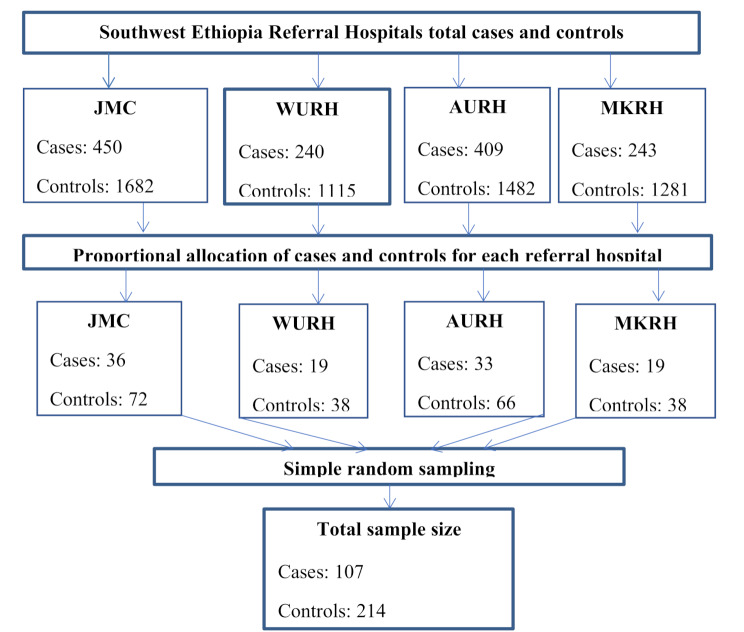
Methods: An institutional-based case-control study was employed from January 1, 2024, to June 30, 2024. The study was conducted in four southwestern referral hospitals in southwest Ethiopia. The final sample size includes 321(107 cases and 214 controls). The sample size was proportionally allocated for cases and controls for each referral hospital. Simple random sampling was used to select patient charts and data was collected from the chart using questions/tools developed after reviewing relevant literature. Data were entered using Epi-data version 3.1 and analyzed using SPSS version 25. Data was analyzed using binary logistic regression. All independent variables with P- the value of < 0.25 in univariable analysis were considered for multivariable logistic regression. Determinant factors of meconium-stained amniotic fluid were identified at a 95% confidence interval with a p-value < 0.05 was utilized to declare statistical significance.
Results: A total of 107 cases and 214 controls were included in this study. The finding from this study stated that induction of labor [AOR = 2.37, 95% CI = 1.28-8.89], obstructed labor [AOR = 2.62, 95%CI = 1.1-6.79], duration of labor greater than 24 h [AOR = 2.8, 95% CI = 1.55-15.44], and premature rupture of the membrane [AOR = 2.98, 95%CI = 1.1-8.23] were found to be significantly associated with meconium-stained amniotic fluid.
Conclusion: Conclusively, a mother with induced or obstructed labor, labor duration greater than 24 h, and premature rupture of membrane need special attention during delivery care to reduce potential risk factors to feto-maternal outcomes related to meconium-stained amniotic fluid.
Keywords: Determinants; Ethiopia; Meconium stained amniotic fluid; Southwest.
© 2024. The Author(s).
Conflict of interest statement
The authors declare no competing interests.
Figures
References
-
- Hailemariam HA, Nigusse FG, Gamshe EN. Prevalence and contributing factors of meconium stained amniotic fluid among women delivered at St Paul’s Hospital Millennium Medical College, Addis Ababa, Ethiopia. J Med Physiol Biophys. 2020;67:1–6.ISSN 2422-8427.
-
- Shrestha A, Singh SD, Tamrakar D. Associated factors and outcome of babies born through meconium-stained amniotic fluid. Kathmandu Univ Med J. 2018;16(61):65–8. - PubMed
-
- Gupta V, Bhatia BD, Mishra OP. Meconium stained amniotic fluid: antenatal, intrapartum and neonatal attributes. Indian Pediatr. 1996;33:293–8. - PubMed
Publication types
MeSH terms
LinkOut - more resources
Full Text Sources
