


The impact of halo-pelvic traction on sagittal kyphosis in the treatment of severe scoliosis and kyphoscoliosis
- PMID: 39402575
- PMCID: PMC11475359
- DOI: 10.1186/s13018-024-04985-5
The impact of halo-pelvic traction on sagittal kyphosis in the treatment of severe scoliosis and kyphoscoliosis
Abstract
Background: Halo-pelvic traction (HPT) is acknowledged for enhancing pulmonary function and reducing neurological complications in severe and rigid scoliosis and kyphoscoliosis. While its role in improving coronal balance is established, its impact on sagittal kyphosis remains under-researched. This study aims to assess HPT's effects on sagittal alignment in these conditions.
Methods: A retrospective review of 37 patients with severe and rigid scoliosis or kyphoscoliosis was conducted to evaluate HPT's efficacy. The analysis focused on the impact of HPT on coronal and sagittal parameters, pulmonary function tests (PFTs) and complications. Radiographic assessments included main cobb angle in coronal, sagittal major kyphosis.
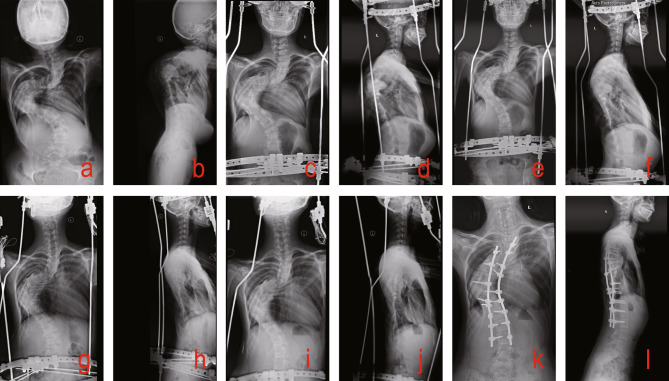
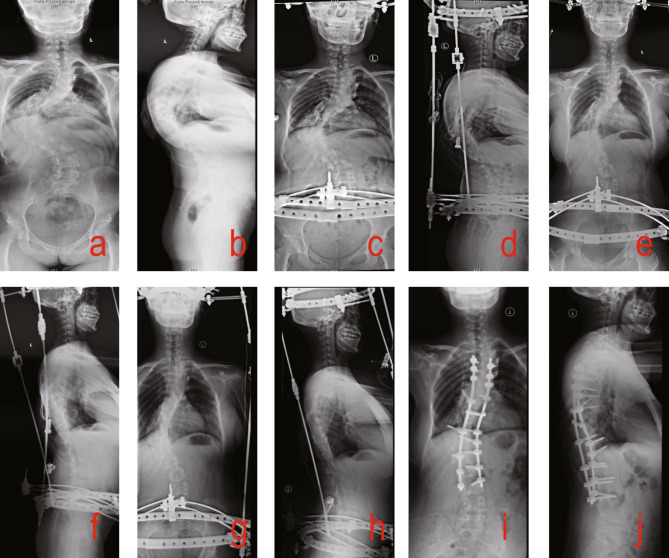
Results: HPT was applied for an average of 2.9 months, significantly reducing the primary coronal curve from 127.7°±30.3° to 74.9°±28.3° (P < 0.05), achieving a 41.3% correction rate. Sagittal kyphosis correction was more pronounced, with angles decreasing from 80.4°±26.4° to 41.3°±24.4° (P < 0.05), resulting in a 48.6% correction rate. Pulmonary function tests showed improvements in forced vital capacity (FVC) (from 1.32 ± 0.91 to 1.55 ± 0.83) and forced expiratory volume in 1 s (FEV1) (from 1.03 ± 0.76 to 1.28 ± 0.72), with percentage predicted values also increasing (FVC%: 40.4%±24.3-51.4%±23.1%; FEV1%: 37.8%±25.2-48.1%±22.7%; all P < 0.05).
Conclusion: HPT effectively reduces spinal deformity severity and improves pulmonary function in patients with severe and rigid scoliosis and kyphoscoliosis. Sagittal kyphosis correction was notably greater than coronal scoliosis correction. The correlation between PFT improvements and coronal curve adjustments suggests that correcting the coronal Cobb angle is pivotal for pulmonary function enhancement.
Keywords: Forced vital capacity; Halo-pelvic traction; Kyphoscoliosis; Pulmonary function; Spine deformities.
© 2024. The Author(s).
Conflict of interest statement
The authors declare that they have no competing interests.
Figures
References
-
- Watanabe K, Lenke LG, Bridwell KH, Kim YJ, Hensley M, Koester L. Efficacy of perioperative halo-gravity traction for treatment of severe scoliosis (≥ 100°). J Orthop Sci. 2010;15(6):720–30. 10.1007/s00776-010-1523-8. - PubMed
-
- Sucato DJ. Management of severe spinal deformity: scoliosis and kyphosis. Spine (Phila Pa 1976). 2010;35(25):2186–92. 10.1097/BRS.0b013e3181feab19. - PubMed
-
- Gollogly S, Smith JT, Campbell RM. Determining lung volume with three-dimensional reconstructions of CT scan data: a pilot study to evaluate the effects of expansion thoracoplasty on children with severe spinal deformities. J Pediatr Orthop. 2004;24(3):323–8. - PubMed
-
- Bouchoucha S, Khelifi A, Saied W, Ammar C, Nessib MN, Ben Ghachem M. Progressive correction of severe spinal deformities with halo-gravity traction. Acta Orthop Belg. 2011;77(4):529–34. - PubMed
-
- Yang C, Wang H, Zheng Z, et al. Halo-gravity traction in the treatment of severe spinal deformity: a systematic review and meta-analysis. Eur Spine J. 2017;26(7):1810–6. 10.1007/s00586-016-4848-y. - PubMed
MeSH terms
Grants and funding
LinkOut - more resources
Full Text Sources
Medical
