. 2024 Oct 24;128(42):9226-9234.
doi: 10.1021/acs.jpca.4c05532. Epub 2024 Oct 15.

Thermal Decomposition of 2-Cyclopentenone

Affiliations

Thermal Decomposition of 2-Cyclopentenone

Kathryn Narkin et al. J Phys Chem A. .

Abstract

The thermal decomposition of 2-cyclopentenone, a cyclic oxygenated hydrocarbon that occurs in the pyrolysis of biomass, has been studied in a combined experimental and theoretical approach. Gas-phase pyrolysis was performed at temperatures ranging from 1000 to 1400 K in a pulsed, microtubular reactor. Products were identified by FTIR spectroscopy following their isolation in a low-temperature argon matrix. The following products were identified: carbon monoxide, ketene, propenylketene, vinylacetylene, ethylene, propene, acrolein, acetylene, propyne, and propargyl radical. Computational results identify three different decomposition channels involving a H atom migration, and producing prop-2-enylketene (Pathway 1), prop-1-enylketene (Pathway 2), and a second conformation of prop-2-enylketene (Pathway 3). A fourth decomposition pathway involves simultaneous rupture of two C-C bonds forming a high energy cyclopropenone intermediate that further reacts to form ethylene, acetylene, and carbon monoxide. Finally, a fifth pathway to the formation of acrolein and acetylene was identified that proceeds via a multistep mechanism, and an interconversion from 2-cyclopentenone to 3-cyclopentenone was identified computationally, but not observed experimentally.


Conflict of interest statement

The authors declare no competing financial interest.

Figures

Figure 1
Figure 1
2-Cyclopentenone.
Figure 2
Figure 2
Temperature study of the pyrolysis of 2-cyclopentenone. All traces display matrix-isolation FTIR spectra of 0.3% mixtures of 2-cyclopentenone in argon, collected following pyrolysis at the indicated temperatures.
Figure 3
Figure 3
Matrix-isolation FTIR spectrum collected following 1300 K pyrolysis of 0.3% 2-cyclopentenone in argon (upper trace) compared to that of unheated 0.3% 2-cyclopentenone in argon. The asterisks mark substituted ketenes, purported to be propenylketenes, as described in the text.
Figure 4
Figure 4
Matrix-isolation FTIR spectrum collected following 1300 K pyrolysis of 0.3% 2-cyclopentenone in argon (upper trace) compared to that of unheated 0.3% 2-cyclopentenone in argon.
Figure 5
Figure 5
Matrix-isolation FTIR spectrum collected following 1300 K pyrolysis of 0.3% 2-cyclopentenone in argon (upper trace) compared to that of unheated 0.3% 2-cyclopentenone in argon.
Figure 6
Figure 6
Three possible 2-cyclopentenone decomposition channels, initiated by hydrogen atom migration, leading to propenylketenes. Molecular structures shown in these images are drawn to show the dynamic arrangement of atoms throughout each pathway and not necessarily drawn to represent geometry optimized structures. Geometry optimized structures for all species can be found in the Supporting Information.
Figure 7
Figure 7
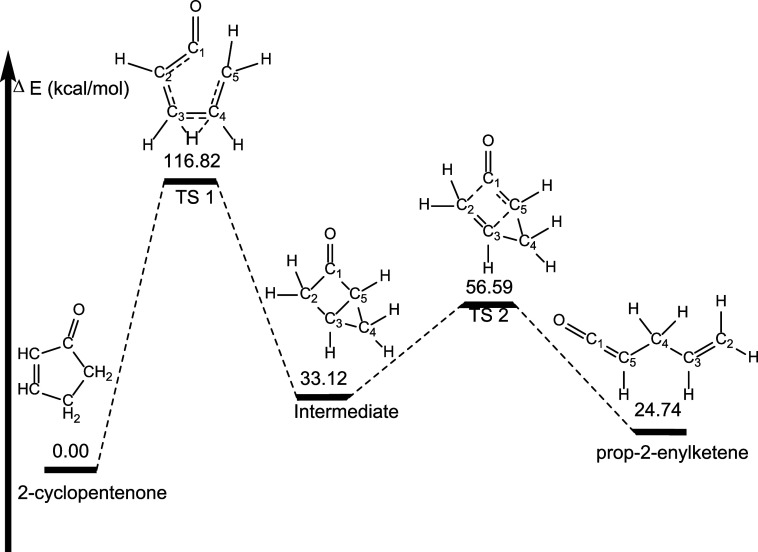
Lowest energy pathway (Pathway 1) for formation of prop-2-enylketene from 2-cyclopentenone. Energetics determined at the B3LYP/6-311++G** level of theory. Note that molecular structures shown in these images are drawn to show the dynamic arrangement of atoms throughout each pathway and not necessarily drawn to represent geometry optimized structures. Geometry optimized structures are shown in Figure 8.
Figure 8
Figure 8
Pathway 1 geometry optimized structures (B3LYP/6-311++G**). This pathway converts 2-cyclopentenone to prop-2-enylketene. For 2-cyclopentenone: ∠O–C1–C2 = 127; ∠O–C1–C5 = 126; ∠C2–C1–C5 = 107; ∠C2–C3–C4 = 113; ∠C3–C4–C5 = 104; ∠1–2–3–4 = 0.011; ∠2–3–4–5 = 0.005; ∠3–4–5–1 = 0.019; ∠4–5–1–2 = 0.025. For prop-2-enylketene ∠5–4–3–2 = 118°.
Figure 9
Figure 9
Pathway (Pathway 2) for formation of prop-1-enylketene from 2-cyclopentenone. Energetics determined at the B3LYP/6-311++G** level of theory. Molecular structures shown in these images are drawn to show the dynamic arrangement of atoms throughout each pathway and not necessarily drawn to represent geometry optimized structures. Geometry optimized structures for all species can be found in the Supporting Information.
Figure 10
Figure 10
Highest lying pathway (Pathway 3) for formation of prop-2-enylketene from 2-cyclopentenone. Energetics determined at the B3LYP/6-311++G** level of theory. Molecular structures shown in these images are drawn to show the dynamic arrangement of atoms throughout each pathway and not necessarily drawn to represent geometry optimized structures. Geometry optimized structures for all species can be found in the Supporting Information.
Figure 11
Figure 11
Matrix-isolation FTIR spectrum collected following 1300 K pyrolysis of 0.3% 2-cyclopentenone in argon (upper trace) compared to that of unheated 0.3% 2-cyclopentenone in argon.
Figure 12
Figure 12
Matrix-isolation FTIR spectrum collected following 1300 K pyrolysis of 0.3% 2-cyclopentenone in argon (middle trace) compared to that of unheated 0.3% 2-cyclopentenone in argon (upper trace). The top trace shows the difference spectrum, which clearly shows the assigned products. The asterisk indicates background CO2.
Figure 13
Figure 13
Pathway for formation of ethylene, acetylene and CO from 2-cyclopentenone decomposition. Energetics determined at the B3LYP/6-311++G** level of theory. Molecular structures shown in these images are drawn to show the dynamic arrangement of atoms throughout each pathway and not necessarily drawn to represent geometry optimized structures. Geometry optimized structures for all species can be found in the Supporting Information.
Figure 14
Figure 14
Pathway for formation of acrolein and acetylene from cyclopentenone decomposition. Energetics determined at the B3LYP/6-311++G** level of theory. Molecular structures shown in these images are drawn to show the dynamic arrangement of atoms throughout each pathway and not necessarily drawn to represent geometry optimized structures. Geometry optimized structures for all species can be found in the Supporting Information.

References

    1. Anca-Couce A. Reaction Mechanisms and Multi-Scale Modelling of Lignocellulosic Biomass Pyrolysis. Prog. Energy Combust. Sci. 2016, 53, 41–79. 10.1016/j.pecs.2015.10.002. - DOI
    1. Liu W.-J.; Li W.-W.; Jiang H.; Yu H.-Q. Fates of Chemical Elements in Biomass During Its Pyrolysis. Chem. Rev. 2017, 117, 6367–6398. 10.1021/acs.chemrev.6b00647. - DOI - PubMed
    1. Vamvuka D. Bio-Oil, Solid and Gaseous Biofuels from Biomass Pyrolysis Processes—an Overview. Int. J. Energy Res. 2011, 35, 835–862. 10.1002/er.1804. - DOI
    1. Nachenius R. W.; Ronsse F.; Venderbosch R. H.; Prins W. Biomass Pyrolysis. Adv. Chem. Eng. 2013, 42, 75–139. 10.1016/B978-0-12-386505-2.00002-X. - DOI
    1. Charon N.; Ponthus J.; Espinat D.; Broust F.; Volle G.; Valette J.; Meier D. Multi-Technique Characterization of Fast Pyrolysis Oils. J. Anal. Appl. Pyrolysis 2015, 116, 18–26. 10.1016/j.jaap.2015.10.012. - DOI

LinkOut - more resources