Review
. 2024 Dec;21(12):1354-1375.
doi: 10.1038/s41423-024-01226-x. Epub 2024 Oct 15.

Immunotherapy for glioblastoma: current state, challenges, and future perspectives

Affiliations
Review

Immunotherapy for glioblastoma: current state, challenges, and future perspectives

Yang Liu et al. Cell Mol Immunol. 2024 Dec.

Abstract

Glioblastoma (GBM) is an aggressive and lethal type of brain tumor in human adults. The standard of care offers minimal clinical benefit, and most GBM patients experience tumor recurrence after treatment. In recent years, significant advancements have been made in the development of novel immunotherapies or other therapeutic strategies that can overcome immunotherapy resistance in many advanced cancers. However, the benefit of immune-based treatments in GBM is limited because of the unique brain immune profiles, GBM cell heterogeneity, and immunosuppressive tumor microenvironment. In this review, we present a detailed overview of current immunotherapeutic strategies and discuss the challenges and potential molecular mechanisms underlying immunotherapy resistance in GBM. Furthermore, we provide an in-depth discussion regarding the strategies that can overcome immunotherapy resistance in GBM, which will likely require combination therapies.

Keywords: Adoptive T-cell therapies; Glioblastoma; Immune checkpoint inhibitors (ICIs); Immunotherapy combination; Oncolytic viral therapies; Tumor vaccines.


Conflict of interest statement

Competing interests: JDL reports being named a coinventor on pending and issued patents held by the Cleveland Clinic relating to cancer therapies, but these are not directly relevant to this review. No potential conflicts of interest are disclosed by the other authors.

Figures
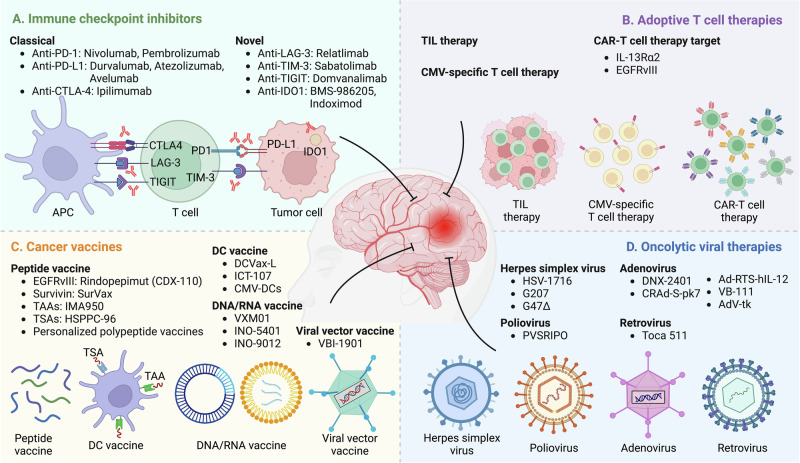
Fig. 1
Fig. 1
Immunotherapeutic strategies for GBM treatment. Four main immunotherapeutic strategies (immune checkpoint inhibitors, adoptive T-cell therapies, cancer vaccines, and oncolytic viral therapies) have been developed for GBM. A Immune checkpoint inhibitors are monoclonal antibodies that target classical (e.g., PD-1, PD-L1, and CTLA-4) and novel (e.g., LAG-3, TIM-3, TIGIT, and IDO1) immune checkpoints. B Adoptive T-cell therapy involves the infusion of activated (TILs) or engineered (CMV-specific T cells and CAR-T cells) autologous T cells to increase their antitumor activity. C Cancer vaccines use tumor antigens to activate the adaptive immune system of GBM patients, which can be delivered in the form of peptides, DCs, DNA/RNA, and viral vectors. D Oncolytic viral therapies (e.g., HSVs, poliovirus, adenovirus, and retrovirus) use replication-competent viruses to selectively infect and destroy cancer cells. Abbreviations: CAR chimeric antigen receptor, CMV cytomegalovirus, CTLA-4 cytotoxic T lymphocyte associated protein 4, DC dendritic cell, EGFRvIII epidermal growth factor receptor variant III, GBM glioblastoma, HSPPC-96 heat shock protein peptide complex-96, IDO1 indoleamine 2,3-dioxygenase 1, IL-13Rα2 interleukin-13 receptor subunit alpha 2, LAG-3 lymphocyte activation gene-3, PD-1 programmed cell death protein 1, PD-L1 programmed cell death ligand 1, TAAs tumor associated antigens, TIGIT T-cell immunoreceptor with immunoglobulin and ITIM domain, TILs tumor infiltrating lymphocytes, TIM-3 T-cell immunoglobulin and mucin domain 3, TSAs tumor specific antigens
Fig. 2
Fig. 2
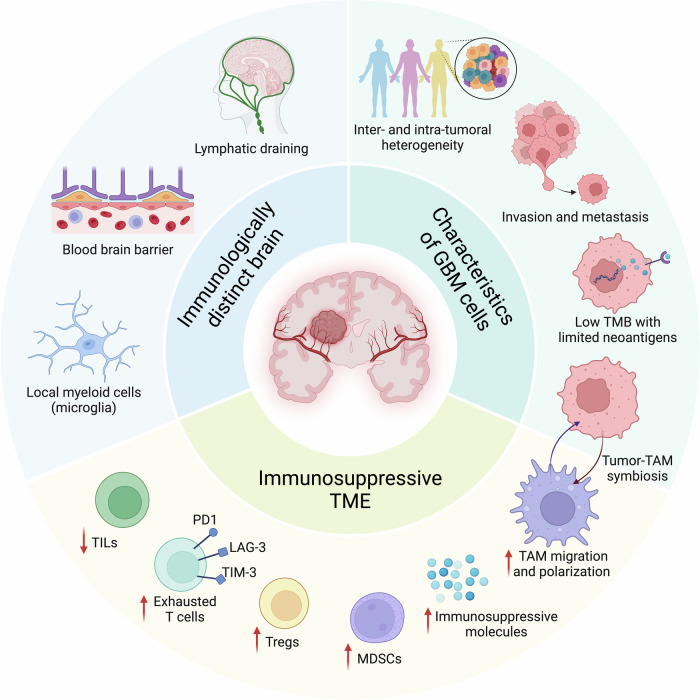
Challenges and molecular mechanisms of immunotherapy in GBM. Multiple processes restrain the response of GBM to immunotherapies, including the immunologically distinct brain (e.g., unique lympatic draining pathway, anatomical location protected by the blood‒brain barrier, and resident microglia), the immunosuppressive TME (e.g., T-cell dysfunction and exhaustion, and immunosuppressive myeloid cells, such as TAMs and MDSCs), and the characteristics of GBM cells (e.g., intertumoral and intratumoral heterogeneity, highly invasive nature, low TMB, and context-dependent GBM cells and their associated TAM biology). GBM glioblastoma, LAG-3 lymphocyte-activation gene 3, MDSCs myeloid-derived suppressor cells, PD-1 programmed cell death protein 1, TAM tumor-associated macrophage and microglia, TILs tumor-infiltrating lymphocytes, TIM-3 T-cell immunoglobulin and mucin domain 3, TMB tumor mutation burden, TME tumor microenvironment, Tregs regulatory T cells
Fig. 3
Fig. 3
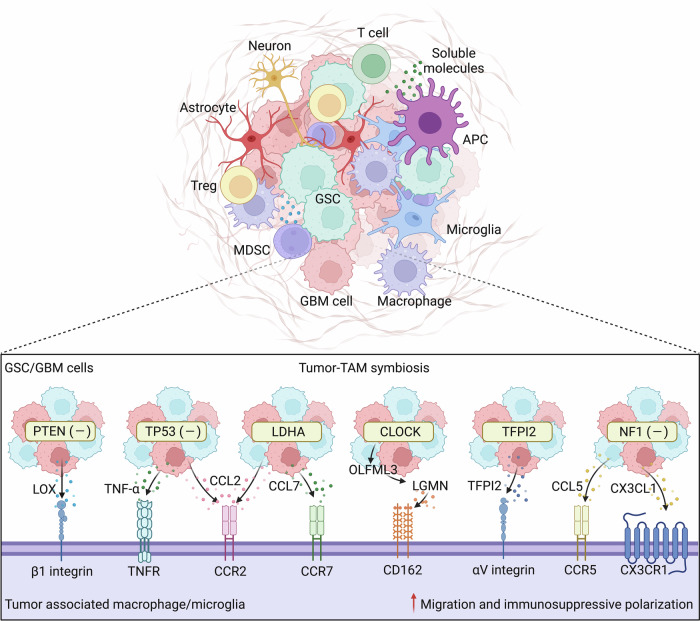
The immunosuppressive TME and tumor-TAM crosstalk in GBM. The immunosuppressive TME of GBM is a highly heterogeneous dynamic system that includes tumor cells (GBM cells and GSCs), low numbers of TILs, high infiltration of immunosuppressive cells (e.g., TAMs, MDSCs, and Tregs), normal brain cells (e.g., astrocytes and neurons), and soluble molecules. Crosstalk between tumor cells and TAMs is an important mechanism within the GBM TME that promotes tumor growth and induces immunosuppression. Under different conditions (e.g., PTEN, P53 and NF1 deletion/mutation, CLOCK and TFPI2 overexpression/amplification, and metabolic changes), tumor cells can secrete various cytokines and chemokines, such as LOX, TNF-α, OLFML3, LGMN, TFPI2, CCL2, CCL5, CCL7, and CX3CL1, to promote the migration and immunosuppressive polarization of TAMs, which in turn promotes tumor progression and immunosuppression. APCs antigen-presenting cells, CCL2 C-C motif chemokine ligand 2, CD162 cluster of differentiation 162, CLOCK circadian locomotor output cycles kaput, CX3CL1 C-X3-C motif ligand 1, CX3CR1 C-X3-C motif chemokine receptor 1, GBM glioblastoma, GSCs glioblastoma stem cells, LDHA lactate dehydrogenase A, LOX lysyl oxidase, LGMN legumain, MDSCs myeloid-derived suppressor cells, NF1 neurofibromin 1, OLFML3 olfactomedin like 3, TAMs tumor-associated macrophages and microglia, TFPI2 tissue factor pathway inhibitor 2, TILs tumor infiltrating lymphocytes, TME tumor microenvironment, TNF-α tumor necrosis factor α, TNFR, CCR2 C-C motif chemokine receptor 2, TNFR TNF-α receptor, Tregs regulatory T cells
Fig. 4
Fig. 4
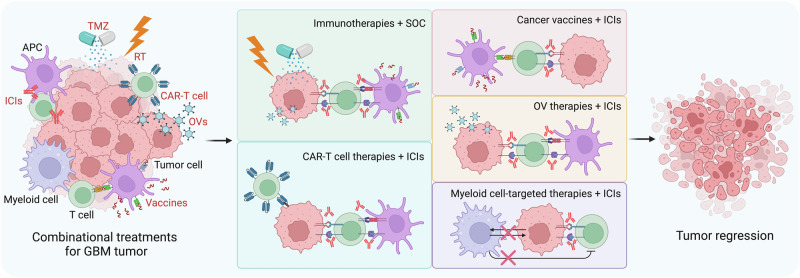
Strategies for overcoming immunotherapy resistance in GBM. Multiple combination strategies, including SOC combined with immunotherapies, ICIs combined with other types of immunotherapies (e.g., CAR-T-cell therapies, cancer vaccines, and OV therapies), and myeloid cell-targeted therapies combined with ICIs, have been developed to overcome immunotherapy resistance in GBM. APC antigen-presenting cell, CAR chimeric antigen receptor, GBM glioblastoma, ICIs immune checkpoint inhibitors, OV oncolytic virus, RT radiotherapy, SOC standard of care, TMZ temozolomide

References

    1. Miller KD, Ostrom QT, Kruchko C, Patil N, Tihan T, Cioffi G, et al. Brain and other central nervous system tumor statistics, 2021. CA Cancer J Clin. 2021;71:381–406. - DOI - PubMed
    1. Tan AC, Ashley DM, Lopez GY, Malinzak M, Friedman HS, Khasraw M. Management of glioblastoma: state of the art and future directions. CA Cancer J Clin. 2020;70:299–312. - DOI - PubMed
    1. Wen PY, Weller M, Lee EQ, Alexander BM, Barnholtz-Sloan JS, Barthel FP, et al. Glioblastoma in adults: a Society for Neuro-Oncology (SNO) and european society of neuro-oncology (EANO) consensus review on current management and future directions. Neuro Oncol. 2020;22:1073–113. - DOI - PMC - PubMed
    1. DeCordova S, Shastri A, Tsolaki AG, Yasmin H, Klein L, Singh SK, et al. Molecular heterogeneity and immunosuppressive microenvironment in glioblastoma. Front Immunol. 2020;11:1402. - DOI - PMC - PubMed
    1. Stupp R, Mason WP, van den Bent MJ, Weller M, Fisher B, Taphoorn MJ, et al. Radiotherapy plus concomitant and adjuvant temozolomide for glioblastoma. N Engl J Med. 2005;352:987–96. - DOI - PubMed