


Preoperative discrimination of invasive and non-invasive breast cancer using machine learning based on automated breast volume scanning (ABVS) radiomics and virtual touch quantification (VTQ)
- PMID: 39406987
- PMCID: PMC11480293
- DOI: 10.1007/s12672-024-01438-7
Preoperative discrimination of invasive and non-invasive breast cancer using machine learning based on automated breast volume scanning (ABVS) radiomics and virtual touch quantification (VTQ)
Abstract
Purpose: Evaluating the efficacy of machine learning for preoperative differentiation between invasive and non-invasive breast cancer through integrated automated breast volume scanning (ABVS) radiomics and virtual touch quantification (VTQ) techniques.
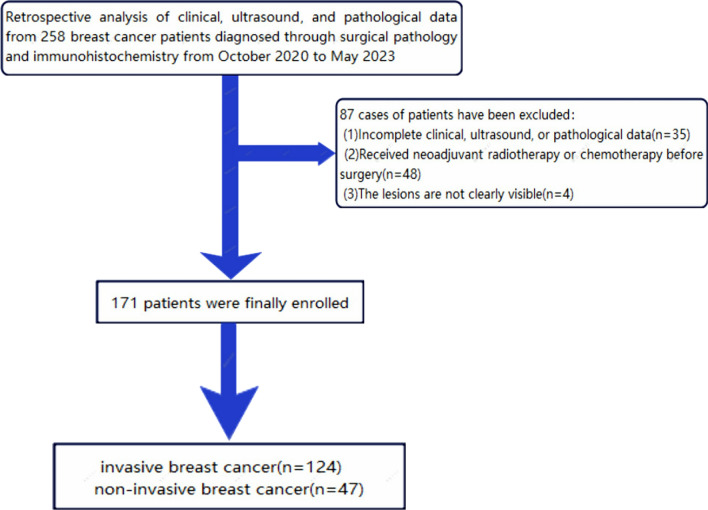
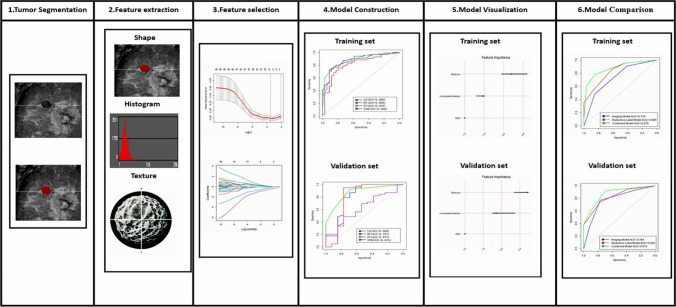
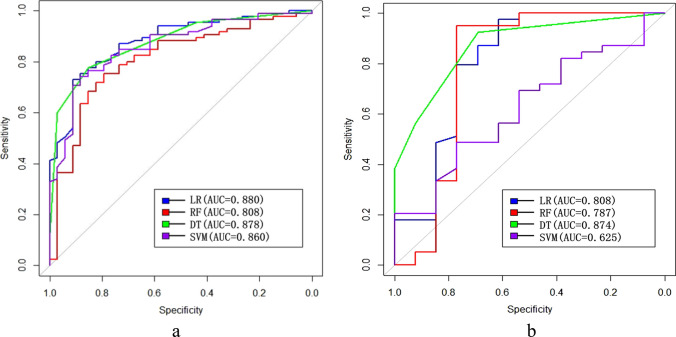
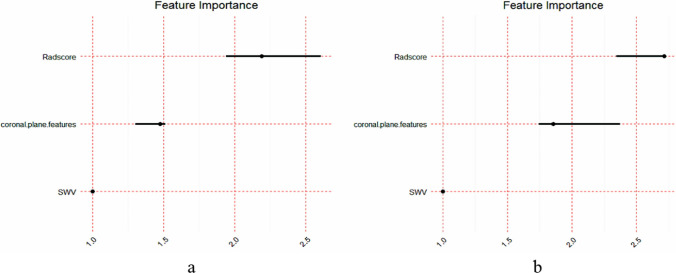
Methods: We conducted an extensive retrospective analysis on a cohort of 171 breast cancer patients, differentiating them into 124 invasive and 47 non-invasive cases. The data was meticulously divided into a training set (n = 119) and a validation set (n = 52), maintaining a 70:30 ratio. Several machine learning models were developed and tested, including Logistic Regression (LR), Random Forest (RF), Decision Tree (DT), and Support Vector Machine (SVM). Their performance was evaluated using the Area Under the Receiver Operating Characteristic (ROC) Curve (AUC), and visualized the feature contributions of the optimal model using Shapley Additive Explanations (SHAP).
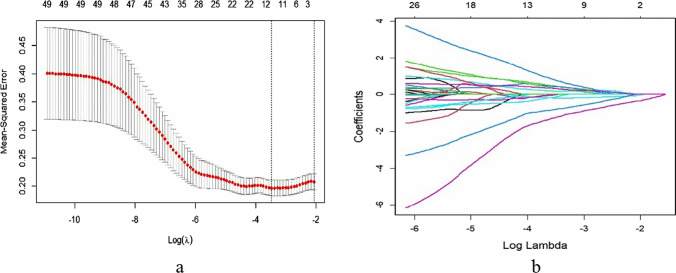
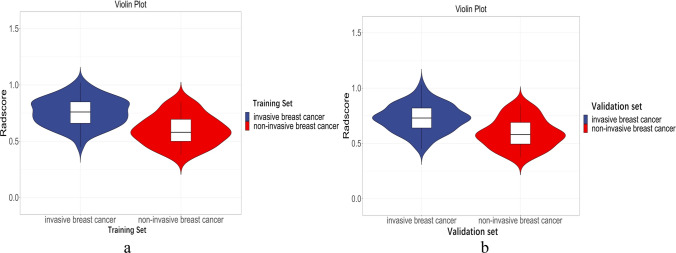
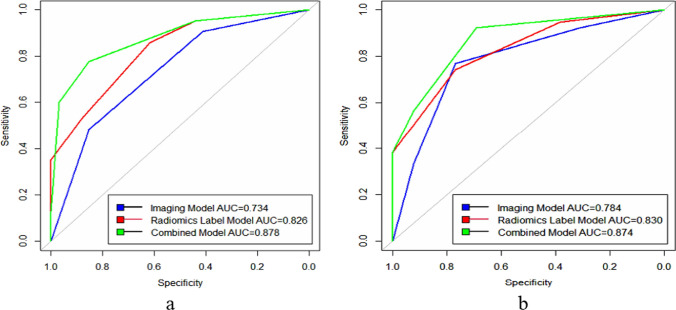
Results: Through both univariate and multivariate logistic regression analyses, we identified key independent predictors in differentiating between invasive and non-invasive breast cancer types: coronal plane features, Shear Wave Velocity (SWV), and Radscore. The AUC scores for our machine learning models varied, ranging from 0.625 to 0.880, with the DT model demonstrating a notably high AUC of 0.874 in the validation set.
Conclusion: Our findings indicate that machine learning models, which integrate ABVS radiomics and VTQ, are significantly effective in preoperatively distinguishing between invasive and non-invasive breast cancer. Particularly, the DT model stood out in the validation set, establishing it as the primary model in our study. This highlights its potential utility in enhancing clinical decision-making processes.
Keywords: Automated breast volume scanning; Breast cancer; Machine learning; Radiomics; Virtual touch quantification.
© 2024. The Author(s).
Conflict of interest statement
The authors have no relevant financial or non-financial interests to disclose.
Figures
References
-
- Chen W, Ru R, Wang F, et al. Automated breast volume scanning combined with shear wave elastography for diagnosis of triple-negative breast cancer and human epidermal growth factor receptor 2-positive breast cancer. Rev Assoc Med Bras (1992). 2021;67(8):1167–71. - PubMed
-
- Ouyang F, Guo B, Huang X, et al. A nomogram for individual prediction of vascular invasion in primary breast cancer. Eur J Radiol. 2019;110:30–8. - PubMed
-
- Galati G, De Vincentis A, Gallo P, et al. Diagnostic value of Virtual Touch Quantification (VTQ®) for differentiation of hemangiomas from malignant focal liver lesions. Med Ultrason. 2019;21(4):371–6. - PubMed
-
- Jakub J, Murphy B, Gonzalez A, et al. A validated nomogram to predict upstaging of ductal carcinoma in situ to invasive disease. Ann Surg Oncol. 2017;24(10):2915–24. - PubMed
-
- Maeda H, Hayashida T, Watanuki R, et al. Predictors of invasive disease in patients preoperatively diagnosed with ductal carcinoma without stromal invasion, with breast magnetic resonance imaging (MRI) and ultrasound (US). Breast Cancer. 2021;28(2):398–404. - PubMed
Grants and funding
- (GXXK-2020-44)/Major Project for the Construction of Peak Disciplines in Universities by the Education Department of Anhui Province
- (GXXK-2020-44)/Major Project for the Construction of Peak Disciplines in Universities by the Education Department of Anhui Province
- (GXXK-2020-44)/Major Project for the Construction of Peak Disciplines in Universities by the Education Department of Anhui Province
- (GXXK-2020-44)/Major Project for the Construction of Peak Disciplines in Universities by the Education Department of Anhui Province
- (GXXK-2020-44)/Major Project for the Construction of Peak Disciplines in Universities by the Education Department of Anhui Province
- (2023AH051743)/Key Scientific Research Project in Natural Sciences for Universities by the Education Department of Anhui Province
- (2023AH051743)/Key Scientific Research Project in Natural Sciences for Universities by the Education Department of Anhui Province
- (2023AH051743)/Key Scientific Research Project in Natural Sciences for Universities by the Education Department of Anhui Province
- (2023AH051743)/Key Scientific Research Project in Natural Sciences for Universities by the Education Department of Anhui Province
- (2023AH051743)/Key Scientific Research Project in Natural Sciences for Universities by the Education Department of Anhui Province
- (NO.KFKT202307)/The open project of Anhui Province Key Laboratory of Cancer Translational Medicine, Bengbu Medical University
- (NO.KFKT202307)/The open project of Anhui Province Key Laboratory of Cancer Translational Medicine, Bengbu Medical University
- (NO.KFKT202307)/The open project of Anhui Province Key Laboratory of Cancer Translational Medicine, Bengbu Medical University
- (NO.KFKT202307)/The open project of Anhui Province Key Laboratory of Cancer Translational Medicine, Bengbu Medical University
- (NO.KFKT202307)/The open project of Anhui Province Key Laboratory of Cancer Translational Medicine, Bengbu Medical University
LinkOut - more resources
Full Text Sources