. 2024 Oct 4;16(19):2815.
doi: 10.3390/polym16192815.

A Thermosensitive and Degradable Chitin-Based Hydrogel as a Brucellosis Vaccine Adjuvant

Affiliations

A Thermosensitive and Degradable Chitin-Based Hydrogel as a Brucellosis Vaccine Adjuvant

Ruibao Ju et al. Polymers (Basel). .

Abstract

Brucellosis is a zoonotic infectious disease that has long endangered the development of animal husbandry and human health. Currently, vaccination stands as the most efficacious method for preventing and managing brucellosis. Alum, as the most commonly used adjuvant for the brucellosis vaccine, has obvious disadvantages, such as the formation of granulomas and its non-degradability. Therefore, the aims of this study were to prepare an absorbable, injectable, and biocompatible hydroxypropyl chitin (HPCT) thermosensitive hydrogel and to evaluate its immunization efficacy as an adjuvant for Brucella antigens. Specifically, etherification modification of marine natural polysaccharide chitin was carried out to obtain a hydroxypropyl chitin. Rheological studies demonstrated the reversible temperature sensitivity of HPCT hydrogel. Notably, 5 mg/mL of bovine serum albumin can be loaded in HPCT hydrogels and released continuously for more than one week. Furthermore, the L929 cytotoxicity test and in vivo degradation test in rats proved that an HPCT hydrogel had good cytocompatibility and histocompatibility and can be degraded and absorbed in vivo. In mouse functional experiments, as adjuvants for Brucella antigens, an HPCT hydrogel showed better specific antibody expression levels and cytokine (Interleukin-4, Interferon-γ) expression levels than alum. Thus, we believe that HPCT hydrogels hold much promise in the development of adjuvants.

Keywords: adjuvant; brucellosis; hydroxypropyl chitin; temperature-sensitive hydrogel; vaccine.


Conflict of interest statement

The authors declare no conflicts of interest.

Figures

Scheme 1
Scheme 1
(A) HPCT preparation and characterization. (B) Hydrogel containing brucellosis antigen for immunization of mice.
Figure 1
Figure 1
The synthesis route (A), FT-IR spectra (B), and 1H NMR spectra (C) of HPCT.
Figure 2
Figure 2
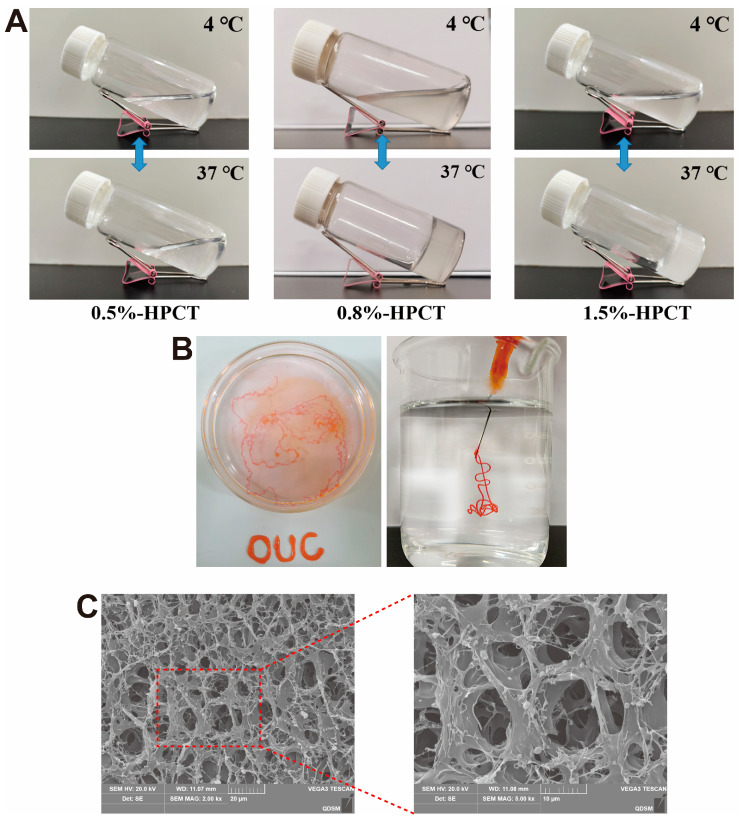
(A) Phase transition of HPCT hydrogels with different concentrations under vial tilting method. (B) Plasticity and injectability of HPCT hydrogel (0.8%). (C) Structural morphology of HPCT hydrogel under scanning electron microscope.
Figure 3
Figure 3
Rheological Behavior of HPCT. (A) Dynamic strain scanning of HPCT to determine the linear viscoelastic zone region (LVR). (BE) Temperature dependence of storage modulus (G′) and loss modulus (G″) of HPCT hydrogels with different concentrations. (F) The correlation between viscosity and shear rate of HPCT hydrogel at 37 °C. (G) Viscosity changes in HPCT hydrogel at different temperatures. (H) Correlation between dynamic frequency (ω) and modulus of HPCT hydrogels at 37 °C. (I) The reversible temperature phase transition ability of HPCT.
Figure 4
Figure 4
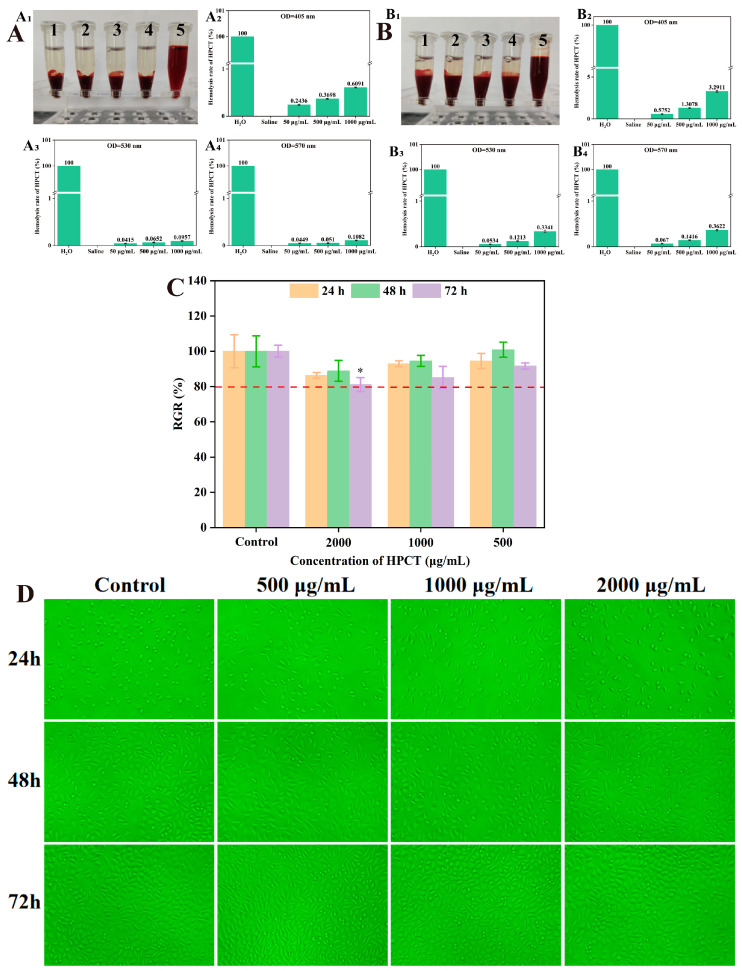
Hemolysis activity and hemolysis assay images of HPCT at different concentrations with pure water as a positive control and saline as a negative control group: (A) Tests using whole blood. (B) Tests using 2% red blood cells (Numbers 1–5 in (A,B) represent 50 μ/mL, 500 μg/mL, and 1000 μg/mL of hydrogel, saline, and pure water, respectively). Data represent the mean ± SD (n = 5). Effect of HPCT solution on the morphology and proliferation of L929 cells: (C) MTT test measured the proliferation rate. (D) Morphological changes of L929 cells were examined under a light microscope (original magnification, 100×) at 24 h, 48 h, and 72 h. Data represent the mean ± SD; n = 6; * p < 0.05 (significant difference compared with the control group).
Figure 5
Figure 5
(A) The initial state of the alum and HPCT hydrogels after subcutaneous injection into rats. (B) H&E staining images at different times (the green pentagram areas are the subcutaneous residual material, the blue arrows show the approximate boundaries of residual material and tissue, and the black lines are the boundaries of the different areas).
Figure 6
Figure 6
(A) The degradation curve of the HPCT hydrogel in different concentrations of lysozyme. (B) Percentage of BSA released in stages from the HPCT hydrogels (weight of BSA released per stage/total weight of BSA). (C) Total release rate for BSA from the HPCT hydrogel.
Figure 7
Figure 7
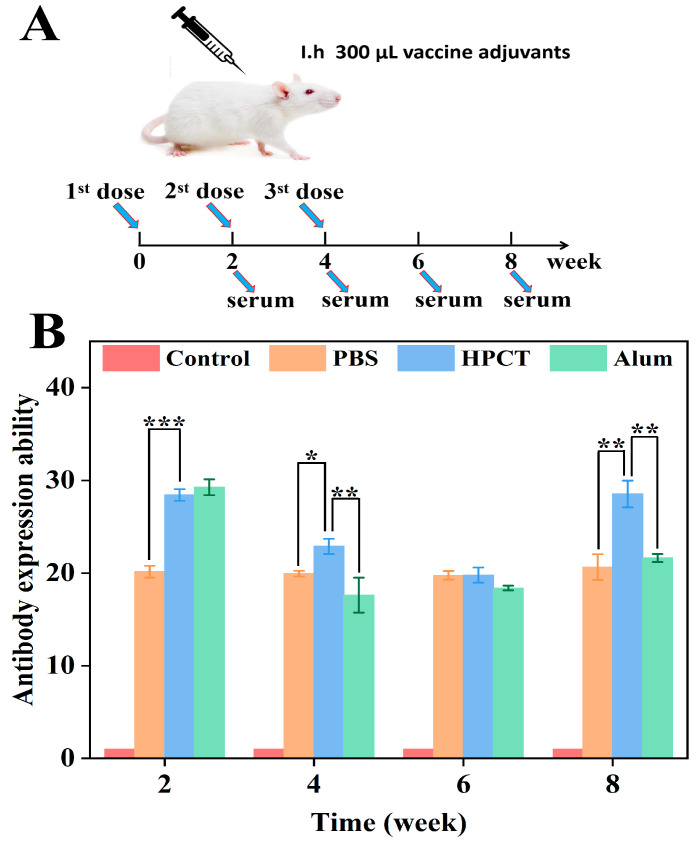
(A) Mouse immune program diagram. (B) Specific antibody expression levels in mouse serum at different time points. Data represent mean ± SD, n = 8, * p < 0.05, ** p < 0.01, and *** p < 0.001 (significant difference compared to other groups).
Figure 8
Figure 8
The expression levels of cytokines IL-4 (A) and IFN-γ (B) in serum at different times after immunization. Data represent mean ± SD, n = 8, * p < 0.05 and ** p < 0.01 (significant difference compared to other groups).

References

    1. Nicoletti P. Brucellosis: Past, present and future. Prilozi. 2010;31:21–32. - PubMed
    1. Shakir R. Brucellosis. J. Neurol. Sci. 2021;420:117280. doi: 10.1016/j.jns.2020.117280. - DOI - PubMed
    1. Ulu-Kilic A., Metan G., Alp E. Clinical presentations and diagnosis of brucellosis. Recent. Pat. Antiinfect. Drug Discov. 2013;8:34–41. doi: 10.2174/1574891X11308010007. - DOI - PubMed
    1. de Figueiredo P., Ficht T.A., Rice-Ficht A., Rossetti C.A., Adams L.G. Pathogenesis and immunobiology of brucellosis: Review of Brucella-host interactions. Am. J. Pathol. 2015;185:1505–1517. doi: 10.1016/j.ajpath.2015.03.003. - DOI - PMC - PubMed
    1. Skalsky K., Yahav D., Bishara J., Pitlik S., Leibovici L., Paul M. Treatment of human brucellosis: Systematic review and meta-analysis of randomised controlled trials. BMJ. 2008;336:701–704. doi: 10.1136/bmj.39497.500903.25. - DOI - PMC - PubMed

LinkOut - more resources