


Determination and Prediction of Amino Acid Digestibility in Rapeseed Cake for Growing-Finishing Pigs
- PMID: 39409713
- PMCID: PMC11482631
- DOI: 10.3390/ani14192764
Determination and Prediction of Amino Acid Digestibility in Rapeseed Cake for Growing-Finishing Pigs
Abstract
Objective: The experiment was conducted to determine the apparent or standardized ileal digestibility (AID or SID) of crude protein (CP) and amino acids (AA) in 10 rapeseed cake samples fed to pigs, and to construct predictive models for the SID of CP and AA based on the chemical composition of rapeseed cakes.
Methods: Twenty-two cannulated pigs (initial body weight: 39.8 ± 1.2 kg) were assigned to two 11 × 3 incomplete Latin square designs, including an N-free diet and 10 diets containing rapeseed cake. Each experimental period included 5 days of adaptation and 2 days of ileal digesta collection. Titanium dioxide (TiO2) was added at 0.3% to all the diets as an indigestible marker for calculating the ileal CP and AA digestibility.
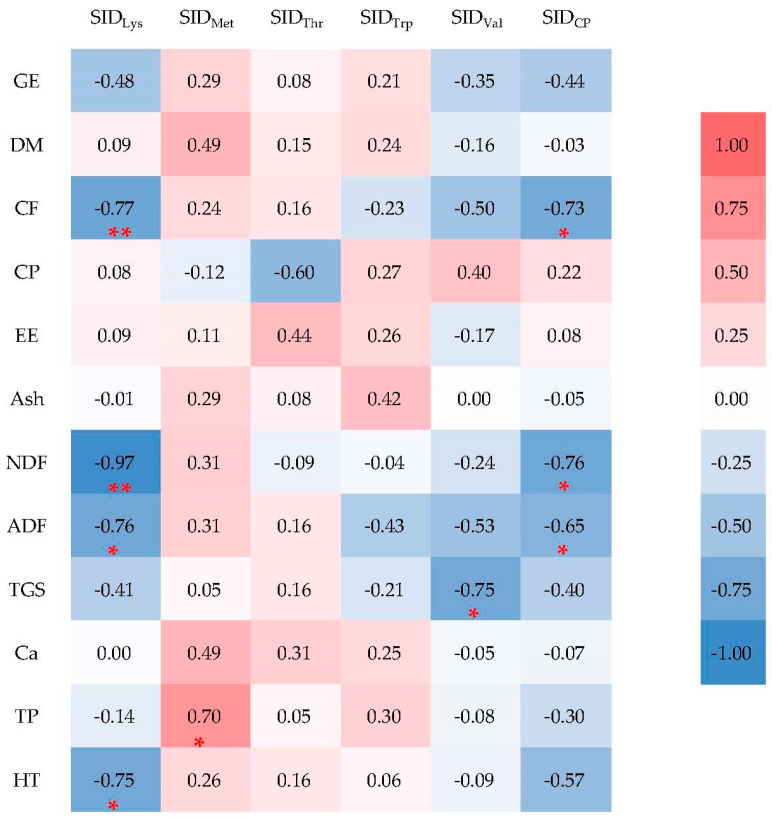
Results: The coefficients of variation (CV) of the content of crude fat (EE), crude fiber (CF), neutral detergent fiber (NDF), acid detergent fiber (ADF), and total glucosinolates (TGS) in 10 samples of rapeseed cake were greater than 10%. The standardized ileal digestibility (SID) of crude protein (CP), lysine (Lys), methionine (Met), threonine (Thr), and tryptophan (Trp) in rapeseed cake was 73.34% (61.49 to 81.12%), 63.01% (41.41 to 73.10%), 69.47% (50.55 to 88.16%), 79.61% (74.41 to 87.58%), and 94.43% (91.34 to 97.20%), respectively. The best prediction equations for SIDCP, SIDLys, and SIDVal were as follows: SIDCP = 90.124 - 0.54NDF (R2 = 0.58), SIDLys = 100.107 - 1.229NDF (R2 = 0.94), and SIDVal = 151.012 - 2.990TGS (R2 = 0.57).
Conclusion: Overall, great variation exists among the 10 rapeseed cakes, and the NDF, TGS, and heating temperature can be used as the key predictors for the SID of CP and AA.
Keywords: amino acids digestibility; prediction model; rapeseed cake.
Conflict of interest statement
Author Z.X. was employed by the company Twins Group, Nanchang, China. The remaining authors declare that the research was conducted in the absence of any commercial or financial relationships that could be construed as a potential conflict of interest.
Figures
References
-
- Cheng H., Liu X., Xiao Q.R., Zhang F., Liu N., Tang L.Z., Wang J., Ma X.K., Tan B., Chen J.S., et al. Rapeseed Meal and Its Application in Pig Diet: A Review. Agriculture. 2022;12:849. doi: 10.3390/agriculture12060849. - DOI
-
- Li D.F. Nutrient Requirements of Swine in China. China Agriculture Press; Beijing, China: 2020.
-
- Liu Y.H., Oliveira M.S.F., Stein H.H. Canola meal produced from high-protein or conventional varieties of canola seeds may substitute soybean meal in diets for gestating and lactating sows without compromising sow or litter productivity. J. Anim. Sci. 2018;96:5179–5187. doi: 10.1093/jas/sky356. - DOI - PMC - PubMed
Grants and funding
- 2021YFD1300201/National Key Research and Development Program of China
- 2021YFD1301004/National Key Research and Development Program of China
- 202202AE090032/Major Science and Technology Special Program of Yunnan Province
- ISA2023201/Open Fund of Key Laboratory of Agroecological Processes in Subtropical Region, Chinese Acad-emy of Sciences
- ISA2021103/Open Fund of Key Laboratory of Agroecological Processes in Subtropical Region, Chinese Academy of Sciences
LinkOut - more resources
Full Text Sources
Research Materials
Miscellaneous
