


Sex-Based Differences in Lung Cancer Incidence: A Retrospective Analysis of Two Large US-Based Cancer Databases
- PMID: 39409866
- PMCID: PMC11476236
- DOI: 10.3390/cancers16193244
Sex-Based Differences in Lung Cancer Incidence: A Retrospective Analysis of Two Large US-Based Cancer Databases
Abstract
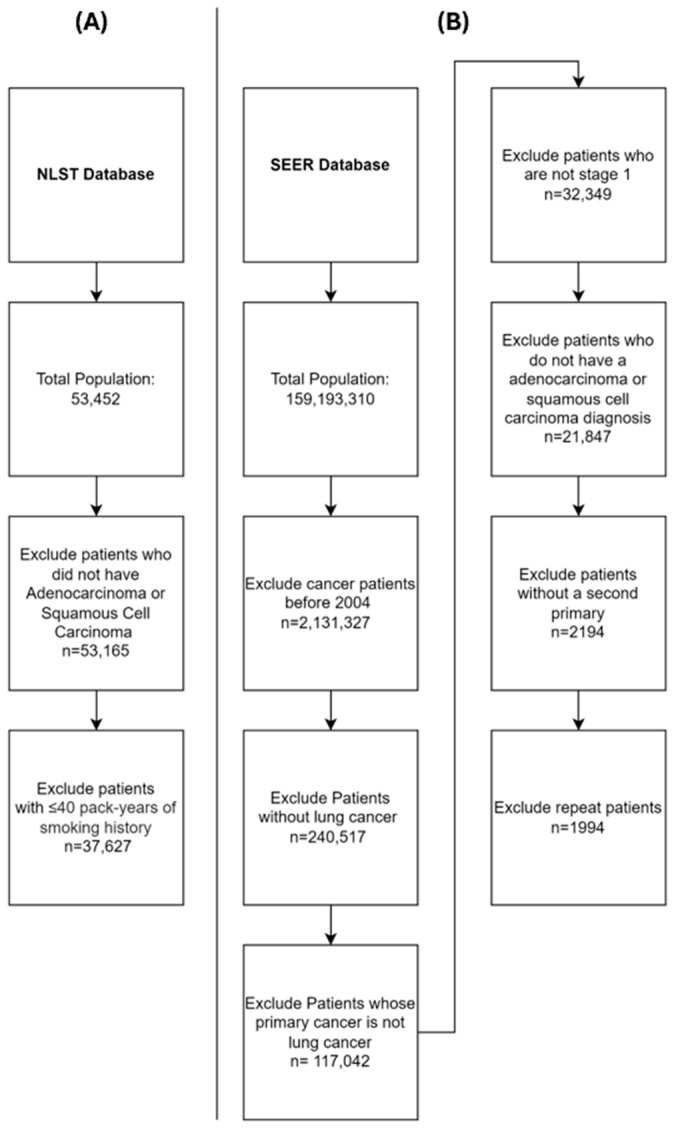
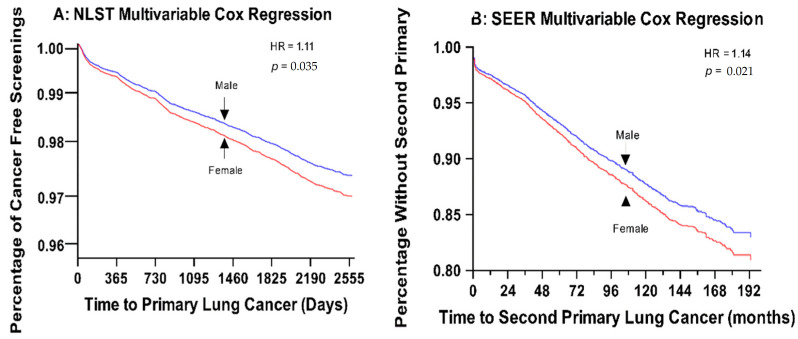
Background/Objectives: Non-small cell lung cancer (NSCLC) has seen a relative rise in incidence among females versus males in recent years, although males still have a higher overall incidence. However, it is unclear whether this trend is consistent across all populations. Therefore, we retrospectively examined this relationship in two large high-risk clinical cohorts. Methods: First, we analyzed lung cancer incidence among individuals with a smoking history of over 40 pack-years in the National Lung Screening Trial (NLST). Then, we investigated the incidence of second primary NSCLC in patients who underwent lobectomy for previous stage I lung cancer using the Surveillance, Epidemiology, and End Results (SEER) database. We performed both univariate and multivariable time-to-event analyses to investigate the relationship between sex and lung cancer incidence. Results: In the NLST cohort (n = 37,627), females had a higher risk of developing primary NSCLC than males (HR = 1.11 [1.007-1.222], p = 0.035) after adjusting for age and pack-year history. In the SEER cohort (n = 19,327), females again exhibited an increased risk of developing a second primary lung cancer (HR = 1.138 [1.02-1.269], p = 0.021), after adjusting for age, race, grade, and histology. Conclusions: Our analysis reveals that females have a modestly higher lung cancer incidence than males in high-risk populations. These findings underscore the importance of further researching the underlying cellular processes that may cause sex-specific differences in lung cancer incidence.
Keywords: NLST; NSCLC; SEER; lung cancer incidence; sex disparities.
Conflict of interest statement
The authors report no proprietary or commercial interest in any product mentioned or concept discussed in this article. The funding sponsors had no role in the choice of research project; design of the study; in the collection, analyses, or interpretation of data; in the writing of the manuscript; or in the decision to publish the results.
Figures
References
Grants and funding
LinkOut - more resources
Full Text Sources
