


Doppler ultrasound, a noninvasive tool for the study of mesenteric arterial flow in systemic sclerosis: a cross-sectional study of a patient cohort with review and meta-analysis of the literature
- PMID: 39412608
- PMCID: PMC11950030
- DOI: 10.1007/s11739-024-03783-5
Doppler ultrasound, a noninvasive tool for the study of mesenteric arterial flow in systemic sclerosis: a cross-sectional study of a patient cohort with review and meta-analysis of the literature
Abstract
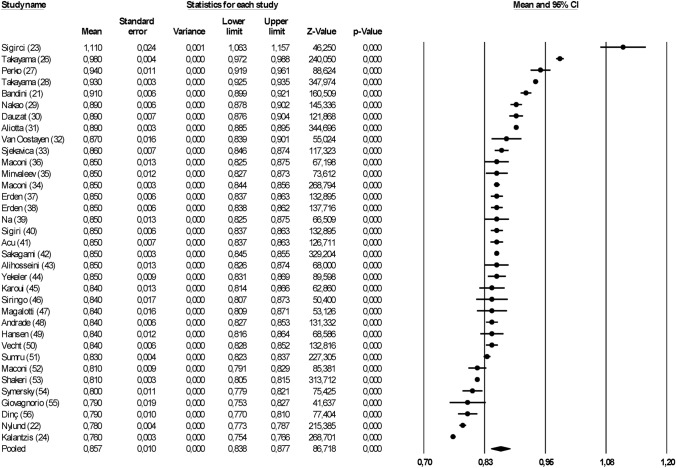
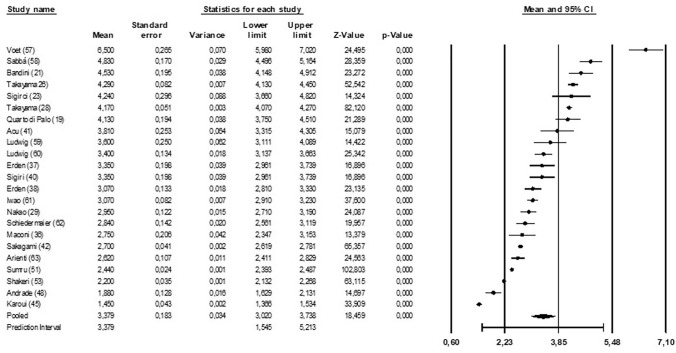
Gastrointestinal involvement (GI) is a frequent and troublesome complication of systemic sclerosis (SSc), whose etiology is poorly understood, though it is hypothesized that autoimmunity and progressive vasculopathy may play a role. Vasculopathy is considered one of the main pathogenetic pathways responsible for many of the clinical manifestations of SSc, and, therefore, studying the principal splanchnic vessels (i.e., superior mesenteric artery-SMA and inferior mesenteric artery-IMA) with Doppler Ultrasound (DUS) may provide further insights into measuring the progression of vasculopathy, evaluating its possible association with SSc GI symptoms, and determining whether it plays a role in the development or severity of SSc GI disease. A cohort of SSc patients consecutively recruited underwent DUS examination, and associations with GI (UCLA-GIT 2.0 questionnaire) and extraintestinal SSc characteristics were evaluated. Semiquantitative DUS parameters (resistive index-RI and pulsatility index-PI), were applied for splanchnic vessel assessment in SSc patients and healthy subjects (HS). Moreover, a review and meta-analysis of the literature to understand which the values of the main semiquantitative DUS parameters (RI and PI) are both in SSc patients and HS has been conducted. Seventy-eight patients completed DUS examinations and clinical assessments. 30 (39%) were classified as diffuse cutaneous SSc (dcSSC), 35 (45%) as limited cutaneous SSc (lcSSc) and 13 (17%) as sine scleroderma. A significant difference was found both for SMA RI (p for trend = 0.032) and SMA PI (p for trend = 0.004) between patients with sine scleroderma, lcSSc and dcSSc, with lower values observed in the sine scleroderma and lcSSc groups. IMA RI and PI were significantly correlated with GI symptoms such as fecal incontinence (ῥ - 0.33, p = 0.008 and ῥ - 0.30, p = 0.021, respectively). By multivariate analysis, significant associations were confirmed between SMA RI and SMA PI and mRSS (β 0.248, p = 0.030 and β 2.995, p = 0.004, respectively) and with bosentan (β 0.400, p = 0.003 and β 3.508, p = 0.001, respectively), but not with anticentromere antibody (ACA). No significant differences were found between the weighted median values of SMA RI and SMA PI of SSc patients compared to those of HS that were derived from the meta-analysis of the literature (p = 0.72 and p = 0.64, respectively). This cross-sectional study confirms that the splanchnic vasculature of SSc patients can noninvasively been studied with DUS. Vascular splanchnic involvement correlates with the presence and/or severity of specific clinical features in SSc, including GI. Larger and prospective studies are needed to confirm these preliminary observations and to examine the role of DUS in SSc-risk stratification and GI progression and to obtain definitive data regarding both HS and SSc patients splanchnic DUS parameters.
Keywords: Bowel vasculopathy; Inferior mesenteric artery; Outcome measures; Pathogenesis; Scleroderma; Superior mesenteric artery; Systemic sclerosis.
© 2024. The Author(s).
Conflict of interest statement
Declarations. Conflict of interest: Z. McMahan is a consultant for Boehringer Ingelheim and Guidepoint. All other authors declare they have no conflict of interest. Ethical approval: The study protocol was approved by local Ethical Committee (approval number: 23805_oss). Informed consent: All patients enrolled in the study signed informed consent.
Figures
References
-
- Gabrielli A, Avvedimento EV, Krieg T (2009) Scleroderma. N Engl J Med 360:1989–2003 - PubMed
-
- Matucci-Cerinic M, Kahaleh B, Wigley FM (2013) Review: evidence that systemic sclerosis is a vascular disease. Arthritis Rheum 65:1953–1962 - PubMed
-
- Sjogren RW (1996) Gastrointestinal features of scleroderma. Curr Opin Rheumatol 8:569–575 - PubMed
Publication types
MeSH terms
LinkOut - more resources
Full Text Sources
Medical
Research Materials
Miscellaneous
