In Utero Exposure to Maternal COVID-19 and Offspring Neurodevelopment Through Age 24 Months
- PMID: 39412802
- PMCID: PMC11581627
- DOI: 10.1001/jamanetworkopen.2024.39792
In Utero Exposure to Maternal COVID-19 and Offspring Neurodevelopment Through Age 24 Months
Abstract
Importance: In utero exposure to maternal infections has been associated with abnormal neurodevelopment among offspring. The emergence of a new, now endemic infection (SARS-CoV-2) warrants investigating developmental implications for exposed offspring.
Objective: To assess whether in utero exposure to maternal COVID-19 is associated with abnormal neurodevelopmental scores among children ages 12, 18, and 24 months.
Design, setting, and participants: Data were ascertained from the ASPIRE (Assessing the Safety of Pregnancy in the Coronavirus Pandemic) trial, a prospective cohort of pregnant individuals aged 18 years or older who were enrolled before 10 weeks' gestation and their children. Individuals were recruited online from May 14, 2020, to August 23, 2021, using the Society for Assisted Reproductive Technology and BabyCenter, an online media platform. Participants from all 50 states and Puerto Rico completed activities remotely.
Exposure: In utero exposure to COVID-19.
Main outcomes and measures: Birth mothers completed the Ages & Stages Questionnaires, Third Edition, a validated screening tool for developmental delays, at 12, 18, and 24 months' post partum. A score below the cutoff in any domain (communication, gross motor, fine motor, problem-solving, and social skills) was considered an abnormal developmental screen (scores range from 0 to 60 in each domain, with higher scores indicating less risk for neurodevelopmental delay).
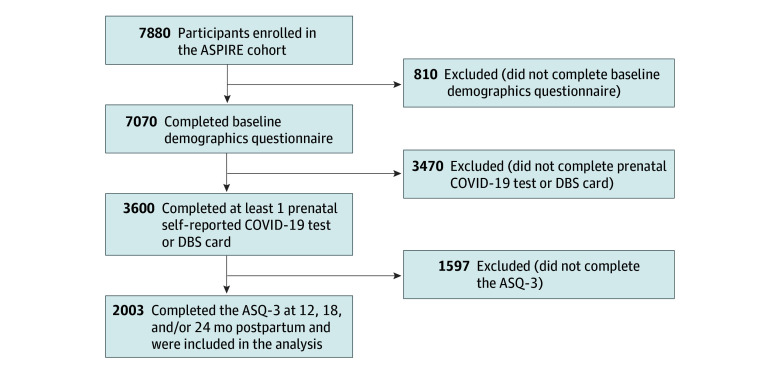
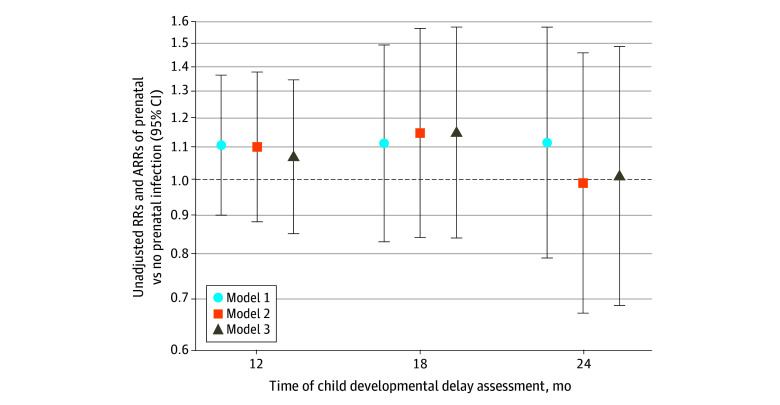
Results: The cohort included 2003 pregnant individuals (mean [SD] age, 33.3 [4.2] years) enrolled before 10 weeks' gestation and who completed study activities; 1750 (87.4%) had earned a college degree. Neurodevelopmental outcomes were available for 1757 children at age 12 months, 1522 at age 18 months, and 1523 at age 24 months. The prevalence of abnormal screens for exposed vs unexposed offspring at age 12 months was 64 of 198 (32.3%) vs 458 of 1559 (29.4%); at age 18 months, 36 of 161 (22.4%) vs 279 of 1361 (20.5%); and at age 24 months, 29 of 151 (19.2%) vs 230 of 1372 (16.8%). In an adjusted mixed-effects logistics regression model, no difference in risk of abnormal neurodevelopmental screens was observed at age 12 months (adjusted risk ratio [ARR], 1.07 [95% CI, 0.85-1.34]), age 18 months (ARR, 1.15 [95% CI, 0.84-1.57]), or age 24 months (ARR, 1.01 [95% CI, 0.69-1.48]). Supplemental analyses did not identify differential risk based on trimester of infection, presence vs absence of fever, or breakthrough infection following vaccination vs primary infection.
Conclusions and relevance: In this cohort study of pregnant individuals and offspring, exposure to maternal COVID-19 was not associated with abnormal neurodevelopmental screening results through 24 months' post partum. Continued study of diverse groups of children is needed because, among other factors, evidence suggests sensitivity of the developing fetal brain to maternal immune activation.
Conflict of interest statement
Figures
Comment in
-
SARS-CoV-2 and Offspring Neurodevelopment-We Don't Know Yet.JAMA Netw Open. 2024 Oct 1;7(10):e2439799. doi: 10.1001/jamanetworkopen.2024.39799. JAMA Netw Open. 2024. PMID: 39412811 No abstract available.
References
Publication types
MeSH terms
Grants and funding
LinkOut - more resources
Full Text Sources
Medical
Miscellaneous