


Survival outcomes of young-age female patients with early breast cancer: an international multicenter cohort study
- PMID: 39413678
- PMCID: PMC11530587
- DOI: 10.1016/j.esmoop.2024.103732
Survival outcomes of young-age female patients with early breast cancer: an international multicenter cohort study
Abstract
Background: The incidence of breast cancer among young Asian women is increasing, yet they remain underrepresented in global data. We analyzed the epidemiology and outcomes of Asian patients with breast cancer <40 years old across different subtypes to identify their clinical unmet needs.
Patients and methods: Female patients aged ≥20 years diagnosed with early breast cancer were analyzed from the prospective cohort of the Asian Breast Cancer Cooperative Group (ABCCG). For comparison, data from the Surveillance, Epidemiology, and End Results Program (SEER) cancer registry were used. Patients were categorized into three age groups: young (<40 years), alleged premenopausal mid-age (40-49 years), and alleged postmenopausal (aged ≥50 years). Multivariable Cox proportional hazards models for survival were adjusted for subtypes, histologic grade, T stage, nodal status, and study centers.
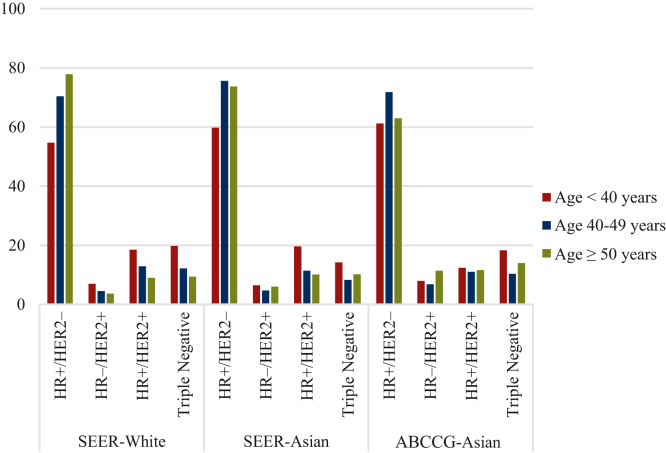
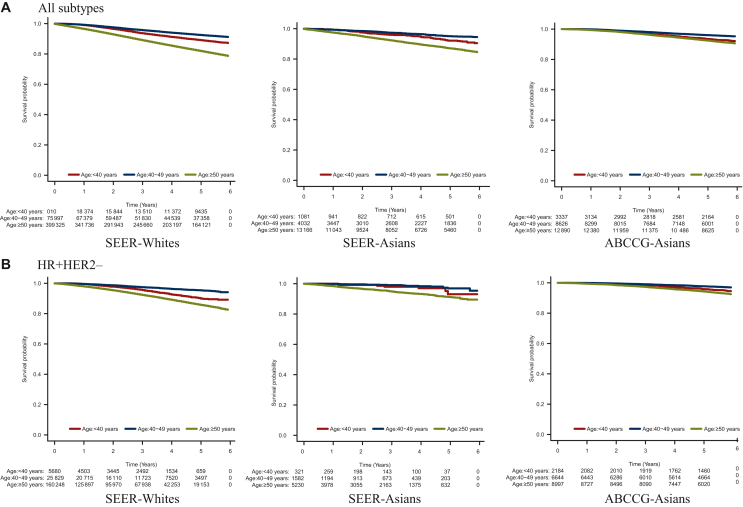
Results: A total of 45 021 patients with breast cancer from Asian study centers, 496 332 SEER-White patients, and 18 279 SEER-Asian patients were included in the analysis. The median age at diagnosis was younger in the Asian cohort (51 years) compared with SEER-Whites (62 years) and SEER-Asians (58 years; P < 0.0001). In the young-age group, hormone receptor-positive/human epidermal growth factor receptor 2 negative (HR+/HER2-) breast cancer was more prevalent among Asians and SEER-Asians compared with SEER-Whites (61.2% and 59.8% versus 54.7%). In the Asian population, young patients with HR+/HER2- breast cancer exhibited significantly inferior overall survival than the mid-age group (6-year overall survival 94.4% versus 96.6%; mid-age to young-age group hazard ratio 0.62; P < 0.001). Similarly, young patients in SEER-Whites showed an earlier decline in survival compared with the mid-age group (89.1% versus 94.0%; P < 0.001).
Conclusion: ABCCG-Asian patients with breast cancer <40 years old with HR+/HER2- subtypes were more likely to have worse survival outcomes than their mid-age counterparts. Our study highlights the poorer prognosis of young patients and underscores the need for a tailored therapeutic approach, such as ovarian function suppression, particularly considering ethnic factors.
Keywords: Asian; HR+/HER2− breast cancer; prevalence; survival; young.
Copyright © 2024 The Author(s). Published by Elsevier Ltd.. All rights reserved.
Figures
References
-
- Keramatinia A., Mousavi-Jarrahi S.H., Hiteh M., Mosavi-Jarrahi A. Trends in incidence of breast cancer among women under 40 in Asia. Asian Pac J Cancer Prev. 2014;15(3):1387–1390. - PubMed
Publication types
MeSH terms
Substances
LinkOut - more resources
Full Text Sources
Medical
Research Materials
Miscellaneous
