


MRI findings and clinical testing for preoperative diagnosis of long head of the biceps pathology
- PMID: 39415802
- PMCID: PMC11480518
- DOI: 10.1002/jeo2.70050
MRI findings and clinical testing for preoperative diagnosis of long head of the biceps pathology
Abstract
Purpose: Determine whether combining magnetic resonance imaging (MRI) observations and clinical tests could substantially improve sensitivity for diagnosis of long head of the biceps tendon (LHBT) pathology.
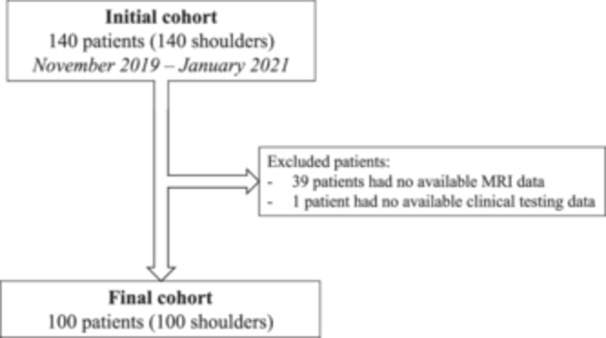
Methods: The authors retrospectively assessed a consecutive series of 140 patients who underwent arthroscopic rotator cuff repair for isolated supraspinatus tears. The presence of LHBT pathology was assessed preoperatively on MRI using three criteria and four clinical tests specific to shoulder injuries. Binary outcomes of MRI observations and four clinical tests were combined to identify combinations resulting in the best sensitivity using intra-operative arthroscopic findings as reference.
Results: The study cohort comprised 100 shoulders (58 men and 42 women) aged 56.6 ± 9.4 years (range, 30-76) at index surgery. A total of 29 combinations were tested to obtain the best diagnostic algorithm for LHBT pathologies. Only four combinations reached a sensitivity ≥0.75, but had a specificity <0.45. The 'Speed or Signal' combination achieved the highest sensitivity (Se: 0.88; 95% confidence interval [CI]: 0.73%-0.96%; Sp: 0.20; 95% CI: 0.10%-0.33%).
Conclusion: The most important findings of this study were that, for the diagnosis of LHBT pathology using clinical tests alone, the Speed test had the highest sensitivity (Se, 0.74), and using MRI observations alone, the signal intensity had the highest sensitivity (Se, 0.68). Combination of 'Speed test or Signal intensity' substantially improved the sensitivity (Se, 0.88) but yielded the lowest specificity (Sp, 0.20). The clinical relevance of these findings is that using the combination 'Speed or Signal' for preoperative diagnosis, 88% of pathologic LHBTs would be correctly diagnosed, while 80% of healthy LHBTs could be misdiagnosed as pathologic.
Level of evidence: Diagnostic study, Level IV.
Keywords: clinical tests; long head of biceps; magnetic resonance imaging; rotator cuff; tendinopathy.
© 2024 The Author(s). Journal of Experimental Orthopaedics published by John Wiley & Sons Ltd on behalf of European Society of Sports Traumatology, Knee Surgery and Arthroscopy.
Conflict of interest statement
David Gallinet reports consulting and royalties from moveUP outside the submitted work. Maxime Antoni reports fees from ConMed and fees and royalties FX Shoulder Solutions outside the submitted work. Julien Berhouet reports consulting for Wright Medical outside the submitted work. Jacques Guery reports fees from moveUP outside of the submitted work. The remaining authors declare no conflict of interest.
Figures
References
-
- Aldon‐Villegas, R. , Perez‐Cabezas, V. & Chamorro‐Moriana, G. (2021) Efficacy of management of associated dysfunctions on rotator cuff and long head of the biceps: systematic review. Journal of Orthopaedic Surgery and Research, 16(1), 501. Available from: 10.1186/s13018-021-02621-0 - DOI - PMC - PubMed
-
- Belk, J.W. , Kraeutler, M.J. , Houck, D.A. , Chrisman, A.N. , Scillia, A.J. & McCarty, E.C. (2021) Biceps tenodesis versus tenotomy: a systematic review and meta‐analysis of level I randomized controlled trials. Journal of Shoulder and Elbow Surgery, 30(5), 951–960. Available from: 10.1016/j.jse.2020.11.012 - DOI - PubMed
LinkOut - more resources
Full Text Sources
Research Materials
