


Drivers of COVID-19 vaccine uptake among rural populations in Madagascar: a cross-sectional study
- PMID: 39420305
- PMCID: PMC11487794
- DOI: 10.1186/s12889-024-20414-y
Drivers of COVID-19 vaccine uptake among rural populations in Madagascar: a cross-sectional study
Abstract
Background: The WHO set the global immunisation threshold for COVID-19 at 70% to achieve worldwide protection against the disease. To date, global COVID-19 vaccine coverage is still below this threshold, in particular in several sub-Saharan African (SSA) countries, such as Madagascar. While factors influencing COVID-19 vaccine hesitancy have been widely explored in the past few years, research on drivers of COVID-19 vaccine uptake remains scarce. This study aimed at investigating drivers associated with COVID-19 vaccine uptake in the Boeny region of Madagascar.
Methods: The study used a cross-sectional survey design to collect data on drivers of vaccine uptake from a sample of adults recruited from 12 healthcare facilities between November 2022 and February 2023. Relative and absolute frequencies were used to summarize participants' characteristics. Prevalence ratios were estimated by Poisson regression to identify and compare sociodemographic and motivational drivers of vaccine uptake among those who were willing to get vaccinated against COVID-19 with those who had already been vaccinated.
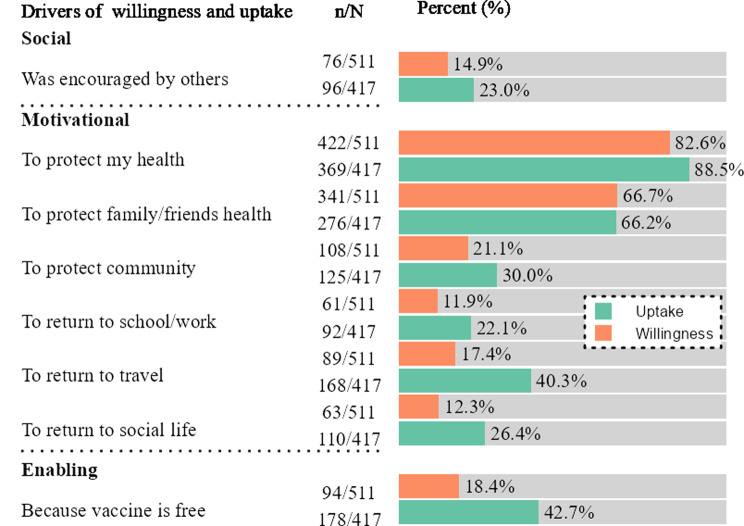
Results: A total of 928 participants aged between 18 and 76 years were included in the study. Among those recruited, 44.9% (n = 417) had already been vaccinated and 55.1% (n = 511) were willing to receive their first dose of COVID-19 vaccine on the day of the interview. The proportions of those respondents who live in urban areas (56.5% vs. 43.8%) and who have high school or university education (46.6% vs. 35.8%) were higher for the uptake group, whereas the proportion of employed respondents (66.3% vs. 56.5%) was higher among those willing to get vaccinated. Vaccine being free of charge (aPR = 1.77 [CI 95%: 1.45-2.17]) and being able to travel again (aPR = 1.61 [CI 95%: 1.30-1.98]) were the drivers most strongly associated with higher vaccine uptake after adjustment for sociodemographic factors.
Conclusions: This study shows that actual COVID-19 vaccine uptake is influenced by a different set of factors than willingness to get vaccinated. Taking this difference in drivers into account can inform more tailored vaccination strategies to increase worldwide coverage.
Keywords: COVID-19; COVID-19 vaccination; Public health; Vaccination strategies; Vaccination uptake; Vaccination willingness.
© 2024. The Author(s).
Conflict of interest statement
The authors declare no competing interests.
Figures
References
-
- Ten health issues WHO will. tackle this year [Internet]. [cited 2023 Jul 24]. https://www.who.int/news-room/spotlight/ten-threats-to-global-health-in-...
-
- Lazarus JV, Wyka K, White TM, Picchio CA, Gostin LO, Larson HJ, et al. A survey of COVID-19 vaccine acceptance across 23 countries in 2022. Nat Med. 2023;29(2):366–75. - PubMed
Publication types
MeSH terms
Substances
LinkOut - more resources
Full Text Sources
Medical
Research Materials
Miscellaneous
