


Photoinactivation of Multidrug-Resistant mcr-1-Positive E. coli Using PCPDTBT Conjugated Polymer Nanoparticles under White Light
- PMID: 39423350
- PMCID: PMC11577311
- DOI: 10.1021/acsabm.4c01049
Photoinactivation of Multidrug-Resistant mcr-1-Positive E. coli Using PCPDTBT Conjugated Polymer Nanoparticles under White Light
Abstract
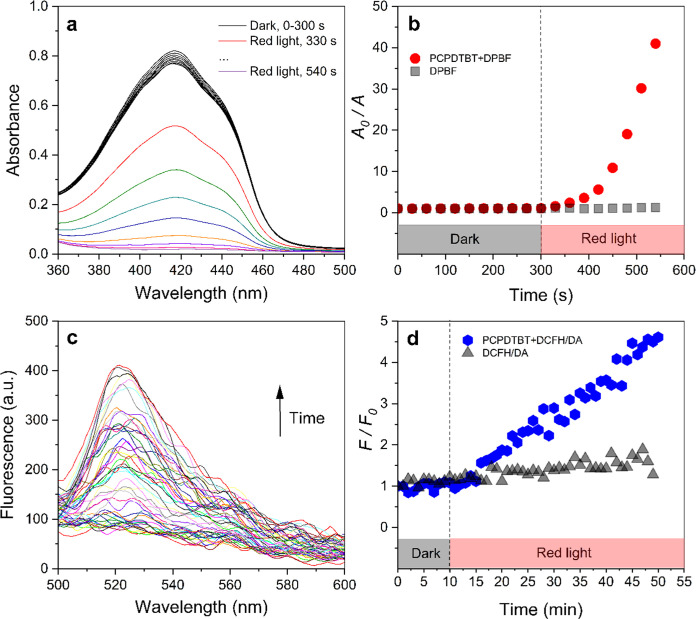
The issue of antimicrobial resistance is an escalating concern within the scope of global health. It is predicted that the existence of antibiotic-resistant bacteria might result in an estimated annual death of up to 10 million by 2050, along with possible economic losses ranging from 100 to 210 trillion. This study reports the production of poly[2,6-(4,4-bis(2-ethylhexyl)-4H-cyclopenta[2,1-b;3,4-b']dithiophene)-alt-4,7(2,1,3-benzothiadiazole)] nanoparticles (PCPDTBT-NPs) by nanoprecipitation as an alternative to tackle this problem. The size, shape, and optical features of these conjugated polymer NPs were analyzed. Their efficacy as photosensitizers against nonresistant (ATCC) and multidrug-resistant mcr-1-positive Escherichia coli was assessed under white light doses of 250 and 375 J·cm-2. PCPDTBT-NPs inactivated both E. coli strains exposed to white light at an intensity of 375 J·cm-2, while no antimicrobial effect was observed in the group not exposed to white light. Reactive oxygen species and singlet oxygen were detected using DCFH-DA and DPBF probes, allowing the investigation of the photoinactivation pathways. This work showcases PCPDTBT-NPs as photosensitizers to eliminate multidrug-resistant bacteria through photodynamic inactivation employing visible light.
Keywords: PCPDTBT; antimicrobial resistance; conjugated polymer; mcr-1 positive Escherichia coli; nanoparticle; photodynamic inactivation.
Conflict of interest statement
The authors declare no competing financial interest.
Figures




References
-
- O’neill J.Tackling Drug-Resistant Infections Globally: Final Report and Recommendations; Wellcome Trust, 2016; p 84.
-
- Liu Y.-Y.; Wang Y.; Walsh T. R.; Yi L.-X.; Zhang R.; Spencer J.; Doi Y.; Tian G.; Dong B.; Huang X.; Yu L.-F.; Gu D.; Ren H.; Chen X.; Lv L.; He D.; Zhou H.; Liang Z.; Liu J.-H.; Shen J. Emergence of Plasmid-Mediated Colistin Resistance Mechanism MCR-1 in Animals and Human Beings in China: A Microbiological and Molecular Biological Study. Lancet Infect. Dis. 2016, 16 (2), 161–168. 10.1016/S1473-3099(15)00424-7. - DOI - PubMed
Publication types
MeSH terms
Substances
LinkOut - more resources
Full Text Sources
Medical
Molecular Biology Databases
Miscellaneous