


Ensembling methods for protein-ligand binding affinity prediction
- PMID: 39424851
- PMCID: PMC11489440
- DOI: 10.1038/s41598-024-72784-3
Ensembling methods for protein-ligand binding affinity prediction
Abstract
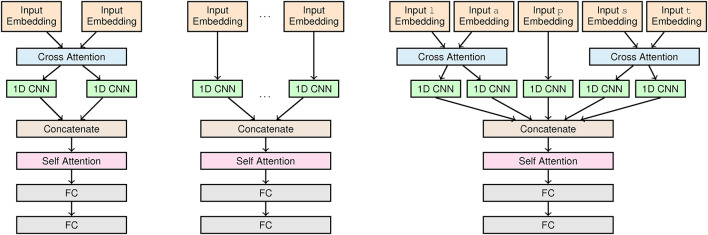
Protein-ligand binding affinity prediction is a key element of computer-aided drug discovery. Most of the existing deep learning methods for protein-ligand binding affinity prediction utilize single models and suffer from low accuracy and generalization capability. In this paper, we train 13 deep learning models from combinations of 5 input features. Then, we explore all possible ensembles of the trained models to find the best ensembles. Our deep learning models use cross-attention and self-attention layers to extract short and long-range interactions. Our method is named Ensemble Binding Affinity (EBA). EBA extracts information from various models using different combinations of input features, such as simple 1D sequential and structural features of the protein-ligand complexes rather than 3D complex features. EBA is implemented to accurately predict the binding affinity of a protein-ligand complex. One of our ensembles achieves the highest Pearson correlation coefficient (R) value of 0.914 and the lowest root mean square error (RMSE) value of 0.957 on the well-known benchmark test set CASF2016. Our ensembles show significant improvements of more than 15% in R-value and 19% in RMSE on both well-known benchmark CSAR-HiQ test sets over the second-best predictor named CAPLA. Furthermore, the superior performance of the ensembles across all metrics compared to existing state-of-the-art protein-ligand binding affinity prediction methods on all five benchmark test datasets demonstrates the effectiveness and robustness of our approach. Therefore, our approach to improving binding affinity prediction between proteins and ligands can contribute to improving the success rate of potential drugs and accelerate the drug development process.
© 2024. The Author(s).
Conflict of interest statement
The authors have disclosed no conflict of interest.
Figures

References
-
- Mufassirin, M. M., Newton, M. H. & Sattar, A. Artificial intelligence for template-free protein structure prediction: A comprehensive review. Artif. Intell. Rev.56, 7665–7732 (2023).
-
- Gilson, M. K. & Zhou, H.-X. Calculation of protein-ligand binding affinities. Annu. Rev. Biophys. Biomol. Struct.36, 21–42 (2007). - PubMed
-
- Seo, M.-H., Park, J., Kim, E., Hohng, S. & Kim, H.-S. Protein conformational dynamics dictate the binding affinity for a ligand. Nat. Commun.5, 3724 (2014). - PubMed
-
- McInnes, C. Virtual screening strategies in drug discovery. Current Opin. Chem. Biol.11, 494–502 (2007). - PubMed
MeSH terms
Substances
Grants and funding
LinkOut - more resources
Full Text Sources
