


Seasonal activity and phoresy rates of Nitidulid beetles (Coleoptera: Nitidulidae) captured in stands with oak wilt infections in northern Michigan, USA
- PMID: 39425902
- PMCID: PMC11649342
- DOI: 10.1093/ee/nvae101
Seasonal activity and phoresy rates of Nitidulid beetles (Coleoptera: Nitidulidae) captured in stands with oak wilt infections in northern Michigan, USA
Abstract
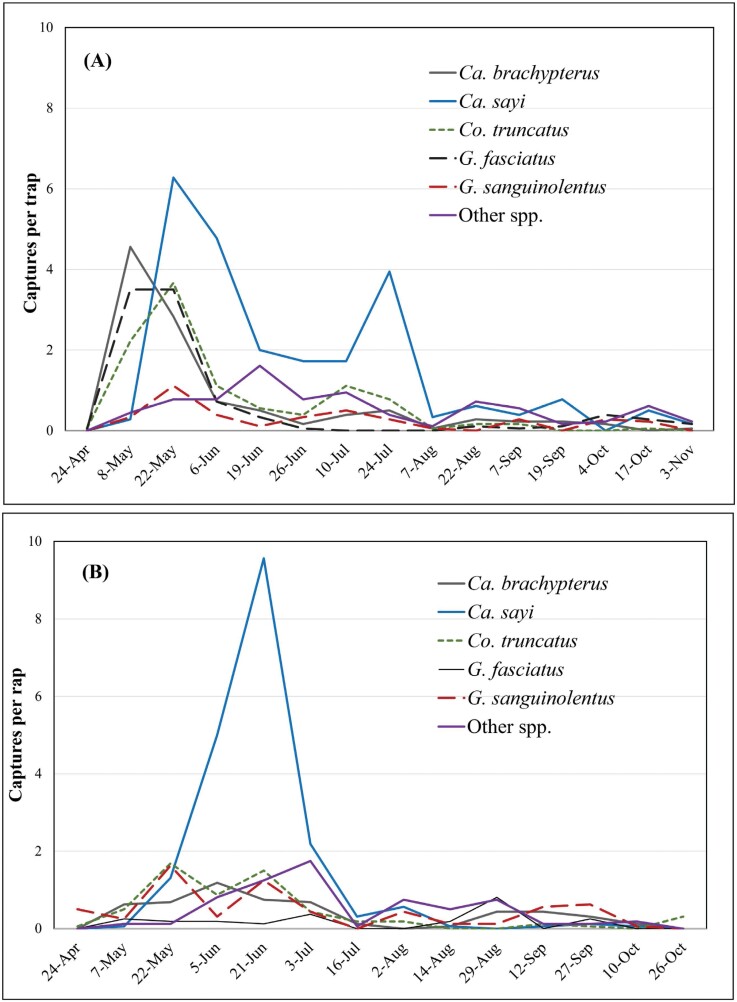
Nitidulid beetles (Coleoptera: Nitidulidae), the overland vectors of the Bretziella fagacearum fungus that causes oak wilt, were monitored in infection centers in Quercus rubra stands in northern Michigan, USA using baited, wind-oriented traps for 2 years. First nitidulid captures, accounting for <1.5% of total annual captures, occurred in late April in both years (<50 cumulative degree days [DDs]; base 10°C). A total of 1,188 and 735 beetles representing 19 and 18 species were captured in 2018 (18 traps; 3 sites) and 2019 (16 traps; 4 sites), respectively. Ground traps (1.5 m high) captured more beetles and species than traps on canopy branches of red oaks. Most nitidulids (81-86%) were captured in May and June, but frequent precipitation and cool spring temperatures extended activity into early July in 2019. In 2018, 336 beetles representing 12 species were screened for B. fagacearum spores, but only 20 beetles from 4 species bore viable spores. Mycelial mats on red oaks killed were 4-fold more abundant in 2019 than in 2018. Of the 225 beetles screened in 2019, 56 beetles representing 6 species had viable spores. Nearly all (96%) spore-bearing beetles in both years were captured in late May or June. In bimonthly xylem samples collected from healthy trees, large earlywood vessels, presumably more vulnerable to infection than latewood, were present from May to June in 2018 and until early July in 2019. Results are consistent with mid-May to mid-July high-risk periods designated in current state and regional guidelines for oak wilt management.
Keywords: Bretziella fagacearum; fungal vector; nitidulid beetle; oak wilt; overland spread; xylem development.
© The Author(s) 2024. Published by Oxford University Press on behalf of Entomological Society of America.
Figures



References
-
- Ambourn AK, Juzwik J, Moon RD.. 2005. Seasonal dispersal of the oak wilt fungus by Colopterus truncatus and Carpophilus sayi in Minnesota. Plant Dis. 89(10):1067–1076. https://doi.org/ 10.1094/PD-89-1067 - DOI - PubMed
-
- Appel DN, Anderson K, Lewis R Jr. 1986. Occurrence of nitidulid beetles in Texas oak wilt centers. J. Econ. Entomol. 79(4):1276–1279.
-
- Bai C, Cao Y, Zhou Y, et al. 2017. Molecular diagnosis Carpophilus dimidiatus (Coleoptera: Nitidulidae) based on species-specific PCR. J. Stored Prod. Res. 74(1):87–90.
-
- Bartelt RJ, Kyhl JF, Ambourn AK, et al. 2004. Male-produced aggregation pheromone of Carpophilus sayi, a nitidulid vector of oak wilt disease, and pheromonal comparison with Carpophilus lugubris. Agr. For. Entomol. 6:39–46.
-
- Blaedow RA, Juzwik J, Barber B.. 2010. Propiconazole distribution and effects on Ceratocystis fagacearum survival in roots of treated red oaks. Phytopathology 100(10):979–985. https://doi.org/ 10.1094/PHYTO-01-10-0008 - DOI - PubMed
MeSH terms
Grants and funding
LinkOut - more resources
Full Text Sources
Miscellaneous
