. 2024 Sep 7;3(5):e240.
doi: 10.1002/imt2.240. eCollection 2024 Oct.

Multi-level insights into the immuno-oncology-microbiome axis: From biotechnology to novel therapies

Affiliations

Multi-level insights into the immuno-oncology-microbiome axis: From biotechnology to novel therapies

Zheshun Pi et al. Imeta. .

Abstract

The multifaceted interactions among the immune system, cancer cells and microbial components have established a novel concept of the immuno-oncology-microbiome (IOM) axis. Microbiome sequencing technologies have played a pivotal role in not only analyzing how gut microbiota affect local and distant tumors, but also providing unprecedented insights into the intratumor host-microbe interactions. Herein, we discuss the emerging trends of transiting from bulk-level to single cell- and spatial-level analyses. Moving forward with advances in biotechnology, microbial therapies, including microbiota-based therapies and bioengineering-inspired microbes, will add diversity to the current oncotherapy paradigm.


Conflict of interest statement

Faming Zhang conceived the concept of GenFMTer and transendoscopic enteral tubing and the devices (FMT Medical, Nanjing, China) related to them. The remaining authors declare no conflict of interest.

Figures
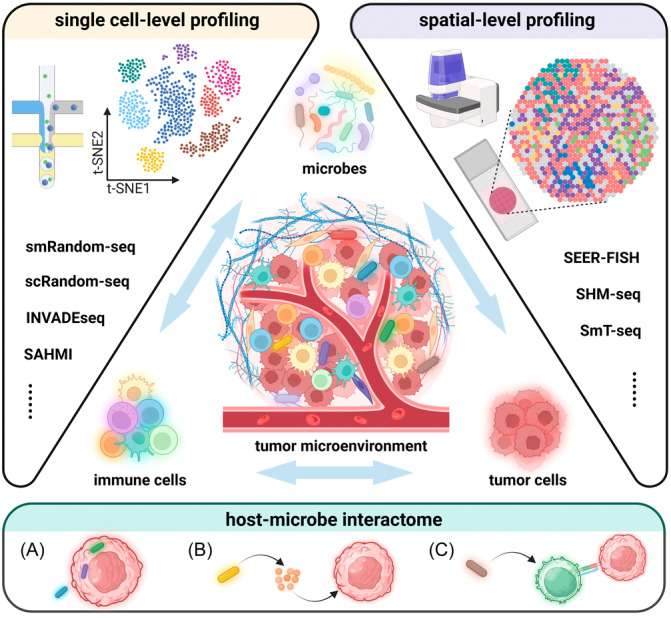
Figure 1
Figure 1
Single‐cell and spatial profiling approaches to decipher the multifaceted host‐microbe interactome. The advent of single‐cell and spatial profiling approaches allows for the precise analysis of individual host and microbial cells. In the context of single cell and spatial‐level profiling, we are able to decipher multi‐modal host‐microbe interactomes that has been overlooked in metagenomic sequencing. For example, (A) microbes may attach to and invade tumor cells to affect their immune phenotypes; (B) microbes can produce multiple substances to modulate TME distantly, including metabolites, extracellular vesicles, and so on; (C) microbes may act as the third party to break the balance between immune cells and tumor cells by regulating the differentiation and activation of immune cells. (Abbreviations: INVADEseq, invasion‐adhesion‐directed expression sequencing; SAHMI, single‐cell analysis of host‐microbiome interactions; SHM‐seq, spatial host‐microbiome sequencing; SmT‐seq, spatial metatranscriptomics sequencing).
Figure 2
Figure 2
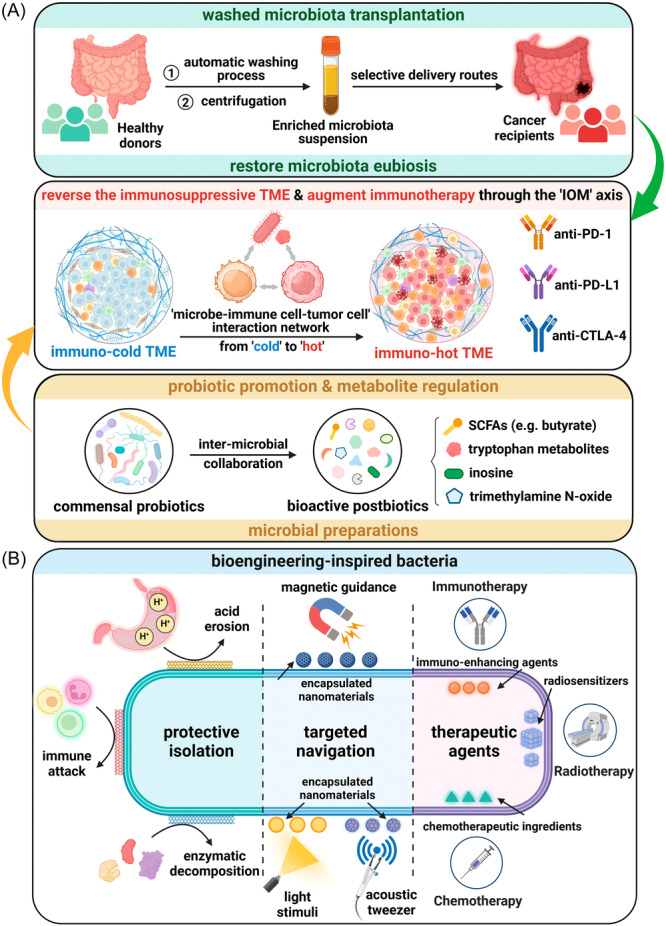
Microbially‐driven strategies for immunotherapy and targeted oncotherapy. (A) Washed microbiota transplantation has provided a quality‐controlled example of optimizing manual fecal microbiota transplantation. Delivery routes should be determined selectively to cope with the complex conditions of the gastrointestinal tract in cancer patients. Restoration of microbiota eubiosis contributes to balance the dysregulated IOM axis. Another microbiota‐based therapy is microbial preparations comprised of probiotics and postbiotics. Their supplementation may also modulate the “microbe‐immune cell‐tumor cell” interaction network to augment immunotherapy by reversing the TME from “cold” to “hot.” (B) Multiple modification approaches are applied to enable the engineered bacteria to reach the tumor stably and maximize their therapeutic effects. These approaches can be divided into three aspects comprised of protective isolation, targeted navigation and therapeutic agents. Camouflagic and protective encapsulations prevent bacteria from immunological and biochemical damage in vivo. For targeted navigation, nanoparticles with the capability of sensing magnetic or acoustic signals can be conjugated to the bacterial surface to ensure controllable translocation. The photoreceptor units can be utilized as light‐sensing switches to control the bacterial lysis for the release of loaded therapeutic agents, including immune‐enhancing agents, radiosentizers, chemotherapeutic ingredients, and so on. (Abbreviations: TME, tumor microenvironment; IOM axis, immuno‐oncology‐microbiome axis; anti‐PD‐1, anti‐programmed death‐1; anti‐PD‐L1, anti‐programmed death ligand‐1; anti‐CTLA‐4, anti‐cytotoxic T lymphocyte‐associated protein‐4; SCFAs, short‐chain fatty acids).

References

    1. Sepich‐Poore, Gregory D. , Zitvogel Laurence, Straussman Ravid, Hasty Jeff, Wargo Jennifer A., and Knight Rob. 2021. “The Microbiome and Human Cancer.” Science 371: eabc4552. 10.1126/science.abc4552 - DOI - PMC - PubMed
    1. Lu, Ying‐Qi , Qiao Han, Tan Xi‐Rong, and Liu Na. 2024. “Broadening Oncological Boundaries: The Intratumoral Microbiota.” Trends in Microbiology 32: 807–822. 10.1016/j.tim.2024.01.007 - DOI - PubMed
    1. Ghaddar, Bassel , Biswas Antara, Harris Chris, Omary M. Bishr, Carpizo Darren R., Blaser Martin J., and De Subhajyoti. 2022. “Tumor Microbiome Links Cellular Programs and Immunity in Pancreatic Cancer.” Cancer Cell 40: 1240–1253.e5. 10.1016/j.ccell.2022.09.009 - DOI - PMC - PubMed
    1. Xu, Ziye , Wang Yuting, Sheng Kuanwei, Rosenthal Raoul, Liu Nan, Hua Xiaoting, Zhang Tianyu, et al. 2023. “Droplet‐Based High‐Throughput Single Microbe RNA Sequencing By Smrandom‐Seq.” Nature Communications 14: 5130. 10.1038/s41467-023-40137-9 - DOI - PMC - PubMed
    1. Meng, Hongen , Zhang Tianyu, Wang Zhang, Zhu Yuyi, Yu Yingying, Chen Hangfei, Chen Jiaye, et al. 2024. “High‐Throughput Host–Microbe Single‐Cell RNA Sequencing Reveals Ferroptosis‐Associated Heterogeneity during Acinetobacter baumannii Infection.” Angewandte Chemie International Edition 63: e202400538. 10.1002/anie.202400538 - DOI - PubMed

LinkOut - more resources