


The presence of oligoclonal bands predicts conversion to multiple sclerosis in isolated myelitis
- PMID: 39433553
- PMCID: PMC11493956
- DOI: 10.1038/s41598-024-71315-4
The presence of oligoclonal bands predicts conversion to multiple sclerosis in isolated myelitis
Abstract
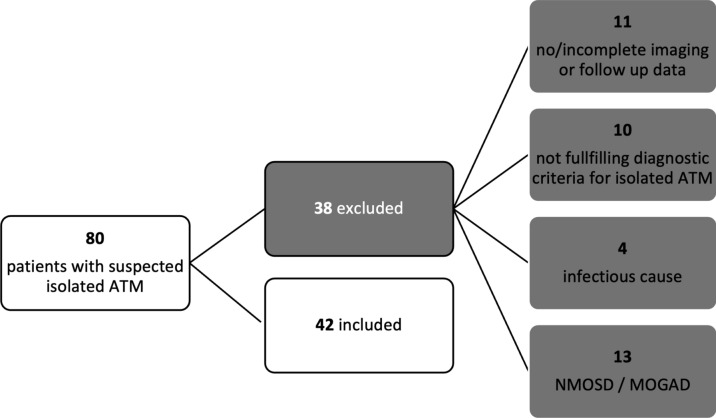
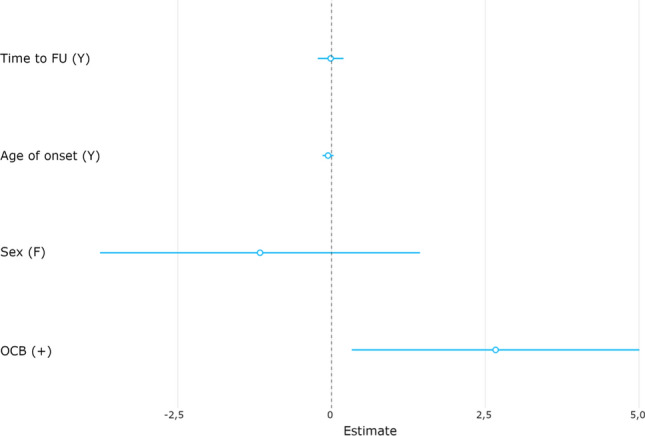
Acute transverse myelitis (ATM) is a disease characterized by inflammation of the spinal cord and may have various causes. In the context of this work, the distinction between isolated ATM and initial manifestation of autoimmune-mediated diseases of the central nervous system such as multiple sclerosis (MS) is crucial. Hence, the aim of this work was to identify predictive factors associated with the conversion to definite MS in a collective of individuals after their initial episode of isolated ATM (no initial identified cause). In this retrospective data analysis from the Vienna MS Database, all patients from Jan. 1, 1999, to Dec. 31, 2019, with a diagnosis of isolated ATM (according to the criteria of the Transverse Myelitis Consortium Working Group) who underwent lumbar puncture were extracted. Electronic medical records were reviewed on the availability of clinical data including therapy and follow-up, laboratory results including cerebrospinal fluid (CSF) analysis, evoked potentials (EP) as well as magnetic resonance imaging data. Among 42 patients with the diagnosis of isolated ATM, 12 (29%) were subsequently diagnosed with MS over a median follow-up period of 7.7 years. Univariately, MS converters were younger (32 years [25-39] vs. 42 years [31-50], p = 0.032), had a lower CSF/serum albumin ratio (29 [24-35] vs 37 [27-52], p = 0.037), lower CSF total protein (4.5 [2.8-4.8] vs. 5.5 [3.4-8.5], p = 0.023) and a higher proportion of CSF-specific oligoclonal bands (OCB; 83% vs. 30%, p = 0.002). In the multivariate regression analysis, the presence of CSF-specific OCB emerged as the sole predictive factor of subsequent MS diagnosis (OR: 14.42, 95% CI 1.39 to 149.48, p = 0.03). In a collective of 42 patients with isolated ATM and an MS conversion rate of nearly 30%, the only but highly predictive factor were CSF-specific OCB. This emphasizes the significance of conducting timely CSF analysis in such patients and underscores the need for tailored monitoring and follow-up strategies in this specific group.
Keywords: Isolated acute transverse myelitis; Multiple sclerosis; Oligoclonal bands; Predictive factors.
© 2024. The Author(s).
Conflict of interest statement
Tobias Monschein: has participated in meetings sponsored by or received travel funding from Biogen, Celgene, Merck, Novartis, Roche, Sanofi-Genzyme and Teva. Markus Ponleitner: has participated in meetings sponsored by or received travel funding from Amicus, Merck, Novartis and Sanofi-Genzyme. Gabriel Bsteh: has participated in meetings sponsored by, received speaker honoraria or travel funding from Biogen, Celgene/BMS, Janssen-Cilag, Lilly, Merck, Novartis, Roche, Sanofi-Genzyme and Teva, and received honoraria for consulting Biogen, Celgene/BMS, Merck, Novartis, Roche, Sanofi-Genzyme and Teva. He has received financial support in the past 12 months by unrestricted research grants (Celgene/BMS, Novartis). Nik Krajnc: has participated in meetings sponsored by, received speaker honoraria or travel funding from Alexion, BMS/Celgene, Janssen-Cilag, Merck, Novartis, Roche and Sanofi-Genzyme and held a grant for a Multiple Sclerosis Clinical Training Fellowship Programme from the European Committee for Treatment and Research in Multiple Sclerosis (ECTRIMS). Gudrun Zulehner: has participated in meetings sponsored by or received travel funding from Biogen, Merck, Novartis, Roche, Sanofi-Genzyme and Teva. Paulus Rommer: has received honoraria for consultancy/speaking from AbbVie, Allmiral, Alexion, Biogen, Merck, Novartis, Roche, Sandoz, Sanofi Genzyme, has received research grants from Amicus, Biogen, Merck, Roche. Barbara Kornek: has received honoraria for speaking and for consulting from Biogen, BMS-Celgene, Johnson&Johnson, Merck, Novartis, Roche, Teva and Sanofi-Genzyme outside of the submitted work. No conflict of interest with respect to the present study. Thomas Berger: has participated in meetings sponsored by and received honoraria (lectures, advisory boards, consultations) from pharmaceutical companies marketing treatments for MS: Allergan, Bayer, Biogen, Bionorica, BMS/Celgene, Genesis, GSK, GW/Jazz Pharma, Horizon, Janssen-Cilag, MedDay, Merck, Novartis, Octapharma, Roche, Sandoz, Sanofi-Genzyme, Teva and UCB. His institution has received financial support in the past 12 months by unrestricted research grants (Biogen, Bayer, BMS/Celgene, Merck, Novartis, Roche, Sanofi-Genzyme, Teva and for participation in clinical trials in multiple sclerosis sponsored by Alexion, Bayer, Biogen, Merck, Novartis, Octapharma, Roche, Sanofi-Genzyme, Teva. Fritz Leutmezer: has participated in meetings sponsored by, received speaker honoraria or travel funding from Actelion, Almirall, Biogen, Celgene, Johnson & Johnson, MedDay, Merck, Novartis, Roche, Sanofi-Genzyme and Teva, and received honoraria for consulting Biogen, Celgene, Merck, Novartis, Roche, Sanofi-Genzyme and Teva. Tobias Zrzavy: has participated in meetings sponsored by or received travel funding from Biogen, Merck, Novartis, Roche, Sanofi-Genzyme and Teva.
Figures
References
-
- Román, G. C. & Kerr, D. Proposed diagnostic criteria and nosology of acute transverse myelitis [6] (multiple letters). Neurology60, 730–731. 10.1212/WNL.60.4.730 (2003). - PubMed
-
- Zalewski, N. L., Flanagan, E. P. & Keegan, B. M. Evaluation of idiopathic transverse myelitis revealing specific myelopathy diagnoses. Neurology90, e96-102. 10.1212/WNL.0000000000004796 (2018). - PubMed
-
- Young, J. et al. Clinically isolated acute transverse myelitis: Prognostic features and incidence. Mult. Scler.15, 1295–1302. 10.1177/1352458509345906 (2009). - PubMed
MeSH terms
Substances
LinkOut - more resources
Full Text Sources
Medical
Research Materials
Miscellaneous
