


Effect of 10-valent pneumococcal conjugate vaccine on trends of pneumococcal meningitis in children under five years, Uganda, 2003-2022
- PMID: 39434021
- PMCID: PMC11494994
- DOI: 10.1186/s12879-024-10075-y
Effect of 10-valent pneumococcal conjugate vaccine on trends of pneumococcal meningitis in children under five years, Uganda, 2003-2022
Abstract
Background: Pneumococcal meningitis, a vaccine-preventable disease caused by Streptococcus pneumoniae (Spn) is the leading bacterial meningitis in under five children. In April 2014, Uganda introduced routine immunization with 10-valent Pneumococcal Conjugate Vaccine (PCV10) for infants. The target coverage for herd immunity is ≥ 90% with three doses (PCV10-dose 3). We assessed the effect of PCV10 introduction and coverage on the trends of pneumococcal meningitis in under five children.
Methods: We analyzed laboratory-confirmed pediatric bacterial meningitis (PBM) data at two high-volume WHO-accredited sentinel surveillance hospitals in Kampala City and Gulu District, from 2003 to 2022. We used confirmed cases to estimate the minimum incidence of pneumococcal meningitis in the host districts and calculated annual incidence of pneumococcal meningitis per one million populations, and the proportion of confirmed PBM attributable to Spn. We divided the study period into 2003-2013 (pre-PCV10) and 2014-2022 (post-PCV10), and conducted interrupted time series analysis using autoregressive integrated moving average models for the effect of PCV10 on trends of pneumococcal meningitis and PBM attributable to Spn. We analyzed reported PCV10 data in DHIS2 from 2014 to 2022 for annual PCV10-dose 3 coverage.
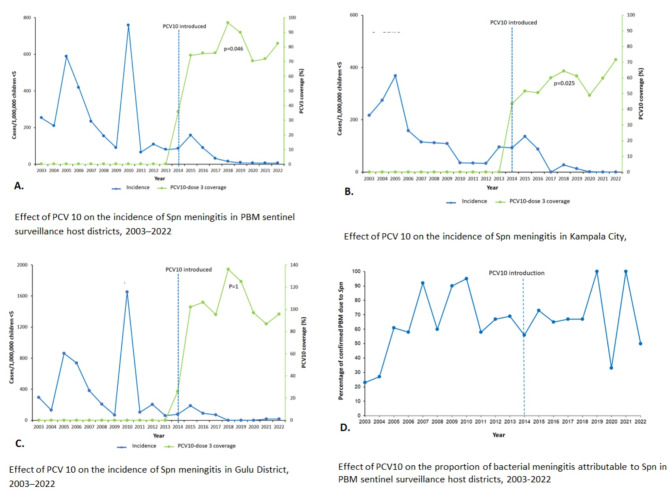
Results: Among the 534 confirmed PBM cases, 331(62%) were pneumococcal meningitis; 227(69%) from Gulu District and 104(31%) from Kampala City. The majority (95%) of the isolates were not serotyped. The majority (57%) were male and unimmunized (98%); median age = 14(IQR = 6-27) months with most (55%) aged ≥ 12 months. The case-fatality rate was 9%. During Pre-PCV10 period, the overall incidence of pneumococcal meningitis in the host districts increased; slope change = 1.0 (95%CI = 0.99999, 1.00001) but declined in post-PCV10 period (2014-2022) by 92% from 86 cases /1,000,000 in 2014 to 7/1,000,000 in 2022, slope change= -1.00006 (95%CI=-1.00033, -0.99979). Whereas there was an immediate decline in the proportion of confirmed PBM attributable to Spn in the host districts, level change=-1.84611(95%CI=-1.98365,-1.70856), an upward trend was recorded from 2016 to 2022, slope change = 1.0 (95%CI = 0.99997, 1.00003). During 2015-2022, PCV10-dose 3 coverage was largely > 90% for Gulu District and 52-72% for Kampala City.
Conclusion: The PCV10 routine immunization program reduced the incidence of pneumococcal meningitis in Kampala City and Gulu District. There was no effect on the confirmed PBM proportionately attributable to Spn. Kampala City persistently recorded PCV10-dose3 coverage < 90%. We recommend enhancing serotyping and periodic nasopharyngeal carriage surveys to ascertain the maximum vaccine effectiveness and monitor Spn serotypes, and strengthening routine immunization in Kampala City.
Keywords: Streptococcus pneumoniae; 10-valent pneumococcal conjugate vaccine; Children under five; Pneumococcal meningitis; Uganda.
© 2024. The Author(s).
Conflict of interest statement
The authors declare no competing interests.
Figures
References
-
- mondiale de la Santé O, Organization WH. Pneumococcal conjugate vaccines in infants and children under 5 years of age: WHO position paper–February 2019 Vaccins antipneumococciques conjugués chez les nourrissons et les enfants de moins de 5 ans: note de synthèse de l’OMS–février 2019. Weekly Epidemiological Record = Relevé épidémiologique hebdomadaire. 2019;94(08):85–103.
-
- WHO, Pneumococcal Disease. 2023. https://www.who.int/teams/health-product-policy-and-standards/standards-...
-
- WHO. Pneumococcal meningitis-Togo 2023 [updated 11-4-2023]. https://www.who.int/emergencies/disease-outbreak-news/item/2023-DON455
-
- Oligbu G, Collins S, Sheppard CL, Fry NK, Slack M, Borrow R, et al. Childhood deaths attributable to invasive pneumococcal disease in England and Wales, 2006–2014. Clin Infect Dis. 2017;65(2):308–14. - PubMed
-
- Mwenda JM, Soda E, Weldegebriel G, Katsande R, Biey JN-M, Traore T, et al. Pediatric bacterial meningitis surveillance in the World Health Organization African region using the invasive bacterial vaccine-preventable disease surveillance network, 2011–2016. Clin Infect Dis. 2019;69(Supplement2):S49–57. - PMC - PubMed
MeSH terms
Substances
Grants and funding
- 001/WHO_/World Health Organization/International
- GH001353-01/President's Emergency Plan for AIDS (PEPFAR) through the United States Centers for Disease Control and Prevention Cooperative Agreement number GH001353-01 through the Makerere University School of Public Health to the Uganda Public Health Fellowship Program, Ministry of Health
LinkOut - more resources
Full Text Sources
Miscellaneous
