. 2024 Oct 22;14(1):24810.
doi: 10.1038/s41598-024-75556-1.

Comorbidities confound metabolomics studies of human disease

Collaborators, Affiliations

Comorbidities confound metabolomics studies of human disease

Madis Jaagura et al. Sci Rep. .

Abstract

The co-occurrence of multiple chronic conditions, termed multimorbidity, presents an expanding global health challenge, demanding effective diagnostics and treatment strategies. Chronic ailments such as obesity, diabetes, and cardiovascular diseases have been linked to metabolites interacting between the host and microbiota. In this study, we investigated the impact of co-existing conditions on risk estimations for 1375 plasma metabolites in 919 individuals from population-based Estonian Biobank cohort using liquid chromatography mass spectrometry (LC-MS) method. We leveraged annually linked national electronic health records (EHRs) data to delineate comorbidities in incident cases and controls for the 14 common chronic conditions. Among the 254 associations observed across 13 chronic conditions, we primarily identified disease-specific risk factors (92%, 217/235), with most predictors (93%, 219/235) found to be related to the gut microbiome upon cross-referencing recent literature data. Accounting for comorbidities led to a reduction of common metabolite predictors across various conditions. In conclusion, our study underscores the potential of utilizing biobank-linked retrospective and prospective EHRs for the disease-specific profiling of diverse multifactorial chronic conditions.

Keywords: Biobank; Chronic disease; Comorbidities; Electronic health records; Metabolomics; Risk factors.


Conflict of interest statement

During the drafting of the manuscript, L.B. is an employee of BioMarin.

Figures
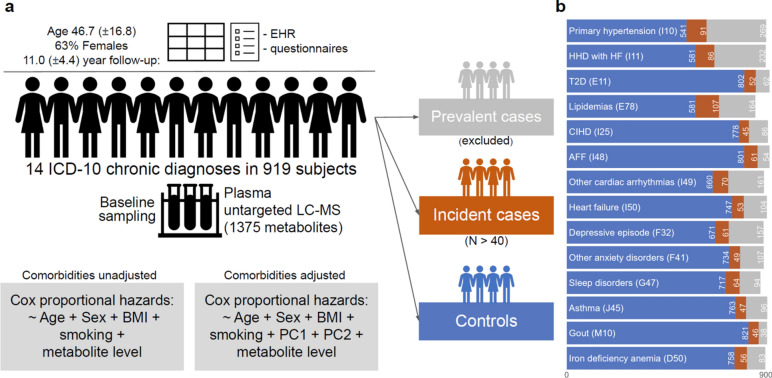
Fig. 1
Fig. 1
Design of the study. a Analysis plan. b Counts of controls (blue, never diagnosed with the respective condition), incident cases (red, first diagnosed with the respective condition after sample collection), prevalent cases (grey, first diagnosed with the respective condition before sample collection, excluded from further analysis) for selected diseases. 14 chronic conditions with more than 40 incident cases were studied. Cox proportional hazard models were adjusted for age, sex, bmi, smoking status in the primary analysis. In the secondary analysis, Cox models were additionally adjusted by the first two principal components (PC) of Hamming distance between comorbidity presence/absence profiles of the study subjects. AFF—atrial fibrillation and flutter, HHD with HF—hypertensive heart disease with heart failure, CIHD—chronic ischemic heart disease, T2D—type 2 diabetes, LC–MS—liquid chromatography mass spectrometry.
Fig. 2
Fig. 2
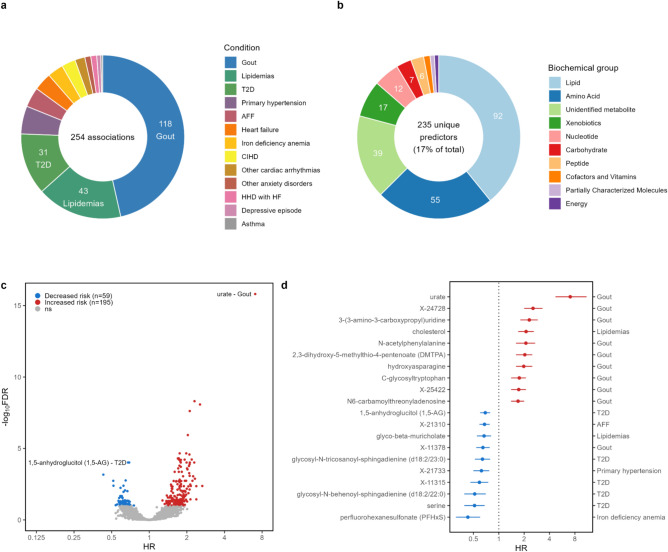
Associations between plasma metabolome and risk of 14 chronic diseases using random controls (FDR < 0.1). a Total number of significant associations with incident diseases. b Total number of significant predictors divided into biochemical groups. c Volcano plot of the hazard ratios (HR) and FDR values of incident risk factors for chronic conditions. d Top 10 associations with both increased and decreased risk of incident diseases. AFF—atrial fibrillation and flutter, HHD with HF—hypertensive heart disease with heart failure, CIHD—chronic ischemic heart disease, T2D—type 2 diabetes. Cox models were adjusted for age, body mass index, sex, and smoking status. Error bars show the 95% confidence interval.
Fig. 3
Fig. 3
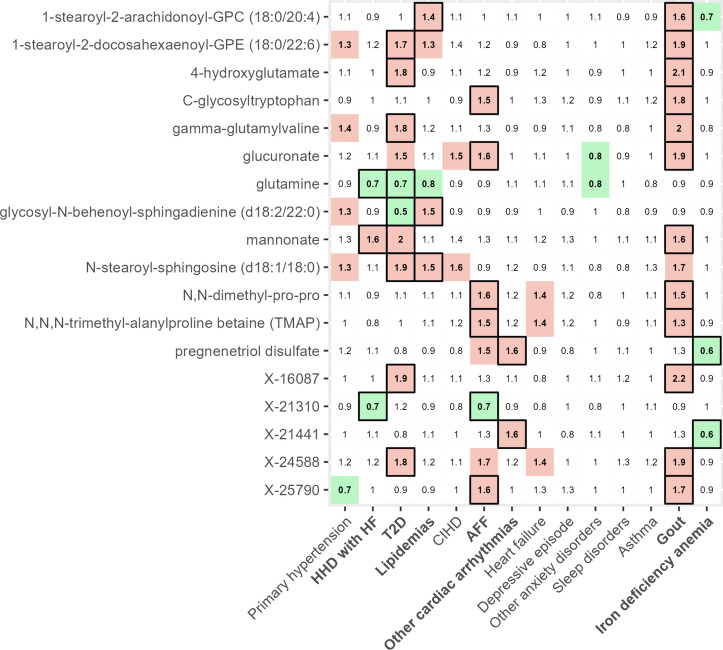
Common risk factors of chronic conditions. Heatmap illustrates hazard ratios of metabolites shared between at least two conditions (FDR < 0.1 significant values are encased in black frames; green highlight—nominally significant reduced risk; red highlight—nominally significant increased risk). AFF—atrial fibrillation and flutter, HHD with HF—hypertensive heart disease with heart failure, CIHD—chronic ischemic heart disease, T2D—type 2 diabetes. Cox models were adjusted for age, body mass index, sex, and smoking status.
Fig. 4
Fig. 4
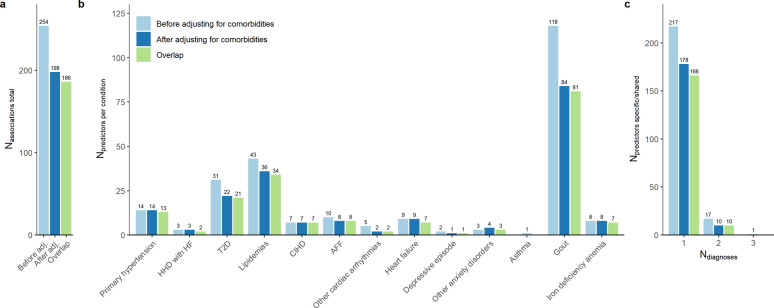
Comparison of results from primary and comorbidity-adjusted analyses. A comparison of results of primary analysis (before adjusting for comorbidities, black) and secondary analysis (after adjusting for comorbidities, dark gray). Light gray highlights the overlap of significant associations/predictors between the two approaches. a Total number of associations. b Number of predictors across evaluated conditions. c Number of condition-specific (Ndiagnoses = 1) and shared predictors (Ndiagnoses > 1). AFF—atrial fibrillation and flutter, HHD with HF—hypertensive heart disease with heart failure, CIHD—chronic ischemic heart disease, T2D—type 2 diabetes. Cox models for primary analysis were adjusted for age, body mass index, sex, smoking status. Cox models for sensitivity analysis were further adjusted by the first two principal components calculated from Hamming distances between comorbidity profiles.
Fig. 5
Fig. 5
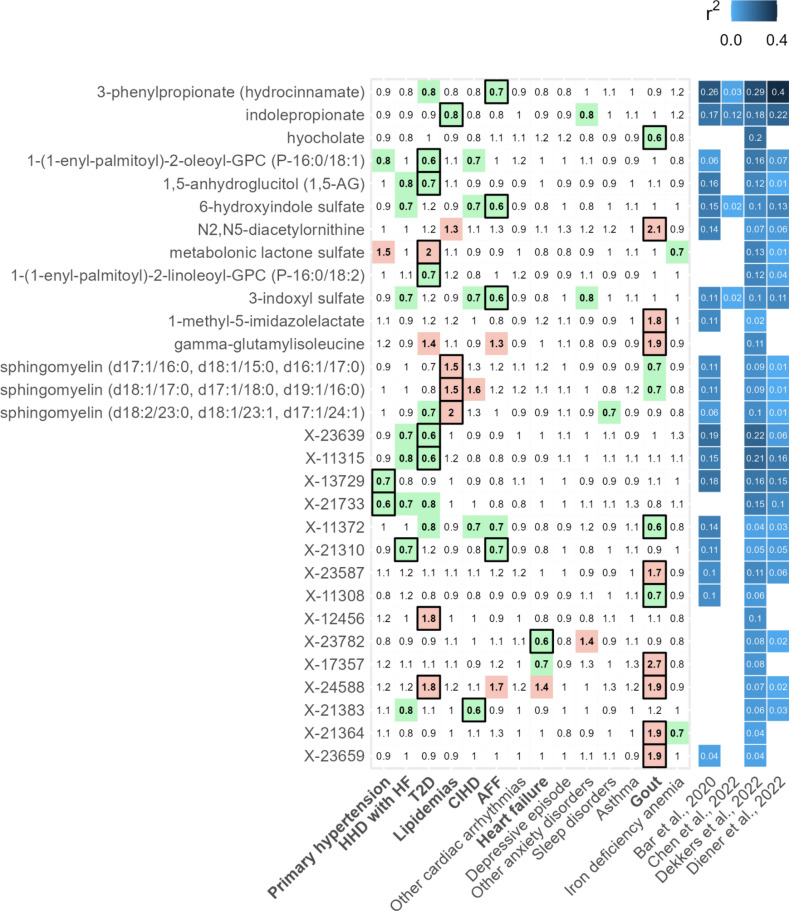
Top microbiome-related incident risk factors of chronic conditions. Left—heatmap illustrates hazard ratio values of the 15 foremost microbiome-related identified and unidentified metabolites with at least 1 significant association (FDR < 0.1 significant values are encased in black frames, nominally significant with green or red highlights). Right—heatmap shows metabolite variance explained by the gut microbiota from the analyzed literature. AFF—atrial fibrillation and flutter, HHD with HF—hypertensive heart disease with heart failure, CIHD—chronic ischemic heart disease, T2D—type 2 diabetes. Cox models were adjusted for age, body mass index, sex, and smoking status.

References

    1. Stanaway, J. D. et al. Global, regional, and national comparative risk assessment of 84 behavioural, environmental and occupational, and metabolic risks or clusters of risks for 195 countries and territories, 1990–2017: a systematic analysis for the global burden of disease stu. Lancet392, 1923–1994. 10.1016/S0140-6736(18)32225-6 (2018). - PMC - PubMed
    1. Mars, N. et al. Polygenic and clinical risk scores and their impact on age at onset and prediction of cardiometabolic diseases and common cancers. Nat. Med.26, 549–557. 10.1038/S41591-020-0800-0 (2020). - PubMed
    1. Vijay, A. & Valdes, A. M. Role of the gut microbiome in chronic diseases: a narrative review. Eur. J. Clin. Nutr.76, 489–501. 10.1038/S41430-021-00991-6 (2022). - PMC - PubMed
    1. Calderón-Larrañaga, A. et al. Multimorbidity and functional impairment-bidirectional interplay, synergistic effects and common pathways. J. Intern. Med.285, 255–271. 10.1111/JOIM.12843 (2019). - PMC - PubMed
    1. Peters, R. et al. Common risk factors for major noncommunicable disease, a systematic overview of reviews and commentary: the implied potential for targeted risk reduction. Ther. Adv. Chronic. Dis.10.1177/2040622319880392 (2019). - PMC - PubMed

LinkOut - more resources