


A premenopausal woman with fragmentation of a nonexpired copper intrauterine device and concomitant presence of Actinomyces species
- PMID: 39440088
- PMCID: PMC11492723
- DOI: 10.1080/08998280.2024.2365074
A premenopausal woman with fragmentation of a nonexpired copper intrauterine device and concomitant presence of Actinomyces species
Abstract
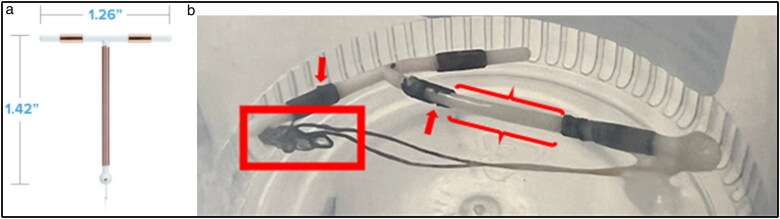
Actinomyces spp. has been shown to form biofilms when exposed to copper, possibly enhancing its degradation. Fragmentation and migration of the copper coil on an intrauterine device (IUD) is rare, but the concomitant presence of Actinomyces spp. may increase its incidence. We present the first case of a fragmented copper IUD within its lifespan of 10 years, with documented Actinomyces genitourinary tract colonization in a premenopausal woman.
Keywords: Actinomyces; intrauterine device.
Plain language summary
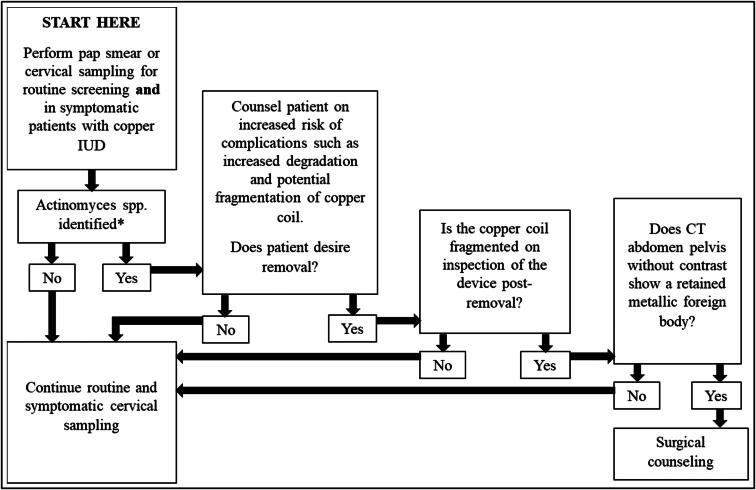
Actinomyces spp. are more prevalent in the urogenital tract of women with IUDs due to the local tissue injury from the device inside the uterus, which creates an anaerobic environment that allows this organism to flourish.Actinomyces spp. can form biofilms when exposed to copper, potentially enhancing its degradation, leading to fragmentation.Patients with a copper IUD and Actinomyces identified on routine or symptomatic cervical sampling should be counseled regarding potential enhanced copper degradation, fragmentation, and migration of the copper coil.
Copyright © 2024 Baylor University Medical Center.
Conflict of interest statement
The planners and faculty for this activity have no relevant financial relationships or funding to disclose. The patient consented to publication of this case report.
Figures
References
-
- Patai K, Balogh I, Szarvas Z.. Clinicopathological problems of the local tissue effect of the copper-releasing intrauterine contraceptive device (IUD). I. General characteristics of the copper-containing IUD (clinical study). Acta Chir Hung. 1989;30(2):129–132. - PubMed
-
- Berthou J, Chrétien FC, Driguez PA.. Dégradation in utero des DIU au cuivre en fonction du temps. Le phénomène de corrosion métallique. Etude au microscope électronique à balayage [Degradation of copper IUDs in utero. The process of metallic corrosion. A scanning electron microscope study]. Gynecol Obstet Fertil. 2003;31(1):29–42. doi:10.1016/s1297-9589(02)00013-9. - DOI - PubMed
Publication types
LinkOut - more resources
Full Text Sources
Miscellaneous