


Dutasteride, a 5 alpha reductase inhibitor, could be associated with the exacerbation of inflammation in patients with benign prostatic hyperplasia
- PMID: 39441013
- PMCID: PMC11803178
- DOI: 10.1111/iju.15612
Dutasteride, a 5 alpha reductase inhibitor, could be associated with the exacerbation of inflammation in patients with benign prostatic hyperplasia
Abstract
Background: α-1 blockers and dutasteride are widely used as agents to treat benign prostatic hyperplasia (BPH); the impact of these drugs on prostatic inflammation is still unclear. Herein, we investigated the impact of α-1 blockers and dutasteride treatment of BPH in terms of the degree of prostatic inflammation.
Materials and methods: Tissue specimens were obtained from 143 BPH patients who were administered α-1 blockers up until their operation. Thirty-three of the patients had also been treated with dutasteride before the procedure. The degree of prostatic inflammation was quantified histologically by the ratio of high endothelial venule (HEV)-like vessels. We divided this retrospective cohort into α-1 blocker monotherapy and combination therapy (α-1 blockers + dutasteride) groups and evaluated clinical parameters of the two groups in relation to the degree of chronic prostatic inflammation. At the same time, we assessed factors exacerbating chronic prostatic inflammation.
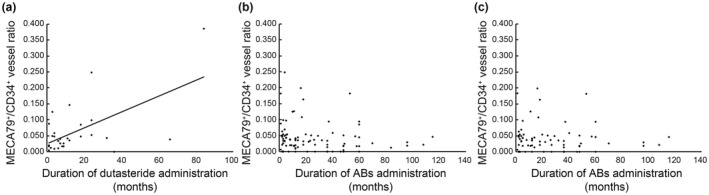
Results: Comparison of the monotherapy and combination therapy groups showed no significant differences in the parameters of the urodynamic study or degree of chronic prostatic inflammation, whereas the IPSS total score, voiding subscore, nocturia, intermittency, weak stream, and straining were significantly lower in the combination than the monotherapy group. The duration of α-1 blockers administration was not correlated with the ratio of HEV-like vessels, while that of dutasteride was strongly correlated (correlation coefficient = 0.595; p < 0.001). Multiple regression analysis demonstrated that the duration of dutasteride administration was a key factor exacerbating the degree of chronic prostatic inflammation.
Conclusions: The present study showed that despite their ameliorating effect on prostatic hyperplasia, dutasteride contributed significantly to chronic prostatic inflammation.
Keywords: IPSS; alpha‐1 blocker; chronic prostatic inflammation; dihydrotestosterone; dutasteride; high endothelial venule‐like vessel.
© 2024 The Author(s). International Journal of Urology published by John Wiley & Sons Australia, Ltd on behalf of The Japanese Urological Association.
Conflict of interest statement
Naoki Terada is an Editorial Board member of International Journal of Urology and a co‐author of this article. To minimize bias, they were excluded from all editorial decision‐making related to the acceptance of this article for publication. The authors except for Naoki Terada declare no conflict of interest.
Figures
References
-
- Carson C 3rd, Rittmaster R. The role of dihydrotestosterone in benign prostatic hyperplasia. Urology. 2003;61:2–7. - PubMed
-
- Inamura S, Shinagawa T, Hoshino H, Sakai Y, Imamura Y, Yokoyama O, et al. Appearance of high endothelial venule‐like vessels in benign prostatic hyperplasia is associated with lower urinary tract symptoms. Prostate. 2017;77:794–802. - PubMed
MeSH terms
Substances
LinkOut - more resources
Full Text Sources
Medical
