


Correlation of screen exposure to stress, learning, cognitive and language performance in children
- PMID: 39443365
- PMCID: PMC12122617
- DOI: 10.1007/s00787-024-02593-6
Correlation of screen exposure to stress, learning, cognitive and language performance in children
Erratum in
-
Correction: Correlation of screen exposure to stress, learning, cognitive and language performance in children.Eur Child Adolesc Psychiatry. 2025 May;34(5):1625. doi: 10.1007/s00787-024-02625-1. Epub 2024 Dec 9. Eur Child Adolesc Psychiatry. 2025. PMID: 39652174 Free PMC article. No abstract available.
Abstract
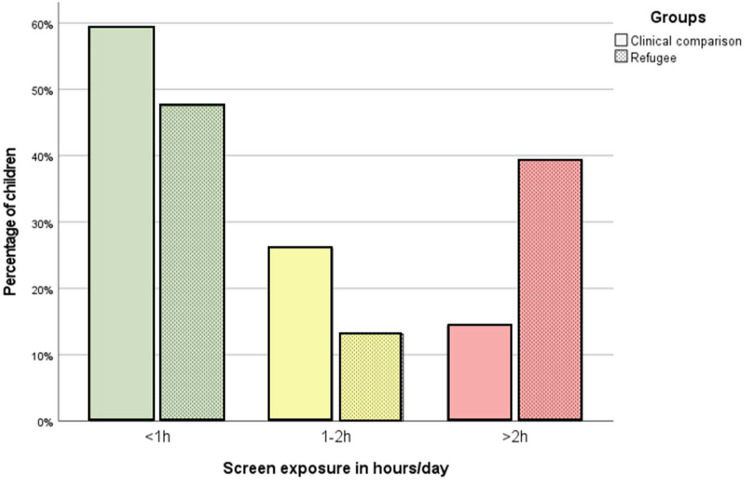
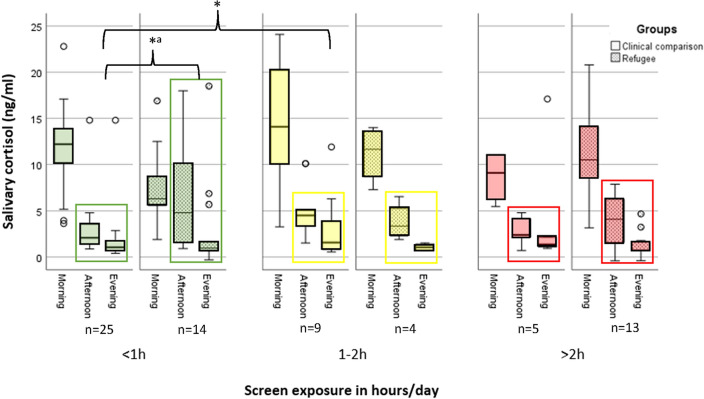
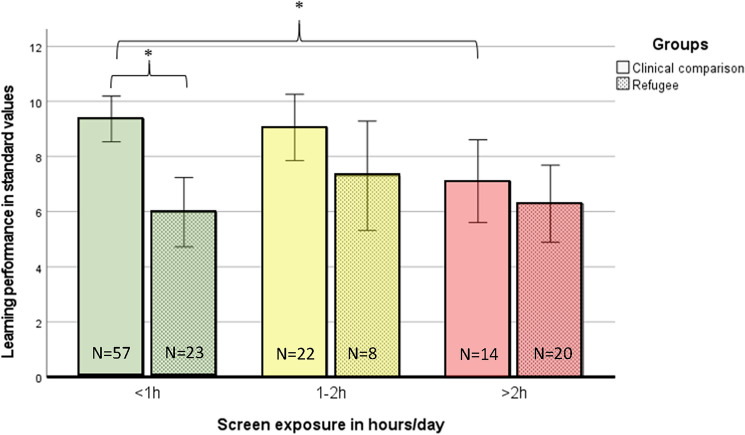
The omnipresence of mobile screens and convenience to operate them has led to increased screen time for young children whereas the sequelae of prolonged exposure are not known yet. 70 refugee children (RG) and 111 children of a clinical comparison group (CG) from a help-seeking population (age: M = 5.10; SD = 1.11; range 3.00-6.97 years) were assessed concerning their amount of daily screen exposure time in relation to parental education and distress. Salivary cortisol was collected as a marker for biological stress and children were tested concerning learning performance, non-verbal IQ and vocabulary with the Kaufmann Assessment Battery for Children (KABC-II). Language skills were assessed in educator rating. The amount of children's screen exposure was negatively related to parental education and positively to distress. In the CG, higher amounts of screen time were associated with elevated cortisol levels and lower learning scores. On both measures, the RG and CG only differed in the condition of screen time less than one hour/day, for higher amounts of screen time the CG approached the more problematic scores of the RG. Whereas in the whole sample the amount of screen time was negatively correlated to language performance, it was not correlated to non-verbal IQ-scores. As a higher amount of media exposure in our clinical comparison group is associated with elevated biological stress, decreased learning and lower language performance, it should be classified as a relevant environmental factor and regularly considered in clinical assessments of children and therapeutical interventions, especially in vulnerable subgroups. German clinical trials register, registration number: DRKS00025734, date: 07-23-2021.
Keywords: Children; Cortisol; Language; Learning; Screen exposure; Stress.
© 2024. The Author(s).
Conflict of interest statement
Declarations. Conflict of interest: The authors have no competing interests to declare that are relevant to the content of this article.
Figures
References
-
- Rideout V, Robb MB (2020) The Common Sense census: Media use by kids age zero to eight. https://www.commonsensemedia.org/sites/default/files/research/report/202.... Accessed 18 Mar 2024
-
- Kabali HK, Irigoyen MM, Nunez-Davis R et al (2015) Exposure and use of mobile media devices by young children. Pediatrics 136(6):1044–1050. 10.1542/peds.2015-2151 - PubMed
-
- Paulus FW, Möhler E, Recktenwald F et al (2021) Electronic media and early childhood: a review. Klin Padiatr 233(4):157–172. 10.1055/a-1335-4936 - PubMed
MeSH terms
Substances
Grants and funding
LinkOut - more resources
Full Text Sources
Medical
Research Materials
