


Long-term cognitive training enhances fluid cognition and brain connectivity in individuals with MCI
- PMID: 39443463
- PMCID: PMC11500385
- DOI: 10.1038/s41398-024-03153-x
Long-term cognitive training enhances fluid cognition and brain connectivity in individuals with MCI
Abstract
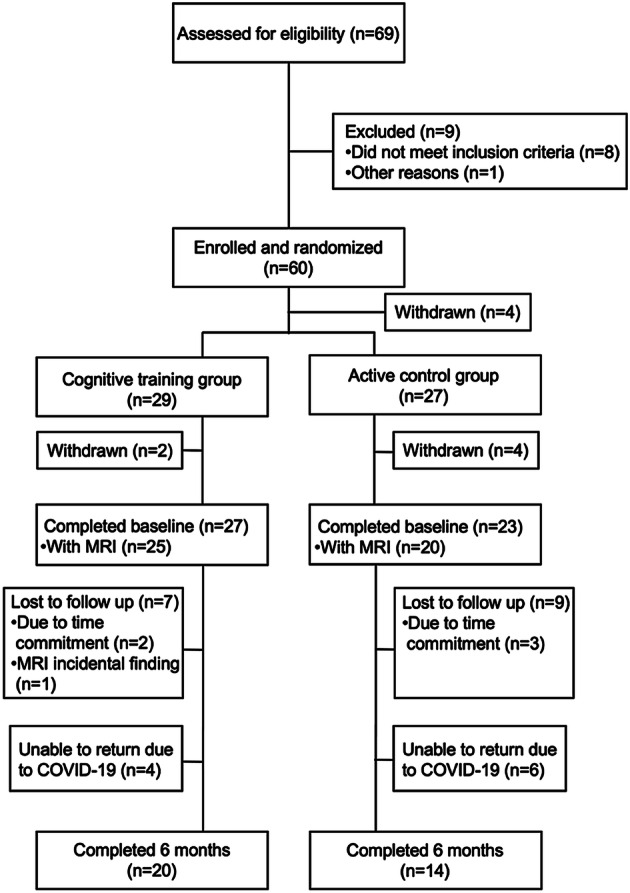
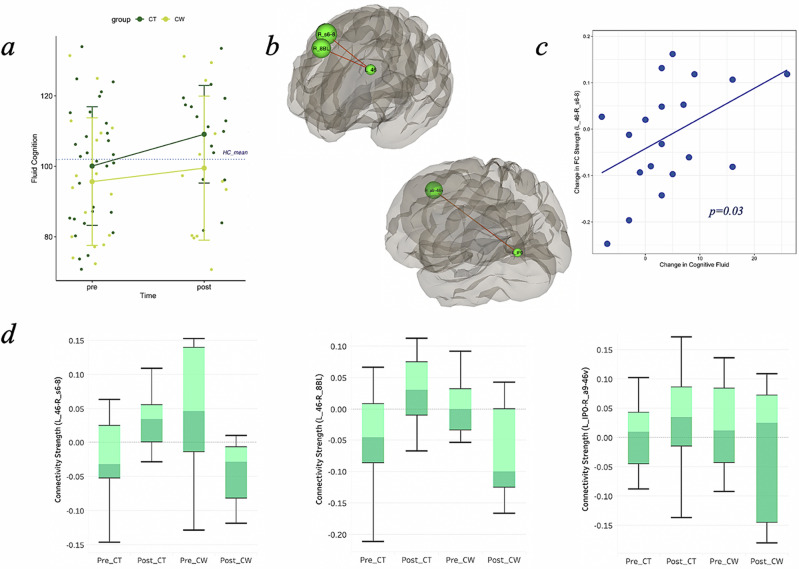
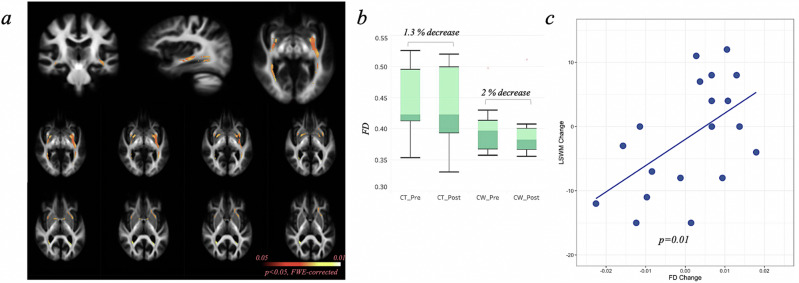
Amnestic mild cognitive impairment (aMCI) is a risk factor for Alzheimer's disease (AD). Multi-domain cognitive training (CT) may slow cognitive decline and delay AD onset. However, most work involves short interventions, targeting single cognitive domains or lacking active controls. We conducted a single-blind randomized controlled trial to investigate the effect of a 6-month, multi-domain CT on Fluid Cognition, functional connectivity in memory and executive functioning networks (primary outcomes), and white matter microstructural properties (secondary outcome) in aMCI. Sixty participants were randomly assigned to either a multi-domain CT or crossword training (CW) group, and thirty-four participants completed the intervention. We found a significant group-by-time interaction in Fluid Cognition (p = 0.007, F (1,28) = 8.26, Cohen's d = 0.38, 95% confidence interval [CI]: 2.45-14.4), with 90% of CT patients showing post-intervention improvements (p < 0.01, Cohen's d = 0.7). The CT group also showed better post-intervention Fluid Cognition than healthy controls (HCs, N = 45, p = 0.045). Functional connectivity analyses showed a significant group-by-time interaction (Cohen's d ≥ 0.8) in the dorsolateral prefrontal cortex (DLPFC) and inferior parietal cortex (IPC) networks. Specifically, CT displayed post-intervention increases whereas CW displayed decreases in functional connectivity. Moreover, increased connectivity strength between the left DLPFC and medial PFC was associated with improved Fluid Cognition. At a microstructural level, we observed a decline in fiber density (FD) for both groups, but the CT group declined less steeply (1.3 vs. 2%). The slower decline in FD for the CT group in several tracts, including the cingulum-hippocampus tract, was associated with better working memory. Finally, we identified regions in cognitive control and memory networks for which baseline functional connectivity and microstructural properties were associated with changes in Fluid Cognition. Long-term, multi-domain CT improves cognitive functioning and functional connectivity and delays structural brain decline in aMCI (ClinicalTrials.gov number: NCT03883308).
© 2024. The Author(s).
Conflict of interest statement
The authors declare no competing interests.
Figures
References
Publication types
MeSH terms
Associated data
Grants and funding
- R01AG073362/U.S. Department of Health & Human Services | NIH | National Institute on Aging (U.S. National Institute on Aging)
- R21 AG073973/AG/NIA NIH HHS/United States
- R01 AG072470/AG/NIA NIH HHS/United States
- R21AG064263/U.S. Department of Health & Human Services | NIH | National Institute on Aging (U.S. National Institute on Aging)
- R61MH119289/U.S. Department of Health & Human Services | NIH | National Institute of Mental Health (NIMH)
- R21 AG064263/AG/NIA NIH HHS/United States
- K25AG050759/U.S. Department of Health & Human Services | NIH | National Institute on Aging (U.S. National Institute on Aging)
- R01AG072470/U.S. Department of Health & Human Services | NIH | National Institute on Aging (U.S. National Institute on Aging)
- R21 MH123873/MH/NIMH NIH HHS/United States
- R21MH123873/U.S. Department of Health & Human Services | NIH | National Institute of Mental Health (NIMH)
- R01 AG073362/AG/NIA NIH HHS/United States
- K25 AG050759/AG/NIA NIH HHS/United States
- R61 MH119289/MH/NIMH NIH HHS/United States
LinkOut - more resources
Full Text Sources
Medical
Miscellaneous
