. 2024 Oct 23;14(1):25100.
doi: 10.1038/s41598-024-74375-8.

Application of a metatranscriptomics technology, CSI-Dx, for the detection of pathogens associated with prosthetic joint infections

Affiliations

Application of a metatranscriptomics technology, CSI-Dx, for the detection of pathogens associated with prosthetic joint infections

Justin R Wright et al. Sci Rep. .

Abstract

Preoperative identification of causal organism(s) is crucial for effective prosthetic joint infection treatment. Herein, we explore the clinical application of a novel metatranscriptomic (MT) workflow, CSI-Dx, to detect pathogens associated with prosthetic joint infection. MT provides insight into transcriptionally active microbes, overcoming limitations of culture-based and available molecular methods. This study included 340 human synovial fluid specimens subjected to CSI-Dx and traditional culture-based methods. Exploratory analyses were conducted to determine sensitivity and specificity of CSI-Dx for detecting clinically-relevant taxa. Our findings provide insights into the active microbial community composition of synovial fluid from arthroplasty patients and demonstrate the potential clinical utility of CSI-Dx for aiding prosthetic joint infection diagnosis. This approach offers potential for improved sensitivity and acceptable specificity compared to synovial fluid culture, enabling detection of culturable and non-culturable microorganisms. Furthermore, CSI-Dx provides valuable information on antimicrobial resistance gene expression. While further optimization is needed, integrating metatranscriptomic technologies like CSI-Dx into routine clinical practice can revolutionize prosthetic joint infection diagnosis by offering a comprehensive and active snapshot of associated pathogens.


Conflict of interest statement

The authors declare a conflict of interest. JRW, JCS, TTL, VT, JP, LP, SLCA, CYW, MH, AJS, and RL, are employees of Contamination Source Identification, LLC. KOT and SG have no relevant conflicts of interest.

Figures

Fig. 1
Fig. 1
Experimental overview of metatranscriptomic analysis. Cohort designations were determined by CD Laboratories (Towson, MD) using the 2018 ICM Guidelines. The total sample count per group denotes samples with at least 5 million sequences after quality filtration. Samples that passed quality filtration were included in downstream analyses. Synovial fluid microbiome research and development included alpha and beta diversity analyses. Per sample clinical assessment involved calculating per taxon Limit of Blank values based on 152 Aseptic Arthroplasty samples with the 95% classical approach method as per CLSI, per sample assessment for pathogenic taxa using preliminary thresholds, and retesting a subset of culture-positive samples using either deep sequencing technology or deep sequencing paired with CSI’s proprietary pathogen amplification (PPA) technique. *Denotes cohort designations that were excluded from alpha and beta diversity statistical analysis in addition to per-sample concordance evaluations due to low sample size or ambiguous clinical results.
Fig. 2
Fig. 2
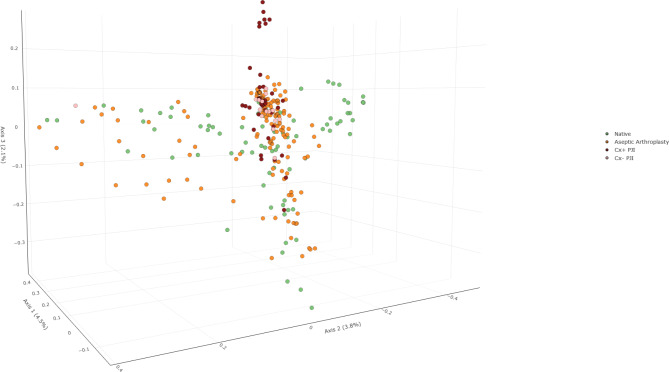
Principal coordinates analysis (PcoA) plot showing the clustering of samples based on Bray-Curtis distances. Only sample groups with a sample size larger than 10 after filtering were included in the analysis. Samples with no taxa remaining after filtering were omitted. The clustering among the groups was found to be significant (Adonis, r2 = 0.028, p = 0.001).
Fig. 3
Fig. 3
Box plot of average CRR taxa CPM-r values across non-Native cohorts with more than 10 samples after filtering, including Cx + PJI and Cx + NSA, Aseptic Arthroplasty CSI-Dx Negative, Aseptic Arthroplasty CSI-Dx Positive, and Cx- PJI. Aseptic Arthroplasty was divided into two groups based on whether any CRR organisms exceeded thresholds, with LoBs based on Native samples, to be considered Positive. Cx + PJI and Cx + NSA were grouped together on the x-axis due to both cohorts consisting of samples with positive cultures. Significant differences (Wilcoxon rank sum Holm adj. p ≤ 0.05) were observed among the groups. Samples with taxa that yielded CPM-r values of 0 were omitted.
Fig. 4
Fig. 4
(a) Bar plot comparing the Microbial counts per million (CPM) values of the original results to their respective Proprietary Pathogen Amplification (PPA) retests. (b) Boxplot comparing the Fold Microbial (%) values of the No-PPA and PPA retests. Fold Microbial was calculated by dividing the Microbial CPM values of the retests by the Microbial CPM values of their respective original results.
Fig. 5
Fig. 5
(a) Bar plot illustrating the CSI-Dx results for culture negative samples. (b) Pie chart displaying the concordance results of CSI-Dx with all culture-positive samples that passed QC (n = 43). (c) Bar plot presenting the concordance results by taxa with taxa colored according to their respective groups. (d) Pie chart depicting the concordance results of CSI-Dx with non-Staphylococcus epidermidis culture-positive samples that passed QC (n = 33).
Fig. 6
Fig. 6
Heatmap depicting log-transformed counts of the KEGG Orthologs (KO) (n = 13) associated with antibiotic resistance genes that were present in a total of at least three samples and/or controls. The color-coded heatmap showcases the relative abundance of the antibiotic-resistance genes in each sample. Only controls and samples containing at least one antibiotic-resistant KO are displayed, highlighting relevant data points. The heatmap visually identifies antibiotic resistance gene expression differences among the analyzed samples.

References

    1. Kim, H. S. et al. Current and Future Burden of Periprosthetic Joint Infection from national claim database. J. Korean Med. Sci. 35, e410 (2020). - PMC - PubMed
    1. Leonenko, V. N., Kaliberda, Y. E., Muravyova, Y. V. & Artyukh, V. A. A decision support Framework for Periprosthetic Joint infection treatment: A cost-effectiveness analysis using two modeling approaches. J. Personalized Med. 12, 1216 (2022). - PMC - PubMed
    1. Trebse, R. & Roskar, S. Evaluation and interpretation of prosthetic joint infection diagnostic investigations. Int. Orthop. 45, 847–855 (2021). - PubMed
    1. Kurtz, S. M. et al. Infection burden for hip and knee arthroplasty in the United States. J. Arthroplasty. 23, 984–991 (2008). - PubMed
    1. Shahi, A., Tan, T. L., Chen, A. F., Maltenfort, M. G. & Parvizi, J. In-Hospital mortality in patients with Periprosthetic Joint infection. J. Arthroplasty. 32, 948–952e1 (2017). - PubMed

LinkOut - more resources