Review
. 2025 Feb;32(2):219-224.
doi: 10.1038/s41418-024-01391-6. Epub 2024 Oct 23.

TP53: the unluckiest of genes?

Affiliations
Review

TP53: the unluckiest of genes?

Andreas C Joerger et al. Cell Death Differ. 2025 Feb.

Abstract

The transcription factor p53 plays a key role in the cellular defense against cancer development. It is inactivated in virtually every tumor, and in every second tumor this inactivation is due to a mutation in the TP53 gene. In this perspective, we show that this diverse mutational spectrum is unique among all other cancer-associated proteins and discuss what drives the selection of TP53 mutations in cancer. We highlight that several factors conspire to make the p53 protein particularly vulnerable to inactivation by the mutations that constantly plague our genome. It appears that the TP53 gene has emerged as a victim of its own evolutionary past that shaped its structure and function towards a pluripotent tumor suppressor, but came with an increased structural fragility of its DNA-binding domain. TP53 loss of function - with associated dominant-negative effects - is the main mechanism that will impair TP53 tumor suppressive function, regardless of whether a neomorphic phenotype is associated with some of these variants.


Conflict of interest statement

Competing interests: The authors declare no competing interests.

Figures

Fig. 1
Fig. 1. Analysis of somatic TP53 variants in tumor tissues according to their frequency in the UMD_TP53 database (2024 release, 248,363 patients).
A Somatic missense variants are localized predominantly in the DNA-binding domain (central panel) of the multidomain p53 protein and have a much lower frequency in the flanking N- and C-terminal regions (left and right panel, respectively). B Frequent cancer-associated somatic variants are found predominantly in the DNA-binding domain, whereas low frequency variants are more predominant in the N- and C-terminal regions and correspond to indels. TD = tetramerization domain (C) TP53 loss of activity for missense variants localized in the DNA-binding domain of the p53 protein. p53 activities ranging from 0 (inactive) to 1 (full activity) were taken from the work of Kotler et al. [39]. Red circles: variants frequently found in human cancer (at least 75 cases in the database); green circles: ultra rare variants (1 or 2 cases) or variants that have not been reported in cancer yet. For each residue, the average activity of all frequent or rare variants is given. Violin plots illustrate the distribution of TP53 activity for the two classes of TP53 variants. The structure of the DNA-binding domain is shown on the right as a cartoon representation (PDB entry 2XWR) [77].
Fig. 2
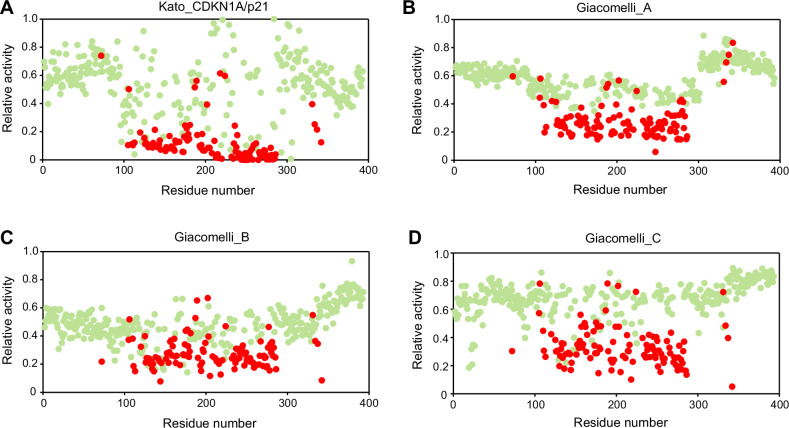
Fig. 2. Distribution of loss-of-activity missense variants in the p53 protein.
p53 activities ranging from 0 (inactive) to 1 (full activity) were taken from the work of Kato et al. (CDKN1A/p21 promoter) [37] (A) or from the three different readouts described by Giacomelli et al. [40] (BD). Mutation frequencies in tumors (somatic count) are taken from the upcoming release of the UMD_TP53 database (2024 release, 248,363 patients). Red circles: variants frequently found in human cancer (more than 75 cases in the database); green circles: ultra rare variants (only 1 or 2 cases in the database) or variants that have never been reported in cancer. For each residue, the average activity of all frequent or rare variants is given. The outlier at codon 72 is due to the R72P polymorphism.

References

    1. Klein G. Oncogenes and tumor suppressor genes. Acta Oncol. 1988;27:427–37. - DOI - PubMed
    1. Friend SH, Dryja TP, Weinberg RA. Oncogenes and tumor-suppressing genes. N. Engl J Med. 1988;318:618–22. - DOI - PubMed
    1. Hanahan D. Hallmarks of cancer: new dimensions. Cancer Discov. 2022;12:31–46. - DOI - PubMed
    1. Hanahan D, Weinberg RA. Hallmarks of cancer: the next generation. Cell. 2011;144:646–74. - DOI - PubMed
    1. Schreiber RD, Old LJ, Smyth MJ. Cancer immunoediting: integrating immunity’s roles in cancer suppression and promotion. Science. 2011;331:1565–70. - DOI - PubMed

Substances