


Borderline personality disorder and post-traumatic stress disorder in adolescents: protocol for a comparative study of borderline personality disorder with and without comorbid post-traumatic stress disorder (BORDERSTRESS-ADO)
- PMID: 39443885
- PMCID: PMC11515767
- DOI: 10.1186/s12888-024-06093-4
Borderline personality disorder and post-traumatic stress disorder in adolescents: protocol for a comparative study of borderline personality disorder with and without comorbid post-traumatic stress disorder (BORDERSTRESS-ADO)
Abstract
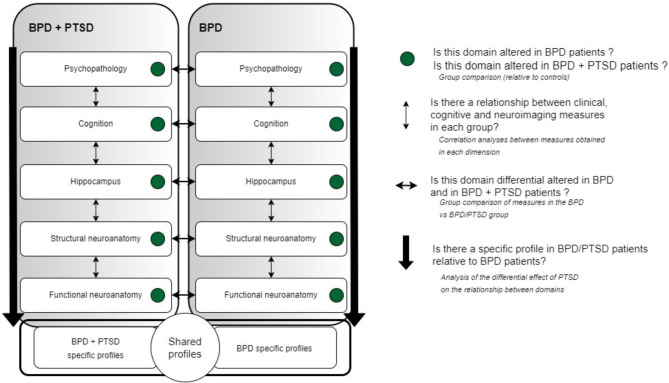
Background: Borderline Personality Disorder (BPD) is a prevalent and debilitating psychiatric condition often accompanied by Post-Traumatic Stress Disorder (PTSD), with a substantial prevalence of trauma history among affected individuals. The clinical, cognitive, and cerebral parallels shared with PTSD suggest a trauma-related etiology for BPD. Studies consistently demonstrate a reduction in hippocampal volume in individuals with BPD, echoing findings in PTSD. However, the interpretation of this shared neurobiological profile remains contentious, with ongoing debates regarding the independence of these pathologies or the potential exacerbation of diminished hippocampal volume in BPD due to concurrent PTSD. Differential impacts on hippocampal subfields across both disorders may further complicate interpretation, suggesting the volume of hippocampal subfields as a potential discriminant biomarker. This study aims to characterize the multidimensional specific and shared profiles of BPD and PTSD-related alterations, with a particular emphasis on hippocampal subfields during adolescence, a crucial period in BPD development.
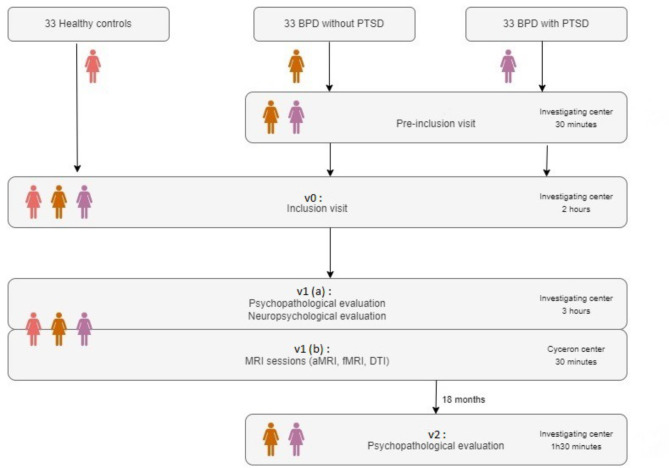
Methods: This study focuses on female adolescents, who are more prevalent in the BPD population. Participants are categorized into three groups: BPD, BPD with comorbid PTSD, and a control group of matched healthy individuals. Data collection encompasses clinical, cognitive, and neuroimaging domains commonly affected in both disorders, utilizing various imaging markers (including gray matter macrostructure, white matter microstructural integrity, and regional functional connectivity).
Discussion: This study examines adolescent BPD with and without comorbid PTSD on clinical, neuroimaging, and cognitive levels. It is the first to use a comprehensive multi-modal approach within the same sample. Additionally, it uniquely explores hippocampal subfield volume differences in adolescents. Analysis of the relationship between the investigated domains and the effects of PTSD comorbidity will elucidate specific and shared alteration profiles in both disorders.
Trial registration: IDRCB number 2019-A00366-51 / clinicaltrials.gov ID: NCT0485274. Registered on 21/04/2021.
Keywords: Adolescent; Borderline personality disorder; Comorbidity; Emotional regulation; Female; Hippocampus; Neuroanatomy; Post-traumatic stress disorder; Psychopathology.
© 2024. The Author(s).
Conflict of interest statement
The authors declare no competing interests.
Figures
References
-
- Bohus M, Stoffers-Winterling J, Sharp C, Krause-Utz A, Schmahl C, Lieb K. Borderline personality disorder. Lancet Lond Engl. 2021;398(10310):1528–40. - PubMed
-
- Leichsenring F, Heim N, Leweke F, Spitzer C, Steinert C, Kernberg OF. Borderline Personality Disorder: Rev JAMA. 2023;329(8):670–9. - PubMed
-
- American Psychiatric Association. Diagnostic and statistical manual of mental disorders: DSM-5. 5th edition. Arlington, VA: American Psychiatric Association. 2013. 947 p.
-
- Ellison WD, Rosenstein LK, Morgan TA, Zimmerman M. Community and clinical epidemiology of Borderline personality disorder. Psychiatr Clin North Am. 2018;41(4):561–73. - PubMed
-
- Gunderson JG, Herpertz SC, Skodol AE, Torgersen S, Zanarini MC. Borderline personality disorder. Nat Rev Dis Primer. 2018;4(1):1–20. - PubMed
Publication types
MeSH terms
Associated data
Grants and funding
LinkOut - more resources
Full Text Sources
Medical
