


Undergraduate musculoskeletal ultrasound training based on current national guidelines-a prospective controlled study on transferability
- PMID: 39443912
- PMCID: PMC11515732
- DOI: 10.1186/s12909-024-06203-6
Undergraduate musculoskeletal ultrasound training based on current national guidelines-a prospective controlled study on transferability
Abstract
Introduction: Musculoskeletal ultrasound (MSUS) is integral to routine clinical diagnostics for musculoskeletal and joint disorders. This study aims to establish and validate a sonography course tailored to undergraduate medical students acquiring MSUS-specific skills at a German university.
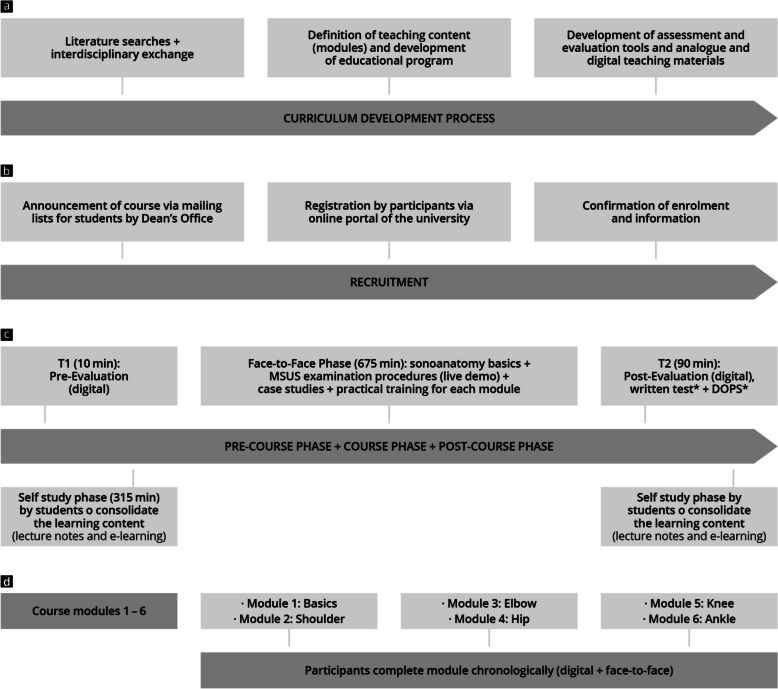
Methods: A blended learning training concept, comprising 24 instruction sessions of 45 min each, was designed based on the current national guidelines of the German Society for Ultrasound in Medicine (DEGUM). This program was integrated into the clinical phase of the undergraduate students' medical education. The self-perceived improvement in competency and the effectiveness of the course design were evaluated using a a 7-point Likert scale questionnaire. Objective learning success was evaluated via a written test and a "Direct Observation of Practical Skills" practical exam. Control groups included medical students without MSUS training (control group 1) and doctors who had completed DEGUM-certified basic MSUS courses (control group 2). Both control groups completed the written test, while control group 2 also took the practical final exam. The study involved 146 participants: 56 were allocated to the study group, 44 to control group 1, and 46 to control group 2.
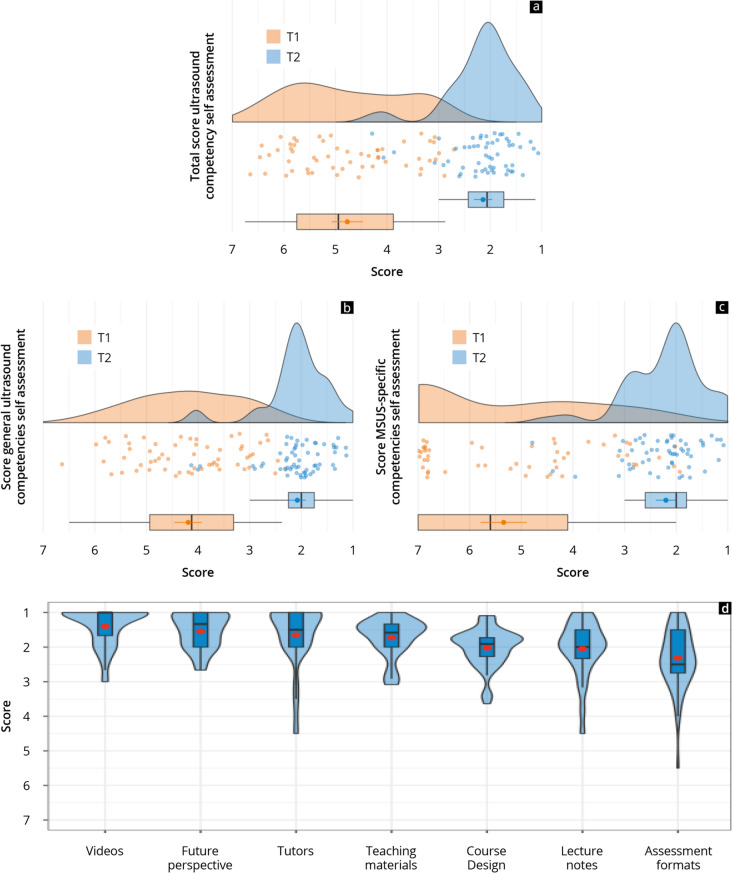
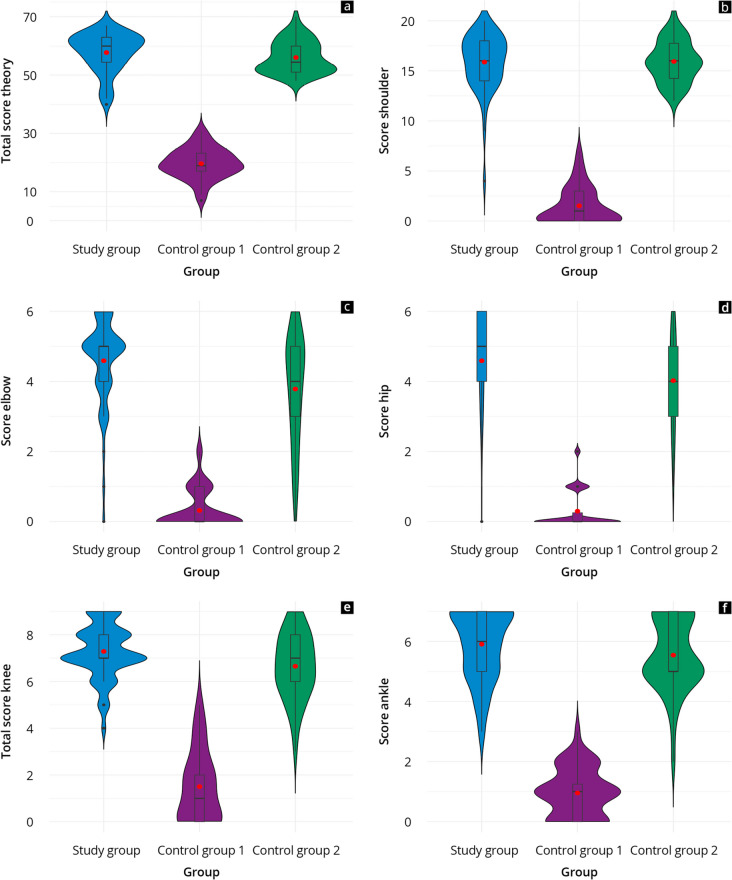
Results: The study group rated their skills significantly higher after the course (p < 0.01). Participants expressed high satisfaction with the course design, the teaching materials, and the teachers. The study group's performance on the final written test was comparable to those of control group 2 (p = 0.06) and significantly superior to control group 1 (p < 0.001). Additionally, the study group's performance on the practical final exam was not significantly different from control group 2 (p = 0.28), with both groups achieving scores exceeding 80%.
Conclusion: Both subjective and objective measures of learning suggest that an MSUS course designed for postgraduates can be effectively adapted for undergraduate medical students. Incorporating MSUS training into the clinical curriculum is recommended to enhance future medical professionals' educational experience and practical skills.
Keywords: Blended learning; Competency-based education; DOPS; Education; Medical; Musculoskeletal ultrasound; Ultrasonography; Undergraduate.
© 2024. The Author(s).
Conflict of interest statement
The authors declare no competing interests.
Figures

References
-
- Dietrich CF, Bolondi L, Duck F, Evans DH, Ewertsen C, Fraser AG, et al. History of Ultrasound in Medicine from its birth to date (2022), on occasion of the 50 Years Anniversary of EFSUMB. A publication of the European Federation of Societies for Ultrasound In Medicine and Biology (EFSUMB), designed to record the historical development of medical ultrasound. Med Ultrason. 2022;24(4):434–50. - PubMed
-
- Kane D, Balint PV, Sturrock R, Grassi W. Musculoskeletal ultrasound--a state of the art review in rheumatology. Part 1: Current controversies and issues in the development of musculoskeletal ultrasound in rheumatology. Rheumatology (Oxford). 2004;43(7):823–8. - PubMed
-
- Jackson SS, Le HM, Kerkhof DL, Corrado GD. Point-of-Care Ultrasound, the New Musculoskeletal Physical Examination. Curr Sports Med Rep. 2021;20(2):109–12. - PubMed
-
- Mankad K, Hoey E, Grainger AJ, Barron DA. Trauma musculoskeletal ultrasound. Emerg Radiol. 2008;15(2):83–9. - PubMed
-
- Lin JS, Gimarc DC, Adler RS, Beltran LS, Merkle AN. Ultrasound-Guided Musculoskeletal Injections. Semin Musculoskelet Radiol. 2021;25(6):769–84. - PubMed
MeSH terms
LinkOut - more resources
Full Text Sources
