. 2025 Feb;97(2):388-396.
doi: 10.1002/ana.27113. Epub 2024 Oct 23.

Recessive Variants in PIGG Cause a Motor Neuropathy with Variable Conduction Block, Childhood Tremor, and Febrile Seizures: Expanding the Phenotype

Affiliations

Recessive Variants in PIGG Cause a Motor Neuropathy with Variable Conduction Block, Childhood Tremor, and Febrile Seizures: Expanding the Phenotype

Christopher J Record et al. Ann Neurol. 2025 Feb.

Abstract

Biallelic variants in phosphatidylinositol glycan anchor biosynthesis, class G (PIGG) cause hypotonia, intellectual disability, seizures, and cerebellar features. We present 8 patients from 6 families with a childhood-onset motor neuropathy and neurophysiology demonstrating variable motor conduction block and temporal dispersion. All individuals had a childhood onset tremor, 5 of 8 had cerebellar involvement, and 6 of 8 had childhood febrile seizures. All individuals have biallelic PIGG variants, including the previously reported pathogenic variant Trp505*, plus 6 novel variants. Null enzyme activity is demonstrated via PIGO/PIGG double knockout system for Val339Gly and Gly19Glu, and residual activity for Trp505* due to read-through. Emm negative blood group status was confirmed in 1 family. PIGG should be considered in unsolved motor neuropathy. ANN NEUROL 2025;97:388-396.


Conflict of interest statement

Nothing to report.

Figures
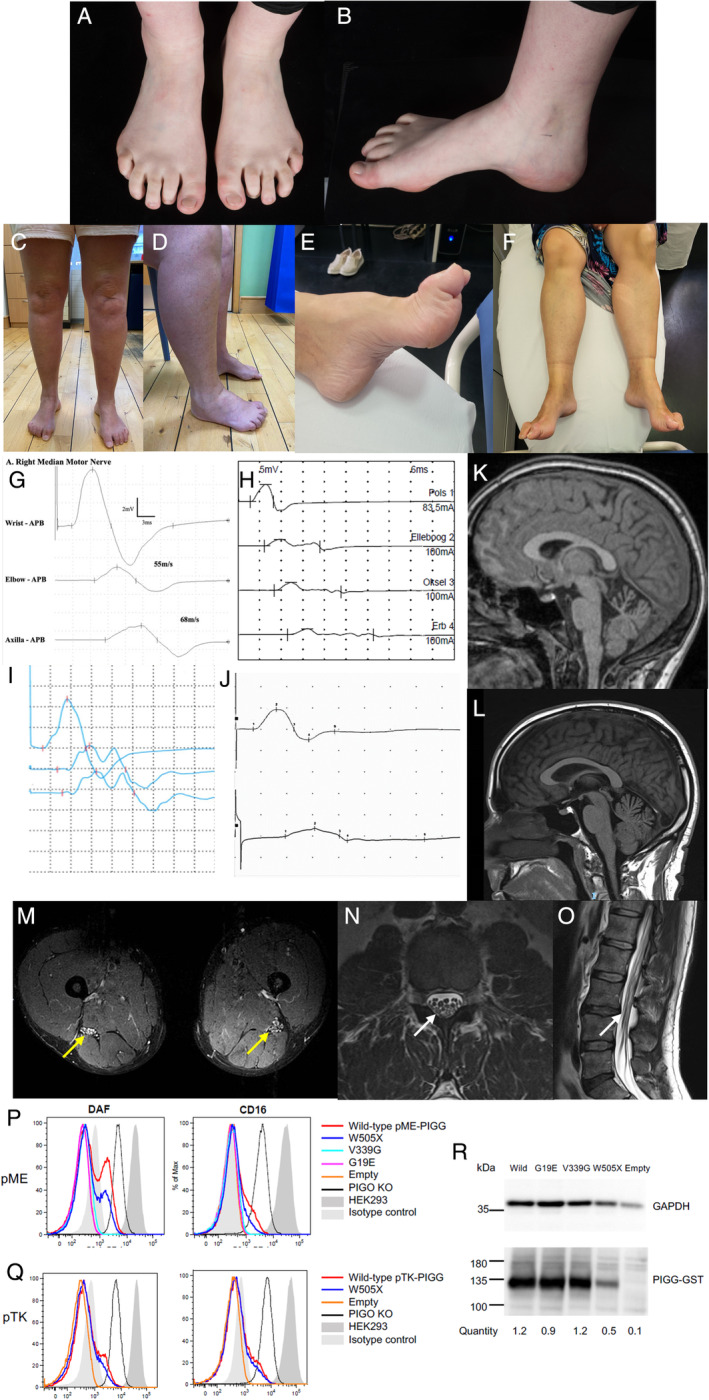
Figure 1
Figure 1
(A–F) Photography of lower limbs showing foot deformity and distal wasting (A and B patient 2:I, C and D patient 1:II, E and F patient 6:I); (G–J) Waveforms of motor nerve conduction studies showing conduction block and temporal dispersion (G patient 2:1 right median, H patient 4:I right median, I patient 5:I right ulnar, J patient 6:I left median); (K–L) MRI of the brain, sagittal T1 views showing prominent (K patient 2:I) and mild (L patient 1:I) superior vermian atrophy; (M) MRI of the thigh of patient 1:I (T2 TIRM axial view) shows thickening of sciatic nerve bilaterally returning high signal (yellow arrows); (N, O) MRI of the lumbar spine of patient 1:I shows thickened intradural roots within the cauda equina (N axial T2, O sagittal T2, white arrows); (P–R) PIGO/PIGG DKO HEK293 cells (permanently expressing CD16) were transfected with the strong promoter (pME, P) or weaker promoter (pTK, Q) driven wild‐type or mutant PIGG. Two days later, fluorescence‐activated cell sorting (FACS) analysis (P, Q) and Western Blotting (R) were performed. FACS analysis – X‐axis is relative cell number, Y‐axis is fluorescent intensity of phycoerythrin. Western blots – quantity was calculated by the band intensities of PIGG‐GST normalized with the band intensities of GAPDH (loading control) and with luciferase activity (transfection control). MRI = magnetic resonance imaging. [Color figure can be viewed at www.annalsofneurology.org]

References

    1. Kinoshita T. Biosynthesis and biology of mammalian GPI‐anchored proteins. Open Biol 2020;10. 10.1098/rsob.190290. - DOI - PMC - PubMed
    1. Makrythanasis P, Kato M, Zaki MS, et al. Pathogenic variants in PIGG cause intellectual disability with seizures and Hypotonia. Am J Hum Genet 2016;98:615–626. 10.1016/j.ajhg.2016.02.007. - DOI - PMC - PubMed
    1. Tremblay‐Laganière C, Maroofian R, Nguyen TTM, et al. PIGG variant pathogenicity assessment reveals characteristic features within 19 families. Genet Med 2021;23:1873–1881. 10.1038/s41436-021-01215-9. - DOI - PMC - PubMed
    1. Duval R, Nicolas G, Willemetz A, et al. Inherited glycosylphosphatidylinositol defects cause the rare Emm‐negative blood phenotype and developmental disorders. Blood 2021;137:3660–3669. 10.1182/blood.2020009810. - DOI - PubMed
    1. Lane WJ, Aeschlimann J, Vege S, et al. PIGG defines the Emm blood group system. Sci Rep 2021;11:1–11. 10.1038/s41598-021-98090-w. - DOI - PMC - PubMed
