. 2024;32(5):375-383.
doi: 10.1080/16066359.2023.2284209. Epub 2023 Nov 24.

Affect Variability in Relation to Alcohol Use Frequency, Intensity, and Concurrent Cannabis Use Among College Students during the COVID-19 Pandemic

Affiliations

Affect Variability in Relation to Alcohol Use Frequency, Intensity, and Concurrent Cannabis Use Among College Students during the COVID-19 Pandemic

Danny Rahal et al. Addict Res Theory. 2024.

Abstract

Although alcohol use is related to daily affect, findings regarding affect variability-the degree to which individuals exhibit day-to-day fluctuations in affect-and alcohol use have been mixed. The present study assessed whether individuals who use alcohol tend to have higher positive and negative affect variability than individuals who do not, as well as whether higher affect variability is related to more frequent and intense alcohol use among individuals who use alcohol. We also explored whether affect variability differed between individuals who use alcohol and those who concurrently use alcohol and cannabis. College students (N=1909; M=20.1, SD=1.3; 67.7% female; 76.6% white; n=1147 individuals who use alcohol) completed a 21-day protocol between February-December 2021 in which they reported daily affect, number of drinks consumed, and any cannabis use. As hypothesized, individuals who used alcohol had higher positive and negative affect variability than individuals who did not. Among individuals who used alcohol, individuals with higher negative affect variability drank alcohol more frequently, and both higher positive and negative affect variability were related to more intense alcohol use. No differences emerged between individuals who used alcohol and those who concurrently used alcohol and cannabis. Taken together, higher positive and negative affect variability were related to higher odds of using alcohol and more frequent and intense use among individuals who use alcohol, over and above average affect. Higher affect variability could relate to alcohol use because of difficulties with emotion regulation or heightened sensitivity to the environment.

Keywords: affective variability; alcohol use; cannabis use; emotion dynamics; emotional variability.


Conflict of interest statement

The authors declare that they have no conflict of interest.

Figures
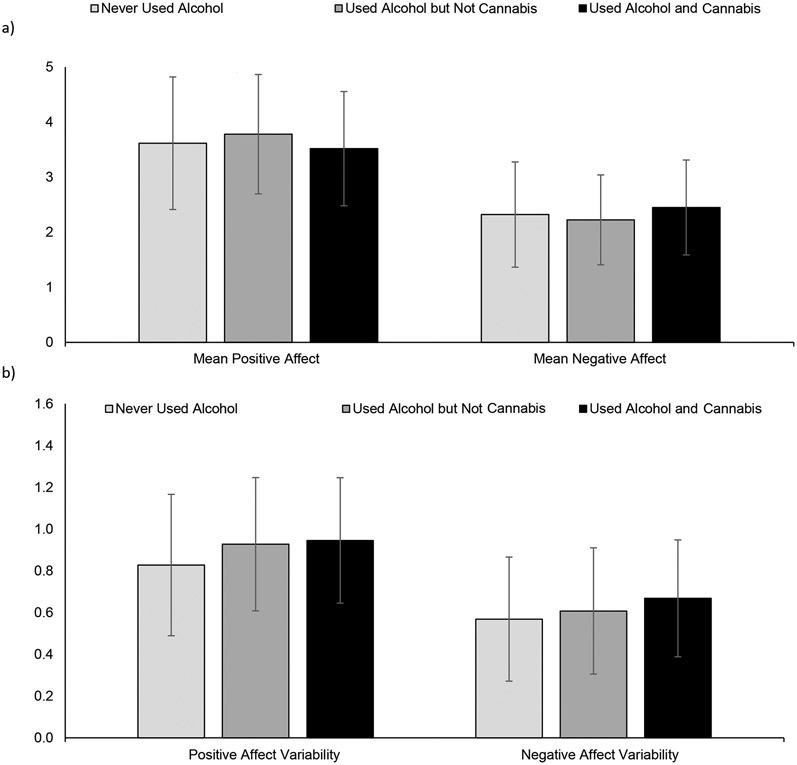
Figure 1.
Figure 1.
Unadjusted mean affect (above) and affect variability (below) for participants who had abstained from alcohol and cannabis use, who had used alcohol but not cannabis, or who had used both alcohol and cannabis during the study period. Note: Error bars indicate standard deviations.
Figure 2.
Figure 2.
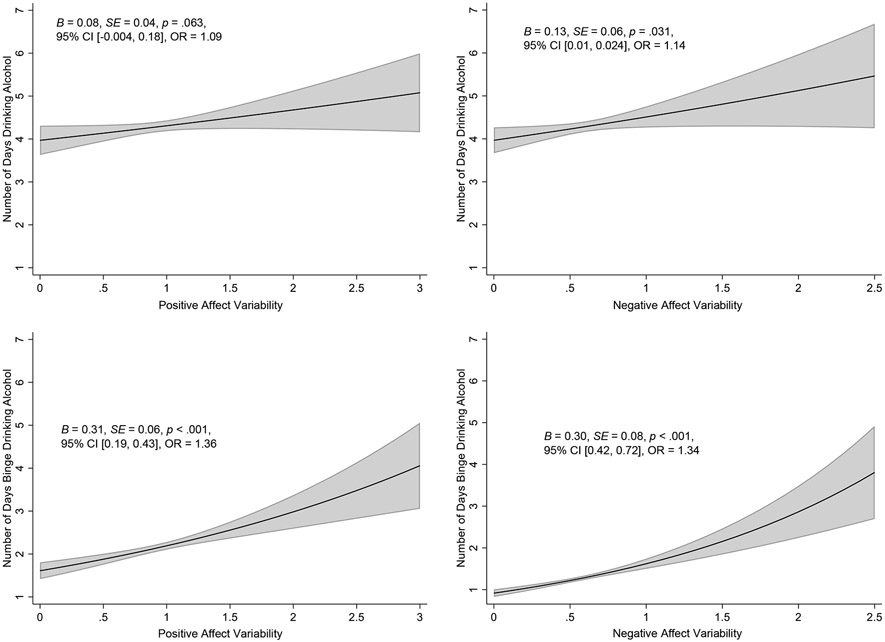
Number of days when participants used alcohol (top), number of days when participants reported binge drinking alcohol (middle), and probability of ever high-intensity drinking (bottom) among participants who used alcohol across the study period as a function of positive affect variability (left) and negative affect variability (right). Note: Figure displays predicted outcomes, adjusting for gender (0=male/man and different gender identity, 1=female/woman), first-generation status (0=continuing-generation, 1=first-generation), LGBTQ+ status (0=does not identify as LGBTQ+, 1=identifies as LGBTQ+), race (each racial category coded relative to white [sample majority] as reference group; 1=NHL Asian, 1=NHL Black, 1=Hispanic/Latinx, 1=multiracial, and 1=different racial identity for each variable), and age (mean-centered).
Figure 2.
Figure 2.
Number of days when participants used alcohol (top), number of days when participants reported binge drinking alcohol (middle), and probability of ever high-intensity drinking (bottom) among participants who used alcohol across the study period as a function of positive affect variability (left) and negative affect variability (right). Note: Figure displays predicted outcomes, adjusting for gender (0=male/man and different gender identity, 1=female/woman), first-generation status (0=continuing-generation, 1=first-generation), LGBTQ+ status (0=does not identify as LGBTQ+, 1=identifies as LGBTQ+), race (each racial category coded relative to white [sample majority] as reference group; 1=NHL Asian, 1=NHL Black, 1=Hispanic/Latinx, 1=multiracial, and 1=different racial identity for each variable), and age (mean-centered).

Similar articles

Cited by

References

    1. Arterberry BJ, Goldstick JE, Walton MA, Cunningham RM, Blow FC, & Bonar EE (2021). Alcohol and cannabis motives: Differences in daily motive endorsement on alcohol, cannabis, and alcohol/cannabis co-use days in a cannabis-using sample. Addiction Research & Theory, 29(2), 111–116. 10.1080/16066359.2020.1787390 - DOI - PMC - PubMed
    1. Conway FN, Sokolovsky A, White HR, & Jackson KM (2020). Simultaneous alcohol and marijuana use: A brief measure of motives. Journal of Studies on Alcohol and Drugs, 81(2), 203–211. 10.15288/jsad.2020.81.203 - DOI - PMC - PubMed
    1. Cox WM, & Klinger E (1988). A motivational model of alcohol use. Journal of abnormal Psychology, 97(2), 168–180. 10.1037/0021-843X.97.2.168 - DOI - PubMed
    1. Deng W, Gadassi Polack R, Creighton M, Kober H, & Joormann J (2021). Predicting negative and positive affect during COVID-19: A daily diary study in youths. Journal of Research on Adolescence, 31(3), 500–516. 10.1111/jora.12646 - DOI - PMC - PubMed
    1. DiGuiseppi GT, Davis JP, Meisel MK, Clark MA, Roberson ML, Ott MQ, & Barnett NP (2020). The influence of peer and parental norms on first-generation college students’ binge drinking trajectories. Addictive Behaviors, 103. 10.1016/j.addbeh.2019.106227 - DOI - PMC - PubMed

LinkOut - more resources