Non-invasive positive pressure ventilation can reduce perioperative mortality in acute aortic dissection patients with hypoxemia
- PMID: 39444862
- PMCID: PMC11494601
- DOI: 10.21037/jtd-24-163
Non-invasive positive pressure ventilation can reduce perioperative mortality in acute aortic dissection patients with hypoxemia
Abstract
Background: Hypoxemia is a common critical respiratory complication in patients with acute aortic dissection (AAD) before operation and results in adverse outcomes. This study aimed to identify the optimal oxygenation treatment for AAD patients with hypoxemia in the emergency department (ED).
Methods: This was a retrospective, observational, cohort study. We retrospectively collected data from 187 adult patients with AAD and hypoxemia who had been admitted to our ED. All patients were divided into nasal cannula group (n=91), Venturi mask group (n=60), and non-invasive positive pressure ventilation (NIPPV) group (n=36). The primary outcome was overall mortality in ED; the secondary outcomes were preoperative intubation rate and postoperative mortality, length of intensive care unit (ICU) stay, length of hospital stay, and length of intubation.
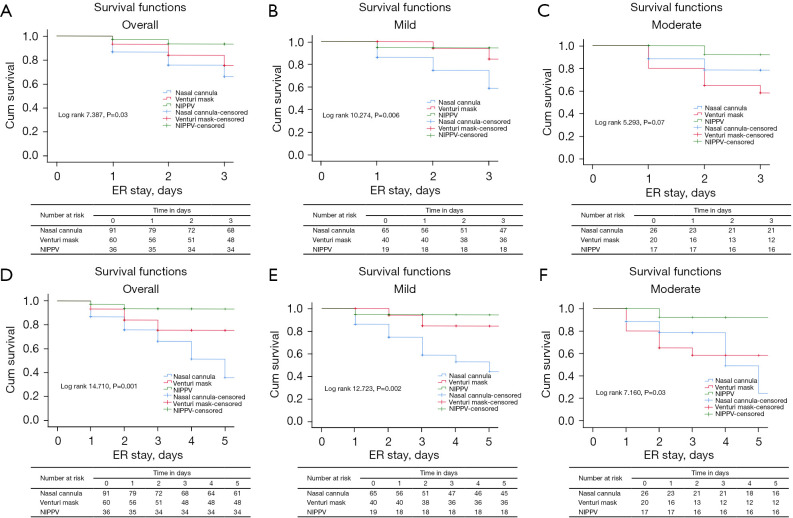
Results: Among all patients, those who received NIPPV treatment showed the lowest ED intubation rate (2.78%, P=0.004), shortest postoperative length of ICU stay (median 2.31, P<0.001), postoperative length of intubation (median 25.10, P<0.001), and post-operative length of hospital stay (median 21.00, P<0.001). Kaplan-Meier analysis showed the highest 3-day survival (log-rank 7.387, P=0.03) and 5-day survival (log-rank 14.710, P=0.001) in the NIPPV group. After adjustment, NIPPV therapy was independently associated with the reduced 3-day [adjusted hazard ratio (HR) 0.102, 95% confidence interval (CI): 0.013-0.791, P=0.03] and 5-day (adjusted HR 0.057, 95% CI: 0.008-0.427, P=0.005) mortality in ED.
Conclusions: Early utilization of NIPPV in AAD patients with hypoxemia in the ED can effectively decrease pre-operative intubation rate and perioperative mortality, and improve postoperative outcomes.
Keywords: Aortic dissection; hypoxemia; mortality; noninvasive ventilation; perioperative.
2024 AME Publishing Company. All rights reserved.
Conflict of interest statement
Conflicts of Interest: All authors have completed the ICMJE uniform disclosure form (available at https://jtd.amegroups.com/article/view/10.21037/jtd-24-163/coif). Y.H. is supported by NSFC Incubation Program of GDPH (No. KY012021167). B.H. is supported by the National Natural Science Grant of China (No. 82072139), the Fund for Distinguished Young Scholar of GDPH (No. KJ012021184), and the High-level Hospital Construction Project of Guangdong Provincial People’s Hospital (No. KJ0122019448). W.L. is supported by Guangdong Medical Science and Technology Research Fund Project (No. A2021067). X.L. is supported by the Ministry of Science and Technology of the People’s Republic of China (No. 2020AAA0109605). The other authors have no conflicts of interest to declare.
Figures

References
LinkOut - more resources
Full Text Sources