


Update of the risk assessment of brominated phenols and their derivatives in food
- PMID: 39444985
- PMCID: PMC11496907
- DOI: 10.2903/j.efsa.2024.9034
Update of the risk assessment of brominated phenols and their derivatives in food
Abstract
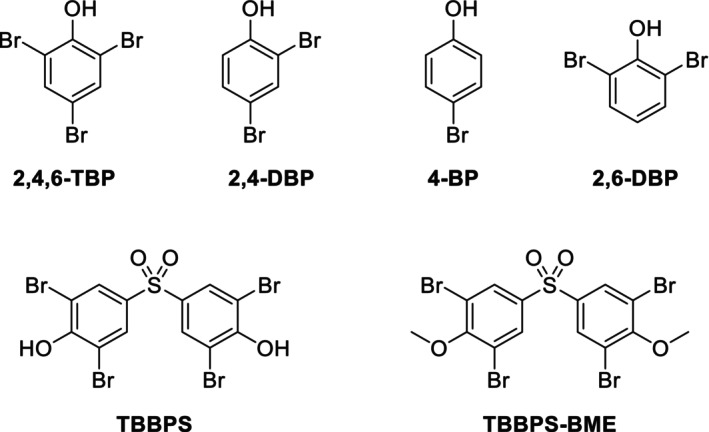
The European Commission asked EFSA to update its 2012 risk assessment on brominated phenols and their derivatives in food, focusing on five bromophenols and one derivative: 2,4,6-tribromophenol (2,4,6-TBP), 2,4-dibromophenol (2,4-DBP), 4-bromophenol (4-BP), 2,6-dibromophenol (2,6-DBP), tetrabrominated bisphenol S (TBBPS), tetrabromobisphenol S bismethyl ether (TBBPS-BME). Based on the overall evidence, the CONTAM Panel considered in vivo genotoxicity of 2,4,6-TBP to be unlikely. Effects in liver and kidney were considered as the critical effects of 2,4,6-tribromophenol (2,4,6-TBP) in studies in rats. A BMDL10 of 353 mg/kg body weight (bw) per day for kidney papillary necrosis in male rats was identified and was selected as the reference point for the risk characterisation. The derivation of a health-based guidance value was not considered appropriate due to major limitations in the toxicological database. Instead, the margin of exposure (MOE) approach was applied to assess possible health concerns. Around 78,200 analytical results for 2,4,6-TBP in food were used to estimate dietary exposure for the European population. Considering the resulting MOE values, all far above an MOE of 6000 that does not raise a health concern, and accounting for the uncertainties affecting the exposure and hazard assessments, the CONTAM Panel concluded with at least 95% probability that the current dietary exposure to 2,4,6-TBP does not raise a health concern. Due to lack of occurrence data, no risk assessment could be performed for breastfed or formula-fed infants. No risk characterisation could be performed for any of the other brominated phenols and derivatives included in the assessment, due to lack of data both on the toxicity and occurrence.
Keywords: 2,4,6‐TBP; brominated phenols; food; human exposure; occurrence; risk assessment; toxicology.
© 2024 European Food Safety Authority. EFSA Journal published by Wiley‐VCH GmbH on behalf of European Food Safety Authority.
Conflict of interest statement
If you wish to access the declaration of interests of any expert contributing to an EFSA scientific assessment, please contact interestmanagement@efsa.europa.eu.
Figures
References
-
- Ahmed, S. H. (2019). The effects of 2,4,6‐tribromphenol (TBP) on expression of biomarkers on inflammation and neurodevelopment by the placenta (Publication No. 67799756) [Masters’ dissertation, Long Island University. The Brooklyn Center]. ProQuest Dissertations & Theses Citation Index.
-
- Albaladejo, G. , Ros, J. , Romero, A. , & Navarro, S. (2012). Effect of bromophenols on the taste and odour of drinking water obtained by seawater desalination in south‐eastern Spain. Desalination, 307, 1–8. 10.1016/j.desal.2012.08.028 - DOI
-
- Ali, N. , Eqani, S. A. , Malik, R. N. , Neels, H. , & Covaci, A. (2013). Organohalogenated contaminants (OHCs) in human serum of mothers and children from Pakistan with urban and rural residential settings. Science of the Total Environment, 1(461–462), 655–662. 10.1016/j.scitotenv.2013.05.044 - DOI - PubMed
-
- Aznar‐Alemany, Ò. , Trabalón, L. , Jacobs, S. , Barbosa, V. L. , Tejedor, M. F. , Granby, K. , Kwadijk, C. , Cunha, S. C. , Ferrari, F. , Vandermeersch, G. , Sioen, I. , Verbeke, W. , Vilavert, L. , Domingo, J. L. , Eljarrat, E. , & Barceló, D. (2017). Occurrence of halogenated flame retardants in commercial seafood species available in European markets. Food and Chemical Toxicology, 104, 35–47. 10.1016/j.fct.2016.12.034 - DOI - PubMed