


Predictive value of radiomics for intracranial aneurysm rupture: a systematic review and meta-analysis
- PMID: 39445076
- PMCID: PMC11496283
- DOI: 10.3389/fnins.2024.1474780
Predictive value of radiomics for intracranial aneurysm rupture: a systematic review and meta-analysis
Abstract
Objective: To systematically review the literature on radiomics for predicting intracranial aneurysm rupture and conduct a meta-analysis to obtain evidence confirming the value of radiomics in this prediction.
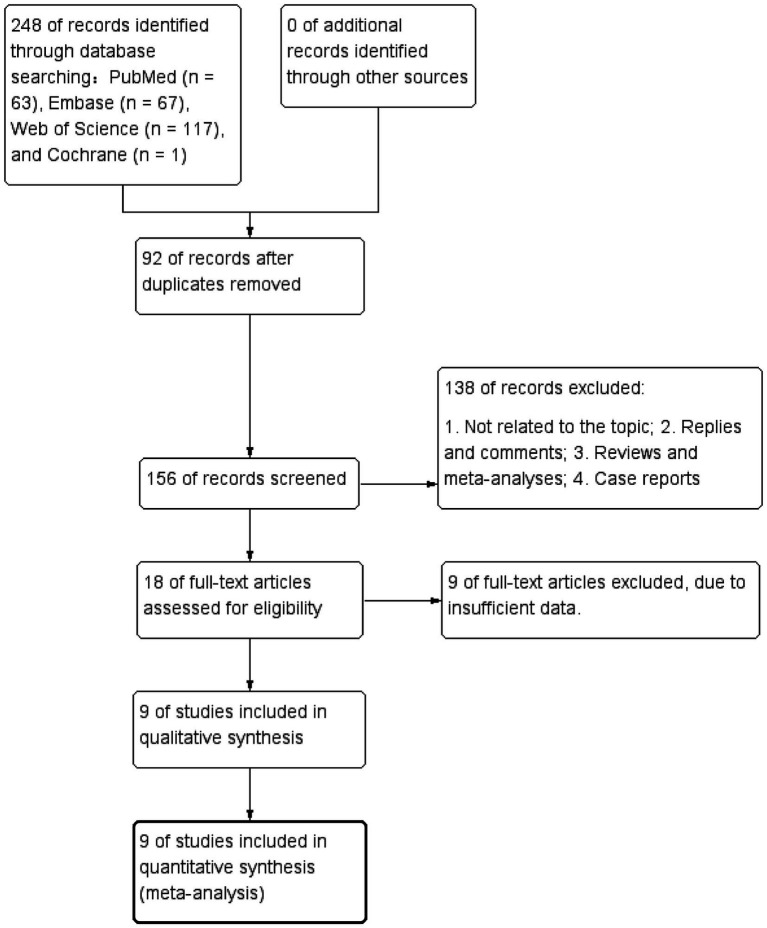
Methods: A systematic literature search was conducted in PubMed, Web of Science, Embase, and The Cochrane Library databases up to March 2024. The QUADAS-2 tool was used to assess study quality. Stata 15.0 and Review Manager 5.4.1 were used for statistical analysis. Outcomes included combined sensitivity (Sen), specificity (Spe), positive likelihood ratio (+LR), negative likelihood ratio (-LR), diagnostic odds ratio (DOR), and their 95% confidence intervals (CI), as well as pre-test and post-test probabilities. The SROC curve was plotted, and the area under the curve (AUC) was calculated. Publication bias and small-study effects were assessed using the Deeks' funnel plot.
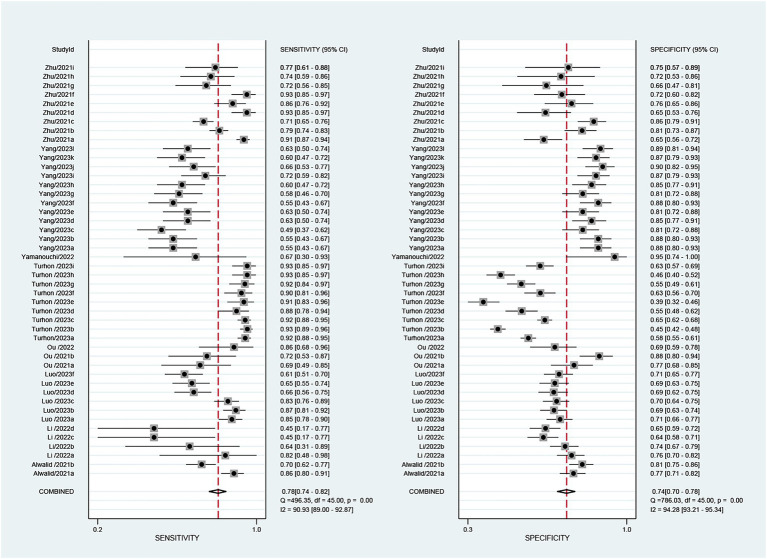
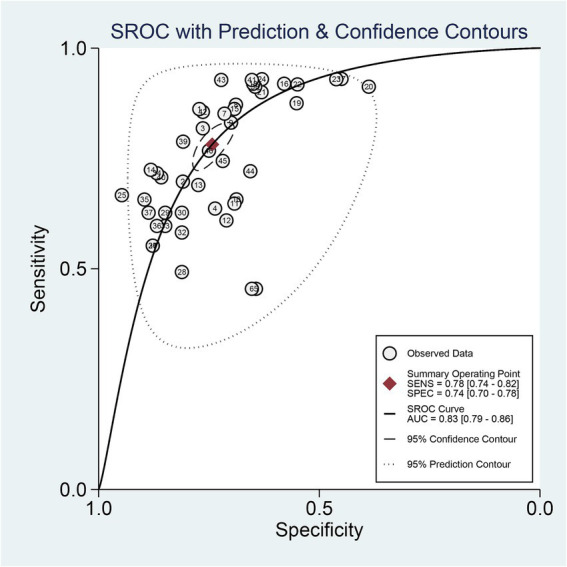
Results: The 9 included studies reported 4,284 patients, with 1,411 patients with intracranial aneurysm rupture (prevalence 32.9%). The overall performance of radiomics for predicting intracranial aneurysm rupture showed a combined Sen of 0.78 (95% CI: 0.74-0.82), Spe of 0.74 (95% CI: 0.70-0.78), +LR of 3.0 (95% CI: 2.7-3.4), -LR of 0.29 (95% CI: 0.25-0.35), DOR of 10 (95% CI: 9-12), and AUC of 0.83 (95% CI: 0.79-0.86). Significant heterogeneity was observed in both Sen (I2 = 90.93, 95% CI: 89.00-92.87%) and Spe (I2 = 94.28, 95% CI: 93.21-95.34%).
Conclusion: Radiomics can improve the diagnostic efficacy of intracranial aneurysm rupture. More large-sample, prospective, multicenter clinical studies are needed to further evaluate its predictive value.
Systematic review registration: https://www.crd.york.ac.uk/PROSPERO/.
Keywords: diagnosis; intracranial aneurysm rupture; meta-analysis; radiomics; systematic review.
Copyright © 2024 Wang, Xu, Fan, Liu, Li, Kong and Zhao.
Conflict of interest statement
The remaining authors declare that the research was conducted in the absence of any commercial or financial relationships that could be construed as a potential conflict of interest.
Figures



References
Publication types
LinkOut - more resources
Full Text Sources
