. 2024 Nov 1;16(11):evae233.
doi: 10.1093/gbe/evae233.

Genomes of Microtus Rodents Highlight the Importance of Olfactory and Immune Systems in Their Fast Radiation

Affiliations

Genomes of Microtus Rodents Highlight the Importance of Olfactory and Immune Systems in Their Fast Radiation

Alexandre Gouy et al. Genome Biol Evol. .

Abstract

The characterization of genes and biological functions underlying functional diversification and the formation of species is a major goal of evolutionary biology. In this study, we investigated the fast radiation of Microtus voles, one of the most speciose group of mammals, which shows strong genetic divergence despite few readily observable morphological differences. We produced an annotated reference genome for the common vole, Microtus arvalis, and resequenced the genomes of 10 different species and evolutionary lineages spanning the Microtus speciation continuum. Our full-genome sequences illustrate the recent and fast diversification of this group, and we identified genes in highly divergent genomic windows that have likely particular roles in their radiation. We found three biological functions enriched for highly divergent genes in most Microtus species and lineages: olfaction, immunity and metabolism. In particular, olfaction-related genes (mostly olfactory receptors and vomeronasal receptors) are fast evolving in all Microtus species indicating the exceptional importance of the olfactory system in the evolution of these rodents. Of note is e.g. the shared signature among vole species on Olfr1019 which has been associated with fear responses against predator odors in rodents. Our analyses provide a genome-wide basis for the further characterization of the ecological factors and processes of natural and sexual selection that have contributed to the fast radiation of Microtus voles.

Keywords: arvicolinae; genome scan; rapid evolution; reference genome; rodent diversification; voles.


Figures

Fig. 1.
Fig. 1.
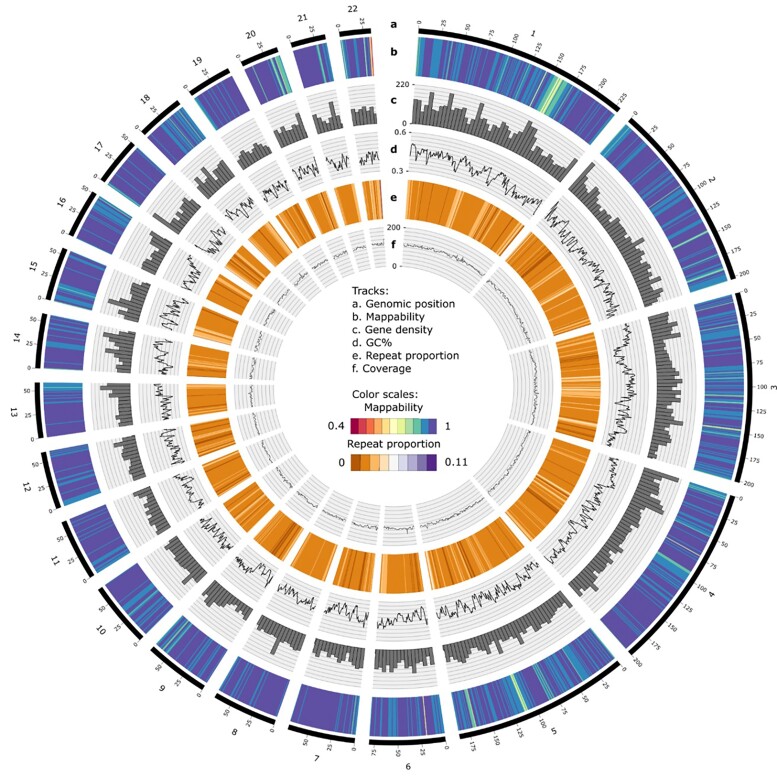
Circos plot representing basic metrics along the M. arvalis genome computed over 1 Mb windows (except for gene density that is represented over 5 Mb windows). The outer track a) represents genomic position in Mb along the 22 largest scaffolds. Then, from the most external to the most internal track, we report: the mappability b), the number of genes per 5 Mb bins c), GC content d), proportion of repeats e), and depth of coverage of the sequenced individual f).
Fig. 2.
Fig. 2.
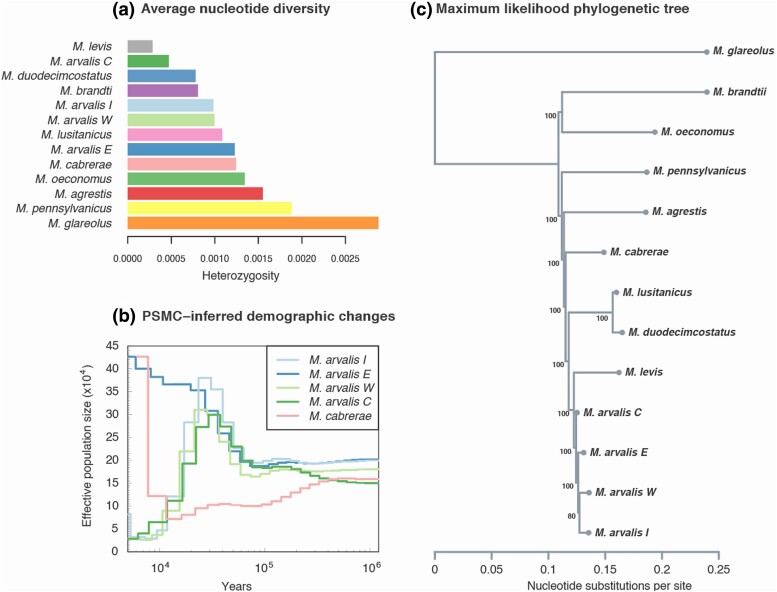
Broad patterns of diversity and divergence of resequenced individuals. Panel a) corresponds to the average nucleotide diversity (shown as heterozygosity) value per individual. PSMC-inferred effective population size evolution of five samples including the 4 M. arvalis lineages is also represented b). This population size estimated assumes a mutation rate of 8.7 × 10⁻⁹ per base pair per generation and a generation time of 0.5 yr. Finally, in panel c) we show the maximum-likelihood phylogenetic tree obtained with RAxML. The number of bootstrap replicates supporting this tree topology out of 100 is indicated next to each ancestral node.
Fig. 3.
Fig. 3.
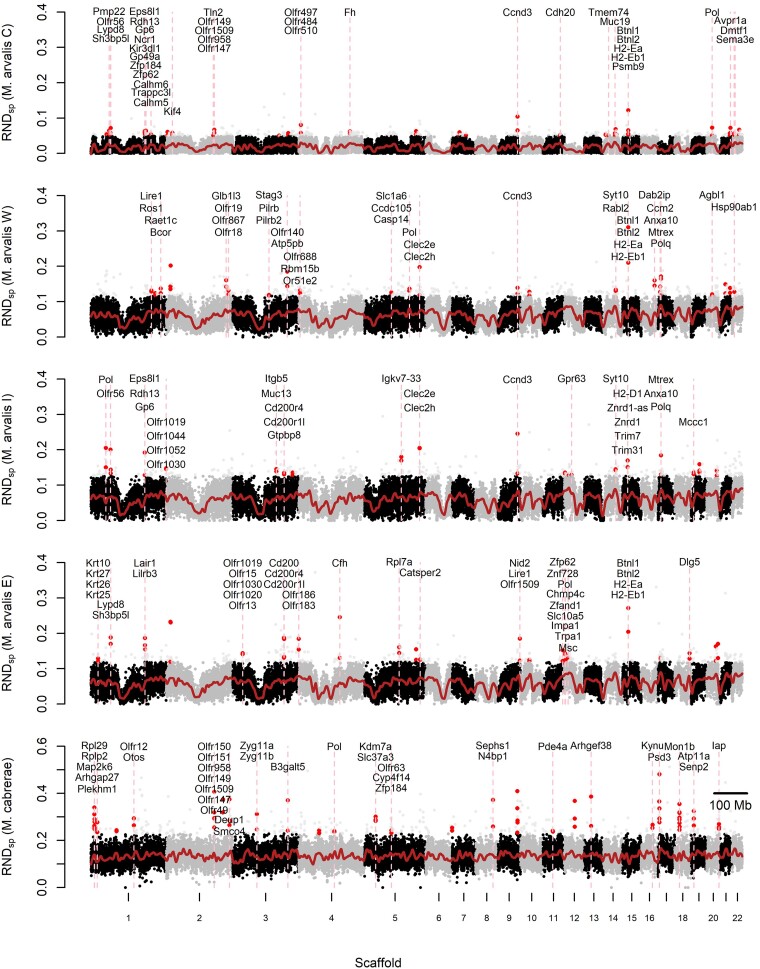
Genome scan for regions of high divergence in M. arvalis individuals and M. cabrerae (for other species, see supplementary fig. S6, Supplementary Material online and S7). For each sample, RNDsp values computed along 50 kb nonoverlapping windows are represented along the 22 largest scaffolds (gray and black colors indicate the alternance between scaffolds) against its closest relative which has the lowest dxy. The red line corresponds to a loess smoothing of RNDsp values. Red dots identify 50 kb windows found in stretches where at least two out of three consecutive windows have an RNDsp value in the top 1% of all values. Genes overlapping with such windows are mentioned along vertical pink lines.
Fig. 4.
Fig. 4.
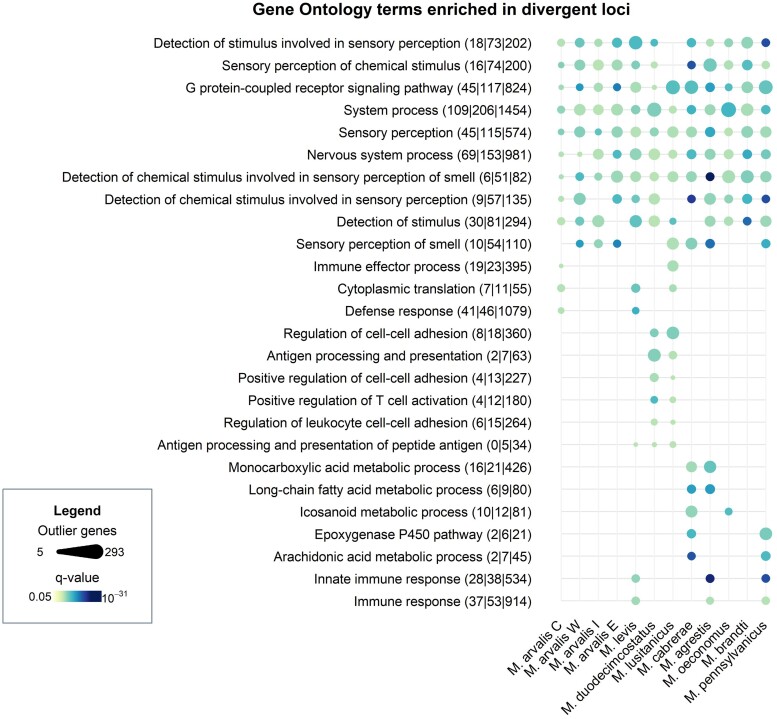
GO terms enriched for highly divergent genes found in more than one Microtus vole species. Each dot represents a significant GO term (FDR < 0.05) in a given species. Dot size is proportional to the number of outlier genes within this GO term, and darker colors indicate more significant enrichment tests (lower q-value). Enrichment tests have been performed using all genes found in the top 1% divergent genomic windows (see Materials and Methods). Each row is labeled with the GO term description and numbers between parentheses indicating i) the number of highly divergent genes that are specific to any genome, ii) is total number of highly divergent genes in this GO term, and iii) the total number of genes in this GO term that have been tested.
Fig. 5.
Fig. 5.
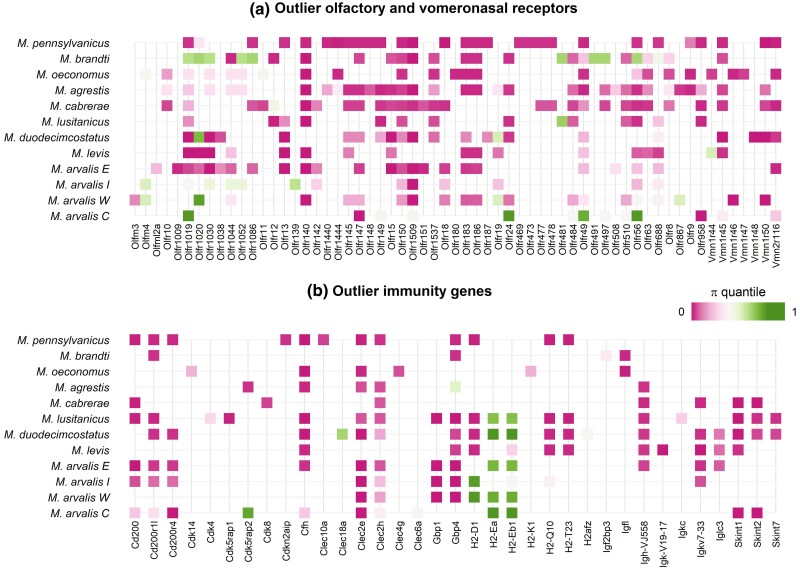
Patterns of diversity at a) olfactory and vomeronasal receptors and b) immunity genes found in the top 1% divergent windows of multiple or single Microtus species. The color of the square corresponds to the nucleotide diversity of the outlier window, expressed as the quantile of the focal genome's diversity distribution (low diversity is pink, high diversity is green).
Fig. 6.
Fig. 6.
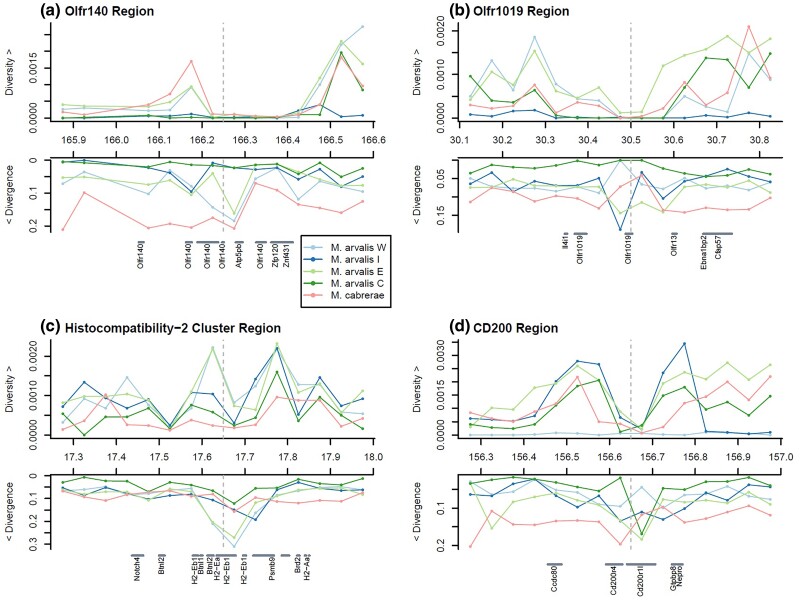
Zooms on patterns of diversity and divergence among three of the most significantly divergent windows in M. arvalis individuals and M. cabrerae: a) the Olfr140 region on scaffold 3, b) the Olfr1019 region on scaffold 3 c) the Histocompatibility-2 (H2) cluster region on scaffold 15 and d) the CD200 region on scaffold 3. For each of the five selected individuals (four M. arvalis lineages and M. cabrerae), window-based average nucleotide diversity (π) and RNDsp are represented along a 1 Mb region surrounding the most divergent window on average (indicated with a dashed gray vertical line).

References

    1. Auer TO, Khallaf MA, Silbering AF, Zappia G, Ellis K, Álvarez-Ocaña R, Arguello JR, Hansson BS, Jefferis GSXE, Caron SJC, et al. Olfactory receptor and circuit evolution promote host specialization. Nature 2020:579(7799):402–408. 10.1038/s41586-020-2073-7. - DOI - PMC - PubMed
    1. Baca M, Popović D, Lemanik A, Bañuls-Cardona S, Conard NJ, Cuenca-Bescós G, Desclaux E, Fewlass H, Garcia JT, Hadravova T, et al. Ancient DNA reveals interstadials as a driver of common vole population dynamics during the last glacial period. J Biogeogr. 2023:50(1):183–196. 10.1111/jbi.14521. - DOI

    1. Barbosa S, Paupério J, Pavlova SV, Alves PC, Searle JB. The Microtus voles: resolving the phylogeny of one of the most speciose mammalian genera using genomics. Mol Phylogenet Evol. 2018:125:85–92. 10.1016/j.ympev.2018.03.017. - DOI - PubMed
    1. Bastos-Silveira C, Santos SM, Monarca R, Mathias M, Heckel G. Deep mitochondrial introgression and hybridization among ecologically divergent vole species. Mol Ecol. 2012:21(21):5309–5323. 10.1111/mec.12018. - DOI - PubMed
    1. Belton J-M, McCord RP, Gibcus JH, Naumova N, Zhan Y, Dekker J. Hi–C: a comprehensive technique to capture the conformation of genomes. Methods 2012:58(3):268–276. 10.1016/j.ymeth.2012.05.001. - DOI - PMC - PubMed

Substances