


Mental health issues and the association of mental health literacy among adolescents in urban Ethiopia
- PMID: 39446875
- PMCID: PMC11500858
- DOI: 10.1371/journal.pone.0295545
Mental health issues and the association of mental health literacy among adolescents in urban Ethiopia
Abstract
Background: Epidemiological evidence about the prevalence of adolescent mental health issues and their association with mental health literacy is crucial for sustained mental health promotion strategies. Adolescence is a critical life stage for mental health promotion. However, evidence is not available among Ethiopian school adolescents. Hence, the present study examined the prevalence of adolescents' mental health issues and their correlation with mental health literacy.
Materials and methods: A cross-sectional study was conducted among adolescents (grades 5-12) in Dire Dawa city, Eastern Ethiopia using multistage random sampling. Data was collected using the Strength and Difficulty Questionnaire, WHO-5 well-being index, and mental health literacy questionnaire. SPSS version 25 was used for the descriptive, Chi-square, binary logistic regression, and correlation analyses.
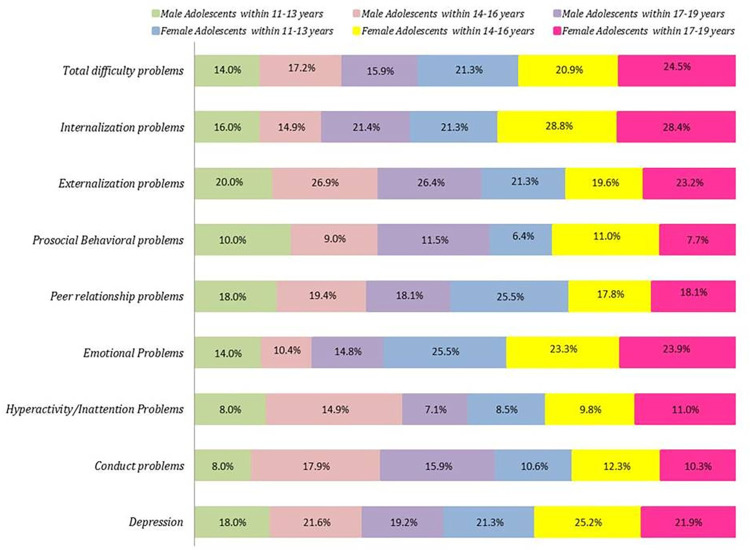
Results: Between 14.0-24.5% of adolescents had reported mental health problems: internalizing problems (14.9-28.8%), emotional problems (10.4-25.5%), and peer relationship problems (17.8-25.5%). These mental health problems were significantly greater among adolescents who had either themselves or their family members used psychoactive substances (p≤0.05). Females from upper elementary (5-8 grade) and lower secondary (9-10) grade levels had a higher prevalence of mental health problems (AOR: 2.60 (0.95-7.10, p<0.05)). The effect of age, parental education, or employment status was insignificant (p>0.05). The prevalence of depression ranged from 18.0-25.5%. Mental health literacy was negatively correlated with total difficulties scores and positively associated with mental well-being scores (p<0.05).
Conclusion: The prevalence of adolescents' mental health problems was higher. It implied that promoting mental health literacy could enhance adolescents' positive mental health. Intervention programs should prioritize vulnerable groups and individuals reporting symptoms of mental health difficulties. Future studies should involve qualitative studies and consider effect of other determinants.
Copyright: © 2024 Hassen et al. This is an open access article distributed under the terms of the Creative Commons Attribution License, which permits unrestricted use, distribution, and reproduction in any medium, provided the original author and source are credited.
Conflict of interest statement
The authors have declared that no competing interests exist.
Figures
References
-
- Renwick L, Pedley R, Johnson I, Bell V, Lovell K, Bee P, et al.. Mental health literacy in children and adolescents in low- and middle-income countries: a mixed studies systematic review and narrative synthesis. Eur Child Adolesc Psychiatry. 2022. doi: 10.1007/s00787-022-01997-6 - DOI - PMC - PubMed
-
- Kucera M, Tomaskova H, Stodola M, Kagstrom A. A Systematic Review of Mental Health Literacy Measures for Children and Adolescents. Adolesc Res Rev. 2023;8: 339–358. doi: 10.1007/s40894-022-00202-8 - DOI
-
- Ministry of Health Federal Democratic Republic of Ethiopia. Ethiopian National Mental Health Strategy (2020–2025). Fed Minist Heal. 2020;2025.
-
- Hassen HM, Behera MR, Jena PK, Dewey RS DG. Mental Health Literacy of Adolescents and the Effect of Socio- demographic Characteristics: A Cross-sectional Study. Online J Heal allied Sci. 2021;20: 2–8. Available: https://www.ojhas.org/issue80/2021-4-6.html
MeSH terms
LinkOut - more resources
Full Text Sources
Medical
