


Joint association of sedentary behavior and physical activity domains with depression in Korean adults: Cross-sectional study combining four biennial surveys (2016-2022)
- PMID: 39446918
- PMCID: PMC11500919
- DOI: 10.1371/journal.pone.0312029
Joint association of sedentary behavior and physical activity domains with depression in Korean adults: Cross-sectional study combining four biennial surveys (2016-2022)
Abstract
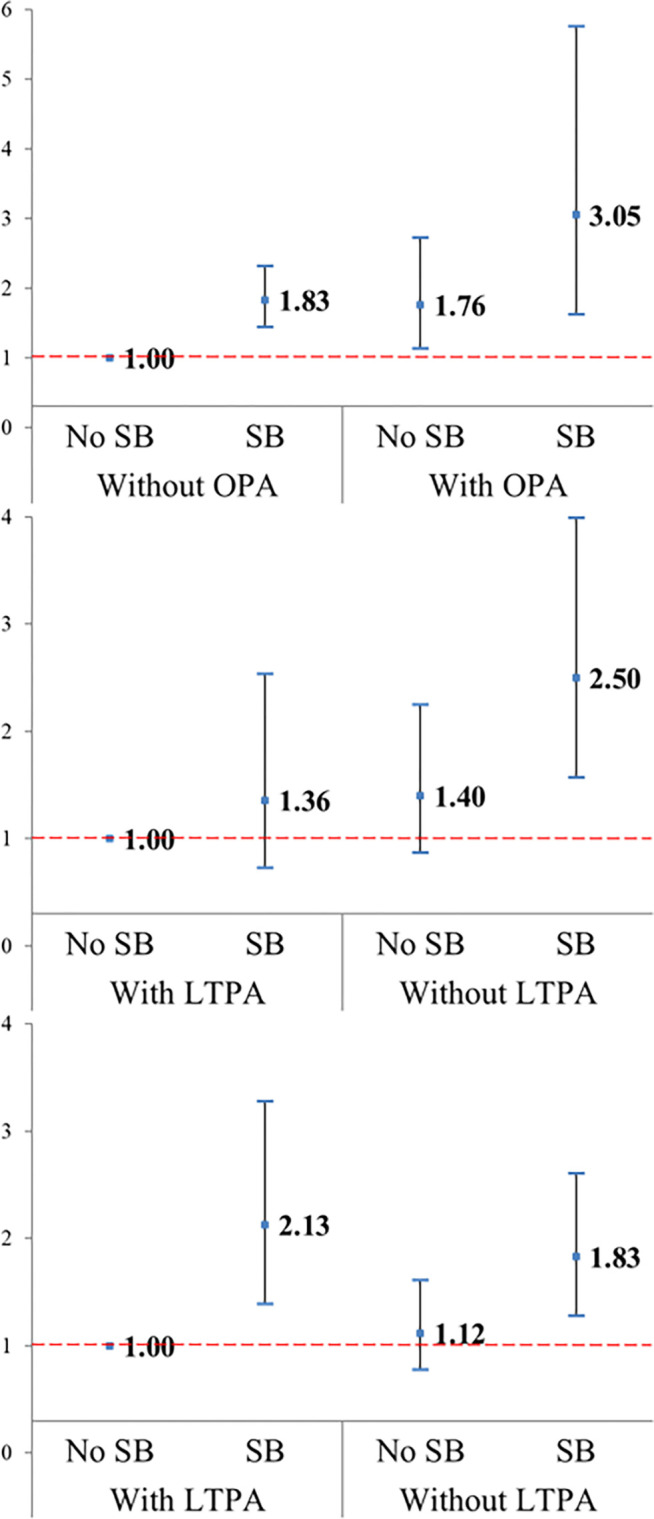
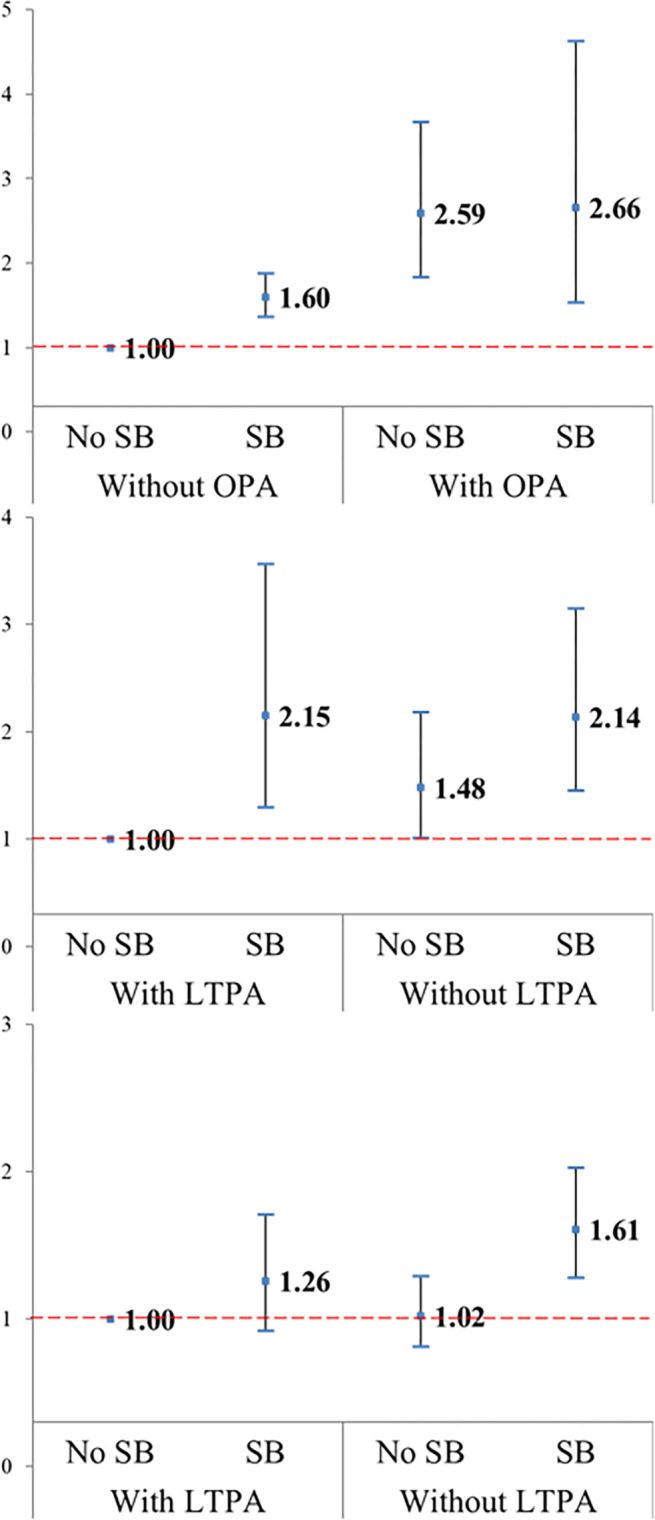
Although the increased prevalence of sedentary behavior and insufficient physical activity constitutes a global public health concern, there is limited research on their effects on mental health. We investigated the combined association of sedentary behavior (daily sitting or reclining ≥10 h/day) and physical activity domains (evaluated using the Global Physical Activity Questionnaire, including occupational physical activity, leisure-time physical activity, and transportation-related physical activity) with depression (Patient Health Questionnaire-9, cutoff score: 10). This cross-sectional study utilized biennial data of 21,416 adults (age >20 years) from the Korea National Health and Nutrition Examination Survey waves 7-9 (2016-2022). Joint associations were explored by combining sedentary behavior and each physical activity domain into four levels. Sedentary behavior and occupational physical activity increased the risk of depression, leisure-time physical activity decreased the risk only in men, and transportation-related physical activity showed no significant association. Logistic regression each physical activity domain revealed, for men and women, a significantly higher risk of depression in the sedentary behavior (+)/occupational physical activity (+) group than in the sedentary behavior (-)/occupational physical activity (-) group (odds ratio: 3.05 and 2.66, respectively). The sedentary-behavior (+)/leisure-time physical-activity (-) group showed a significantly higher risk of depression than the sedentary behavior (-)/leisure-time physical activity (+) group (odds ratio: 2.50 and 2.14), and sedentary behavior (+)/transportation-related physical activity (-) group also showed a significantly higher risk of depression compared to the sedentary behavior (-)/transportation-related physical activity (+) group (odds ratio: 1.83 and 1.61). With concurrent exposure to sedentary behavior, the occupational physical activity and lack of leisure time and transportation-related physical activity synergistically increased the risk of depression. Encouraging leisure-time physical activity, minimizing rigorous occupational physical activity, and reducing sedentary behavior may reduce depressive symptoms, and research into specific domains of sedentary behavior and the quantity and quality of transportation-related physical activity is needed.
Copyright: © 2024 Park, Lee. This is an open access article distributed under the terms of the Creative Commons Attribution License, which permits unrestricted use, distribution, and reproduction in any medium, provided the original author and source are credited.
Conflict of interest statement
The authors have declared that no competing interests exist.
Figures
Similar articles
-
Examining total and domain-specific sedentary behaviour using the socio-ecological model - a cross-sectional study of Irish adults.BMC Public Health. 2019 Aug 22;19(1):1155. doi: 10.1186/s12889-019-7447-0. BMC Public Health. 2019. PMID: 31438911 Free PMC article.
-
Correlates of Total and domain-specific Sedentary behavior: a cross-sectional study in Dutch adults.BMC Public Health. 2020 Feb 12;20(1):220. doi: 10.1186/s12889-020-8316-6. BMC Public Health. 2020. PMID: 32050958 Free PMC article.
-
Joint associations of sedentary behavior and domain-specific physical activity on C-reactive protein in Korea.Prev Med. 2024 May;182:107944. doi: 10.1016/j.ypmed.2024.107944. Epub 2024 Apr 6. Prev Med. 2024. PMID: 38588827
-
Physical activity, sedentary behavior, and postnatal depressive symptoms: a review.Am J Prev Med. 2013 Aug;45(2):217-27. doi: 10.1016/j.amepre.2013.04.004. Am J Prev Med. 2013. PMID: 23867030 Review.
-
Job strain as a risk factor for leisure-time physical inactivity: an individual-participant meta-analysis of up to 170,000 men and women: the IPD-Work Consortium.Am J Epidemiol. 2012 Dec 15;176(12):1078-89. doi: 10.1093/aje/kws336. Epub 2012 Nov 9. Am J Epidemiol. 2012. PMID: 23144364 Free PMC article. Review.
Cited by
-
Prevalence and Associated Factors of Dynapenia, Pre-Sarcopenia, and Sarcopenia in Korean Adults: A Cross-Sectional Epidemiological Study.Medicina (Kaunas). 2025 Mar 24;61(4):575. doi: 10.3390/medicina61040575. Medicina (Kaunas). 2025. PMID: 40282866 Free PMC article.
References
-
- Meyer J, McDowell C, Lansing J, Brower C, Smith L, Tully M, et al.. Changes in physical activity and sedentary behavior in response to COVID-19 and their associations with mental health in 3052 US adults. Int J Environ Res Public Health. 2020;17: 6469. doi: 10.3390/ijerph17186469 - DOI - PMC - PubMed
MeSH terms
LinkOut - more resources
Full Text Sources
Medical
