Machine Learning to Predict Interim Response in Pediatric Classical Hodgkin Lymphoma Using Affordable Blood Tests
- PMID: 39447089
- PMCID: PMC11529834
- DOI: 10.1200/GO.23.00435
Machine Learning to Predict Interim Response in Pediatric Classical Hodgkin Lymphoma Using Affordable Blood Tests
Abstract
Purpose: Response assessment of classical Hodgkin lymphoma (cHL) with positron emission tomography-computerized tomography (PET-CT) is standard of care in well-resourced settings but unavailable in most African countries. We aimed to investigate correlations between changes in PET-CT findings at interim analysis with changes in blood test results in pediatric patients with cHL in 17 South African centers.
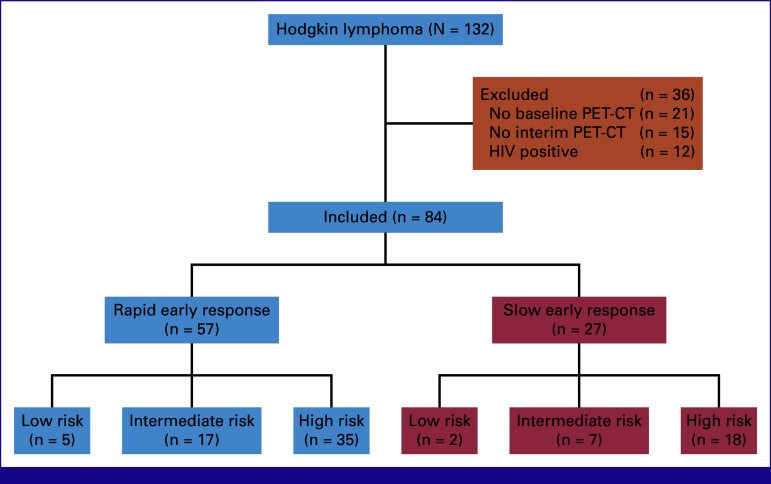
Methods: Changes in ferritin, lactate dehydrogenase (LDH), erythrocyte sedimentation rate (ESR), albumin, total white cell count (TWC), absolute lymphocyte count (ALC), and absolute eosinophil count were compared with PET-CT Deauville scores (DS) after two cycles of doxorubicin, bleomycin, vinblastine, and dacarbazine in 84 pediatric patients with cHL. DS 1-3 denoted rapid early response (RER) while DS 4-5 denoted slow early response (SER). Missing values were imputed using the k-nearest neighbor algorithm. Baseline and follow-up blood test values were combined into a single difference variable. Data were split into training and testing sets for analysis using Python scikit-learn 1.2.2 with logistic regression, random forests, naïve Bayes, and support vector machine classifiers.
Results: Random forest analysis achieved the best validated test accuracy of 73% when predicting RER or SER from blood samples. When applied to the full data set, the optimal model had a predictive accuracy of 80% and a receiver operating characteristic AUC of 89%. The most predictive variable was the differences in ALC, contributing 21% to the model. Differences in ferritin, LDH, and TWC contributed 15%-16%. Differences in ESR, hemoglobin, and albumin contributed 11%-12%.
Conclusion: Changes in low-cost, widely available blood tests may predict chemosensitivity for pediatric cHL without access to PET-CT, identifying patients who may not require radiotherapy. Changes in these nonspecific blood tests should be assessed in combination with clinical findings and available imaging to avoid undertreatment.
Conflict of interest statement
The following represents disclosure information provided by authors of this manuscript. All relationships are considered compensated unless otherwise noted. Relationships are self-held unless noted. I = Immediate Family Member, Inst = My Institution. Relationships may not relate to the subject matter of this manuscript. For more information about ASCO's conflict of interest policy, please refer to
Open Payments is a public database containing information reported by companies about payments made to US-licensed physicians (
No other potential conflicts of interest were reported.
Figures


References
-
- World Health Organization : CureAll framework: WHO global initiative for childhood cancer: Increasing access, advancing quality, saving lives. World Health Organization, 2021. https://apps.who.int/iris/handle/10665/347370
-
- Mauz-Körholz C, Metzger ML, Kelly KM, et al. : Pediatric Hodgkin lymphoma. J Clin Oncol 33:2975-2985, 2015 - PubMed
-
- Vorster M, Doruyter A, Brink A, et al. : Recommendations: Appropriate indications for positron emission tomography/computed tomography, 2015. South Afr Med J 106:105-122, 2015 - PubMed
MeSH terms
Substances
LinkOut - more resources
Full Text Sources
Medical
Miscellaneous