


Risk factors for refractory respiratory distress syndrome among very-low-birth-weight infants
- PMID: 39448962
- PMCID: PMC11515632
- DOI: 10.1186/s12887-024-05138-7
Risk factors for refractory respiratory distress syndrome among very-low-birth-weight infants
Abstract
Background: The objective was to evaluate refractory respiratory distress syndrome (RDS) risk factors among very-low-birth-weight infants (VLBWIs).
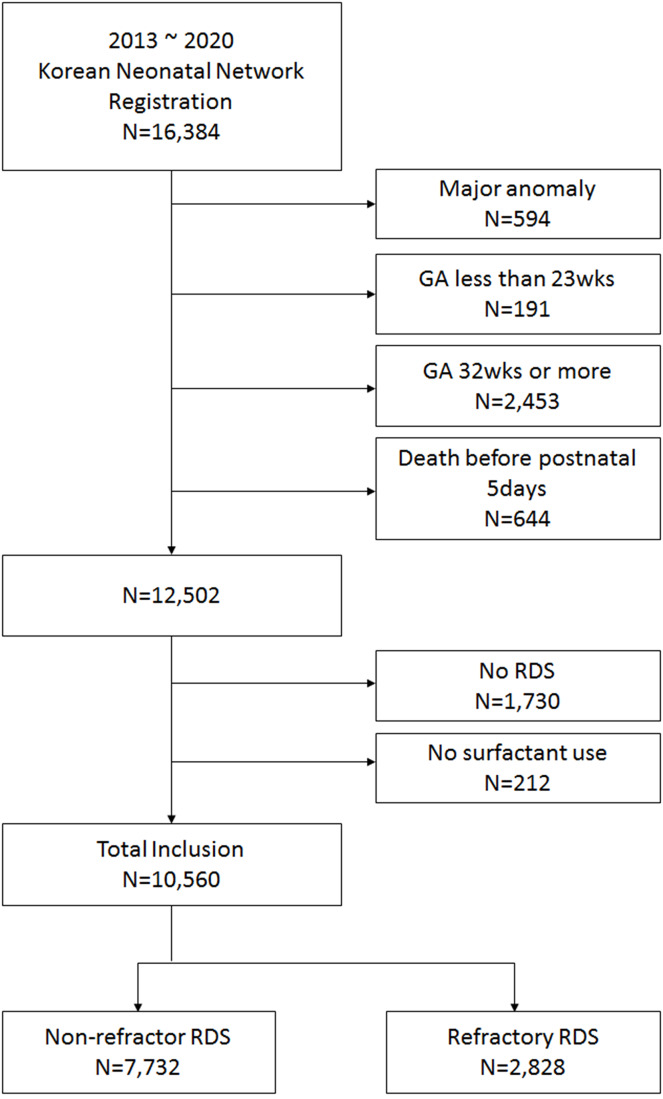
Method: The data of VLBWIs born between January 2013 and December 2020 registered in the Korean Neonatal Network (KNN) were analyzed. Infants who died within 5 postnatal days or who were not given surfactant were excluded. Infants were divided into a well-responding RDS group, which received surfactant replacement therapy (SRT) only once, and a refractory RDS group, which received SRT twice or more. The associations between perinatal characteristics and refractory RDS were investigated via multivariate logistic regression analysis.
Results: Multivariate logistic regression analysis revealed that low gestational age (adjusted odds ratio [aOR] = 1.26, 95% confidence interval (CI) [1.23, 1.26], male sex (aOR = 1.17, 95% CI [1.06, 1.29]), cesarean section (aOR = 1.59, 95% CI [1.38, 1.80]), maternal hypertensive disorder (aOR = 1.54, 95% CI[1.35, 1.75]), and low 5-minute Apgar scores (aOR = 1.24, 95% CI [1.12, 1.37]) were significantly associated with refractory RDS. Antenatal corticosteroid use (aOR = 0.81, 95% CI [0.73, 0.89]) and maternal chorioamnionitis (aOR = 0.79, 95% CI [0.71, 0.88]) were significantly inversely associated with refractory RDS. Compared with well-responding RDS, refractory RDS was significantly associated with increased major neonatal morbidity and mortality risk at 5 postnatal days.
Conclusion: Maternal hypertensive disorder is a significant risk factor for refractory RDS. Refractory RDS was associated with unfavorable neonatal outcomes.
Keywords: Preeclampsia; Pregnancy-induced hypertension; Respiratory distress syndrome; Surfactant; Very-low-birth-weight infant.
© 2024. The Author(s).
Conflict of interest statement
The authors declare no competing interests.
Figures
References
-
- Eras Z, Zeybek C, Akansel R, Yildirim S, Simsek DG, Turkyilmaz C, et al. Neurodevelopmental outcomes of very low birth weight preterm infants treated with poractant alfa versus beractant for respiratory distress syndrome. Am J Perinatol. 2014;31(6):463–8. - PubMed
-
- Bancalari E. Antenatal infections and respiratory outcome in preterm infants. Am J Perinatol. 2020;37:S02. - PubMed
MeSH terms
Substances
LinkOut - more resources
Full Text Sources
