


Macroscale Gradient Dysfunction in Alzheimer's Disease: Patterns With Cognition Terms and Gene Expression Profiles
- PMID: 39449114
- PMCID: PMC11502409
- DOI: 10.1002/hbm.70046
Macroscale Gradient Dysfunction in Alzheimer's Disease: Patterns With Cognition Terms and Gene Expression Profiles
Abstract
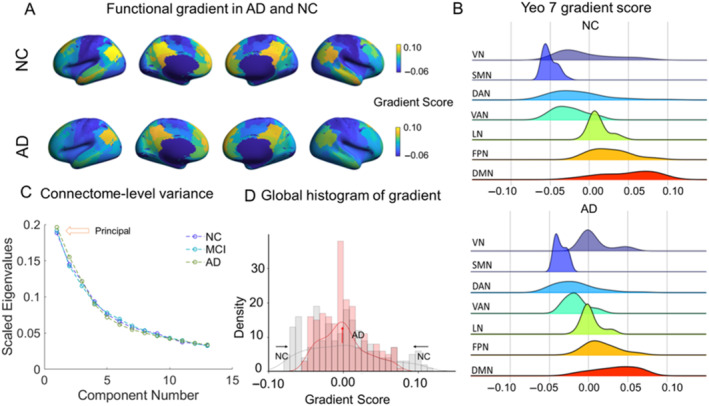
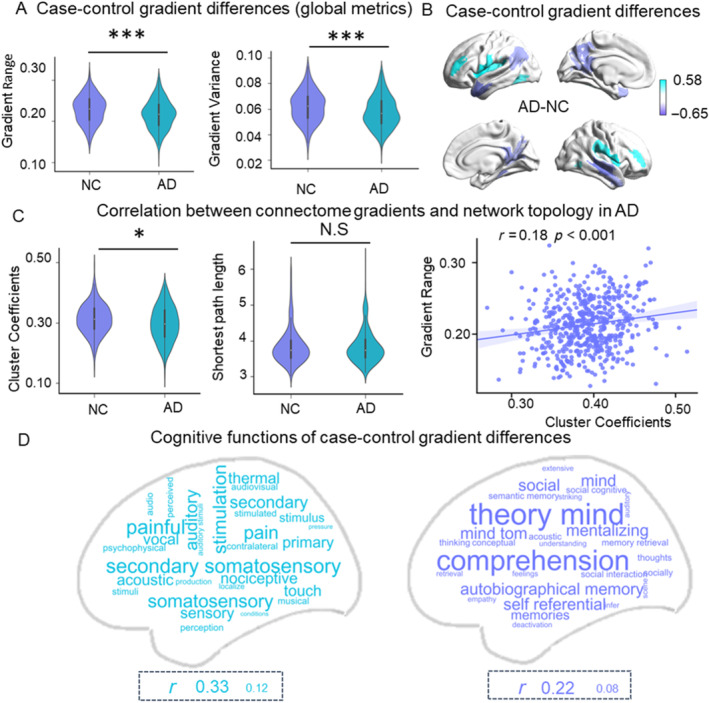
Macroscale functional gradient techniques provide a continuous coordinate system that extends from unimodal regions to transmodal higher-order networks. However, the alterations of these functional gradients in AD and their correlations with cognitive terms and gene expression profiles remain to be established. In the present study, we directly studied the functional gradients with functional MRI data from seven scanners. We adopted data-driven meta-analytic techniques to unveil AD-associated changes in the functional gradients. The principal primary-to-transmodal gradient was suppressed in AD. Compared to NCs, AD patients exhibited global connectome gradient alterations, including reduced gradient range and gradient variation, increased gradient scores in the somatomotor, ventral attention, and frontoparietal regions, and decreased in the default mode network. More importantly, the Gene Ontology terms of biological processes were significantly enriched in the potassium ion transport and protein-containing complex remodeling. Our compelling evidence provides a new perspective in understanding the connectome alterations in AD.
Keywords: Alzheimer's disease; functional gradient; microscale transcriptome profile.
© 2024 The Author(s). Human Brain Mapping published by Wiley Periodicals LLC.
Figures

References
Publication types
MeSH terms
Grants and funding
LinkOut - more resources
Full Text Sources
Medical
