


The Effect of Isometric Exercise Position on the Effectiveness of Isolated Work of the Thigh Flexor Muscles Based on the Results of the sEMG Study
- PMID: 39449382
- PMCID: PMC11503410
- DOI: 10.3390/clinpract14060174
The Effect of Isometric Exercise Position on the Effectiveness of Isolated Work of the Thigh Flexor Muscles Based on the Results of the sEMG Study
Abstract
Backgroud: The main function of the hamstring muscles is to bend the knee joint and support the function of the hip extensors. Their frequent injuries are the result of overload related to, among others, dynamic running or jumping, and inadequate preparation for athletics activities. The asymmetry of the work of individual flexor muscle groups is clearly marked in the case of valgus or varus of the knee joint, i.e., in different positions of the lower limb. The aim of the study was to determine the position and form of a rehabilitation exercise in which an isolated group of muscles flexing the knee joint will show the greatest bioelectrical activity.
Methods: The study involved 25 students of the Jagiellonian University Medical College. The students were aged 20-26. The average age was 22.9 (±1.4). The study participants included 17 women with an average age of 23.0 (±1.1) and 8 men with an average age of 22.6 (±1.9). Women constituted 68% and men 32% of all respondents. All participants agreed to participate in the study. Surface electromyography measurements in both lower limbs provided an initial number of 50 cases. The activity of the knee flexor muscles during isometric contraction with resistance was measured in correlation with three foot and lower leg settings: internal rotation, neutral position, and external rotation. The bioelectrical activity of the semitendinosus muscle is significantly higher (p < 0.01) in the internal rotation position than in the neutral position of the lower leg, while the bioelectrical activity of the biceps femoris muscle is inversely higher (p < 0.01) in the external rotation position than in the neutral position.
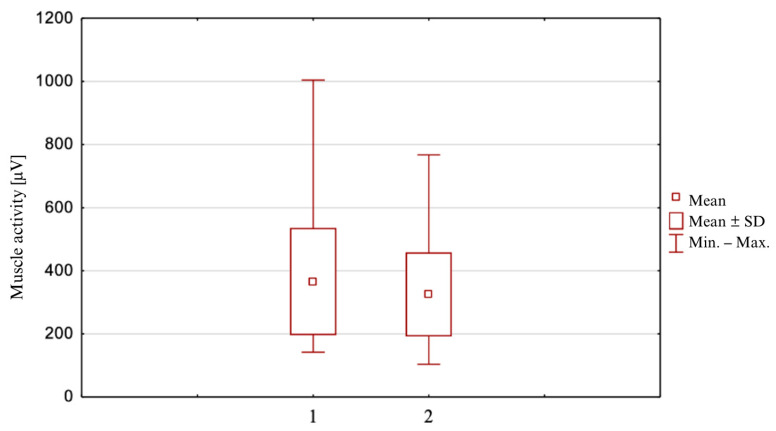
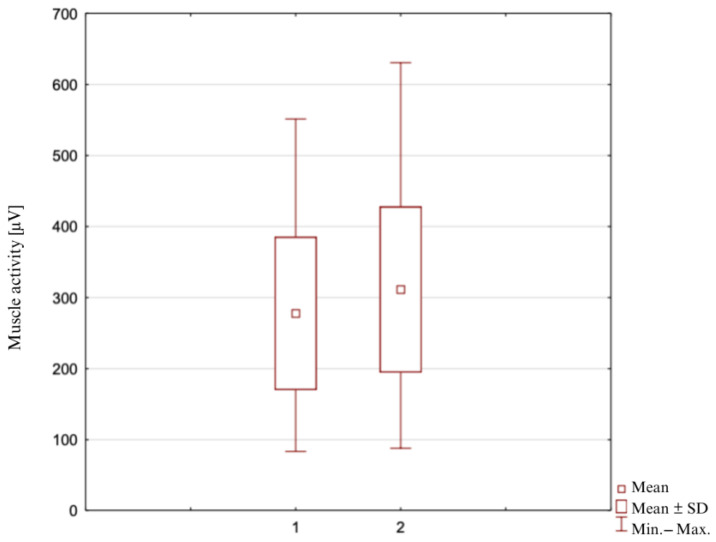
Results: The results are significant for both average and maximum values of muscle stimulation. During isometric contraction with resistance, the semitendinosus muscle shows the greatest bioelectrical activity in the internal rotation position of the lower leg and foot, and the biceps femoris muscle in the external rotation position of the lower leg and foot.
Conclusions: The above information has important implicational applications when improving isolated groups of hamstrings. In the future, this may contribute to more effective rehabilitation of patients with injuries of the muscles described in the article.
Keywords: activity muscles; biceps femoris; hamstrings; injury; lower limb; sEMG; sport.
Conflict of interest statement
The authors declare no conflicts of interest.
Figures


References
-
- Dolman B., Verrall G., Reid I. Physical principles demonstrate that the biceps femoris muscle relative to the other hamstring muscles exerts the most force: Implications for hamstring muscle strain injuries. Muscles Ligaments Tendons J. 2014;4:371–377. doi: 10.11138/mltj/2014.4.3.371. - DOI - PMC - PubMed
-
- Biernat R., Lemiesz G. Postępowanie rehabilitacyjne w przypadku urazu grupy tylnej mięśni uda (kulszowo-goleniowej)—Doniesienie wstępne. Rocz. Nauk. AWFiS W Gdańsku. 2008;18:43–50.
LinkOut - more resources
Full Text Sources
