


Cardiac Troponin Levels in Patients with Chronic Kidney Disease: "Markers of High Risk or Just Noise''?
- PMID: 39451639
- PMCID: PMC11507122
- DOI: 10.3390/diagnostics14202316
Cardiac Troponin Levels in Patients with Chronic Kidney Disease: "Markers of High Risk or Just Noise''?
Abstract
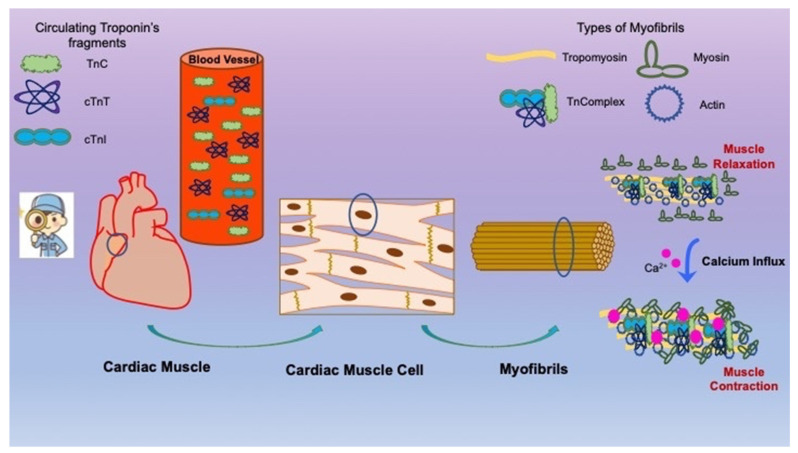
Kidney disease is linked to the development of cardiovascular disorders, further increasing morbidity and mortality in this high-risk population. Thus, early detection of myocardial damage is imperative in order to prevent devastating cardiovascular complications within this patient group. Over the years, cardiac biomarkers have been identified and are now widely used in everyday clinical practice. More specifically, available data suggest that cardiac troponin and its regulatory subunits (TnT, TnI, and TnC) reflect the injury and necrosis of myocardial tissue. While cTnC is identical in cardiac and skeletal muscle, TnT and TnI constitute cardiac-specific forms of troponin, and, as such, they have been established by international societies as biomarkers of cardiac damage and diagnostic indicators for acute myocardial infarction. Elevations in the levels of both cardiac troponins (cTnT and cTnI) have been also reported in asymptomatic patients suffering from chronic kidney disease. Therefore, if abnormal, they often generate confusion among clinicians regarding the interpretation and clinical significance of their numerical values in emergency settings. The aim of this review is to explore the reasons behind elevated troponin levels in patients with chronic kidney disease and identify when these elevated levels of biomarkers indicate the need for urgent intervention, considering the high cardiovascular risk in this patient group.
Keywords: biomarkers; cardiovascular risk; chronic kidney disease; high-sensitivity cardiac troponin; troponin.
Conflict of interest statement
Angelos Evangelopoulos is employed by Roche Diagnostics (Hellas) SA. All views expressed here are solely of the co-author.
Figures
References
-
- National Institutes of Health. National Institute of Diabetes and Digestive and Kidney Diseases US Renal Data System, USRDS 2000 Annual Data Report. Bethesda, Md: National Institutes of Health, National Institute of Diabetes and Digestive and Kidney Diseases. [(accessed on 12 September 2003)];2000 Available online: http://www.usrds.org/atlas_2000.htm.
-
- Anavekar N.S., McMurray J.J., Velazquez E., JSolomon S.D., Kober L., Rouleau J.L., White H.D., Nordlander R., Maggioni A., Dickstein K., et al. Relation between renal dysfunction and cardiovascular outcomes after myocardial infarction. N. Engl. J. Med. 2004;351:1285–1295. doi: 10.1056/NEJMoa041365. - DOI - PubMed
-
- Ohtake T., Kobayashi S., Moriya H., Negishi K., Okamoto K., Maesato K., Saito S. High prevalence of occult coronary artery stenosis in patients with chronic kidney disease at the initiation of renal replacement therapy: An angiographic examination. J. Am. Soc. Nephrol. 2005;16:1141–1148. doi: 10.1681/ASN.2004090765. - DOI - PubMed
Publication types
LinkOut - more resources
Full Text Sources
Research Materials
Miscellaneous
