


Influence of Continuous Rotation and Optimal Torque Reverse Kinematics on the Cyclic Fatigue Strength of Endodontic NiTi Clockwise Cutting Rotary Instruments
- PMID: 39452445
- PMCID: PMC11506770
- DOI: 10.3390/dj12100317
Influence of Continuous Rotation and Optimal Torque Reverse Kinematics on the Cyclic Fatigue Strength of Endodontic NiTi Clockwise Cutting Rotary Instruments
Abstract
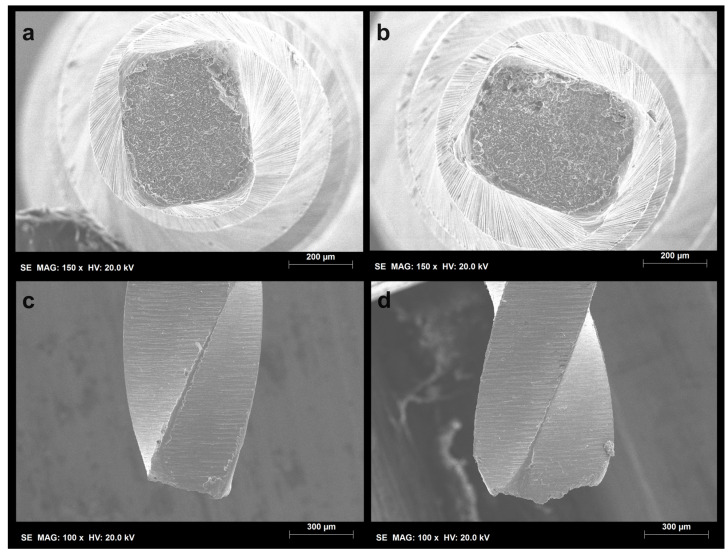
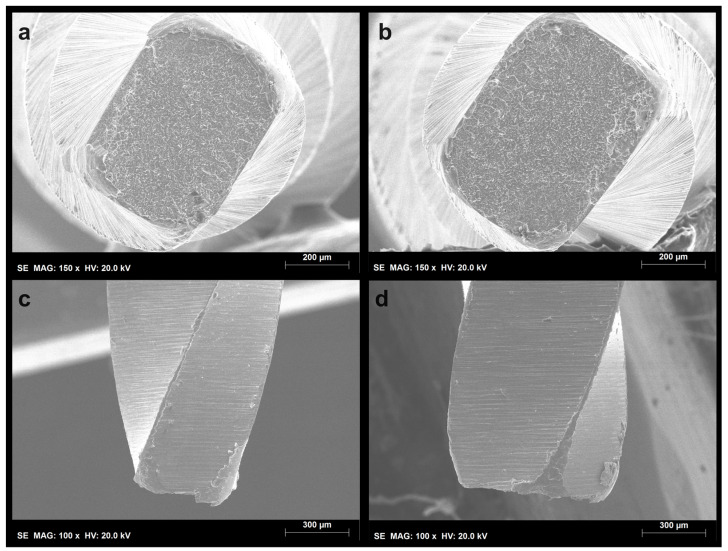
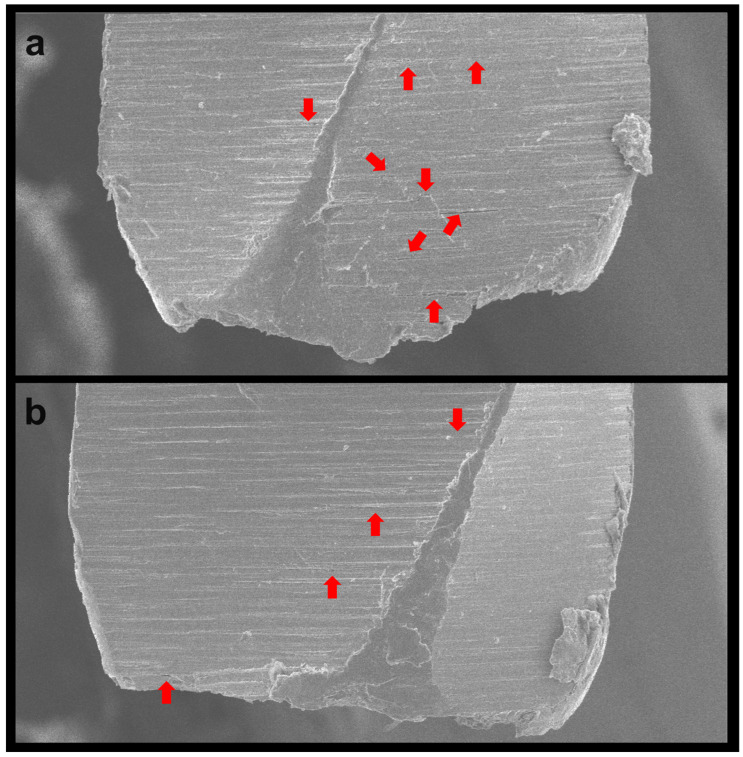
Objectives: The objective of the present study was to evaluate the cyclic fatigue strength of clockwise cutting rotary endodontic instruments when subjected to two different kinematics: continuous clockwise rotation and clockwise reciprocation movement under optimum torque reverse (OTR) motion. Methods: New ProTaper Next X1 (n = 20) and X2 (n = 20) instruments were randomly divided into two subgroups (n = 10) based on kinematics (continuous rotation or OTR). The specimens were tested using a custom-made device with a non-tapered stainless-steel artificial canal measuring 19 mm in length, featuring a 6 mm radius and an 86-degree curvature. All instruments were tested with a lubricant at room temperature until a fracture occurred. The time to fracture and the length of the separated fragment were recorded. Subsequently, the fractured instruments were inspected under a scanning electron microscope for signs of cyclic fatigue failure, plastic deformation, and/or crack propagation. The subgroup comparisons for time to fracture and instrument length were performed using the independent samples t-test, with the level of statistical significance set at 0.05. Results: When using OTR movement, the ProTaper Next X1 increased the time to fracture from 52.9 to 125.8 s (p < 0.001), while the ProTaper Next X2 increased from 45.4 to 66.0 s (p < 0.001). No subgroup exhibited plastic deformations, but both showed dimpling marks indicative of cyclic fatigue as the primary mode of failure. Additionally, OTR movement resulted in more metal alloy microcracks. Conclusions: The use of OTR motion extended the lifespan of the tested instruments and resulted in a higher number of metal microcracks. This suggests that OTR motion helped to distribute the mechanical stress more evenly across the instrument, thereby relieving localized tension. As a result, it delayed the formation of a single catastrophic crack, enhancing the overall performance of the instruments during the experimental procedures.
Keywords: cyclic fatigue; endodontics; kinematics; reciprocation; root canal therapy; scanning electron microscope.
Conflict of interest statement
The authors declare no conflicts of interest.
Figures
References
-
- Hülsmann M., Peters O.A., Dummer P.M. Mechanical preparation of root canals: Shaping goals, techniques and means. Endod. Top. 2005;10:30–76. doi: 10.1111/j.1601-1546.2005.00152.x. - DOI
-
- Puentes C.G., Jaime A., Versiani M. Evolução dos instrumentos endodônticos: Das limas manuais ao movimento reciprocante. In: De Deus G., Silva E., Souza E., Versiani M., Zuolo M., editors. O Movimento Reciprocante na Endodontia. 1st ed. Quintessence Publishing; São Paulo, Brazil: 2017. pp. 49–75.
LinkOut - more resources
Full Text Sources
Research Materials
