


How is the quality of randomized controlled trials (RCTs) for acupuncture treatment of post-stroke aphasia? A report quality assessment
- PMID: 39453955
- PMCID: PMC11508150
- DOI: 10.1371/journal.pone.0308704
How is the quality of randomized controlled trials (RCTs) for acupuncture treatment of post-stroke aphasia? A report quality assessment
Abstract
Objective: This study aimed to assess the quality of randomized controlled trials (RCTs) that have reported the use of acupuncture for the treatment of post-stroke aphasia (PSA).
Methods: We systematically searched PubMed, Embase, Cochrane Library, Web of Science, Chinese National Knowledge Infrastructure (CNKI), Wanfang data Information Site, and China Science and Technology Journal Database from January 2013 to June 2023. RCTs utilizing acupuncture as an intervention for the treatment of post-stroke aphasia were included in this study. The overall quality score (OQS) of RCTs was independently evaluated by two researchers using the Consolidated Standards for Reporting Trials (CONSORT) and the Standards for Reporting Interventions in Controlled Trials of Acupuncture (STRICTA) guidelines, with the agreement between researchers calculated using Cohen's kappa statistics.
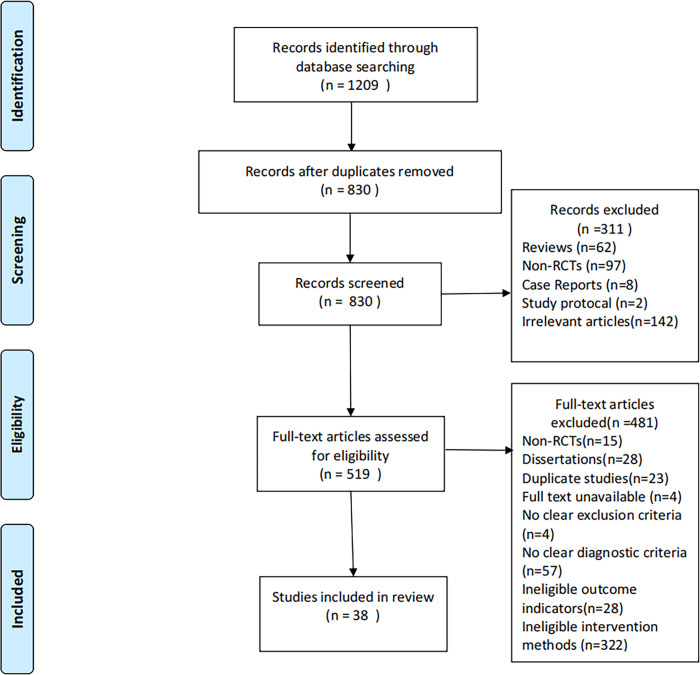
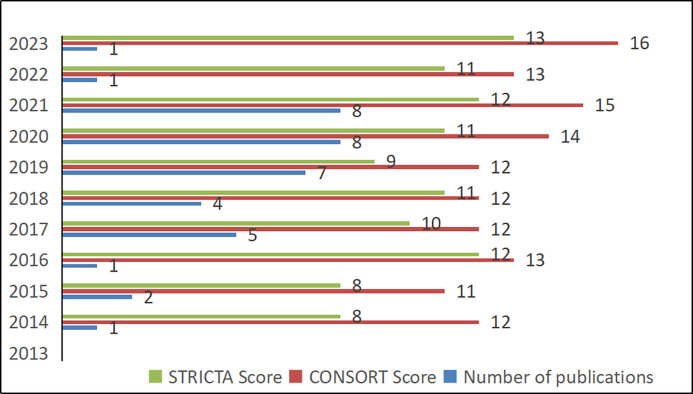
Results: In conclusion, we included 38 RCTs in this study. The median OQS of the 38 RCTs was 13 (minimum 8, maximum 20) based on the CONSORT statement. Out of all CONSORT items, 10 (27%) had a positive rate of greater than 80%, while 17 (46%) had a positive rate of less than 10%. The median OQS of the 38 RCTs was 12 (minimum 6, maximum 14) based on the STRICTA guideline. Within the STRICTA guideline, 6 items (35%) had a positive rate of greater than 80%, and 3 items (18%) had a positive rate of less than 10%. Most items based on the CONSORT and STRICTA guidelines were observed to have a perfect or good degree of agreement.
Conclusions: The overall reporting quality of RCTs for acupuncture treatment of PSA was found to be suboptimal. Notably, the reporting quality of the STRICTA guideline is higher compared to the CONSORT statement. Therefore, strict adherence to both the CONSORT and STRICTA statements is recommended to enhance the quality of RCT reports on acupuncture treatment for post-stroke aphasia.
Copyright: © 2024 Qin et al. This is an open access article distributed under the terms of the Creative Commons Attribution License, which permits unrestricted use, distribution, and reproduction in any medium, provided the original author and source are credited.
Conflict of interest statement
The authors have declared that no competing interests exist.
Figures
References
-
- Campbell B, De Silva D A, Macleod M R, et al. Ischaemic stroke[J]. Nat Rev Dis Primers, 2019,5(1):70. - PubMed
-
- Global, regional, and national disability-adjusted life-years (DALYs) for 359 diseases and injuries and healthy life expectancy (HALE) for 195 countries and territories, 1990–2017: a systematic analysis for the Global Burden of Disease Study 2017[J]. Lancet, 2018,392(10159):1859–1922. - PMC - PubMed
-
- Ferro J M, Caeiro L, Figueira M L. Neuropsychiatric sequelae of stroke[J]. Nat Rev Neurol, 2016,12(5):269–280. - PubMed
-
- Stefaniak J D, Halai A D, Lambon R M. The neural and neurocomputational bases of recovery from post-stroke aphasia[J]. Nat Rev Neurol, 2020,16(1):43–55. - PubMed
MeSH terms
LinkOut - more resources
Full Text Sources
Medical
Research Materials
Miscellaneous
