


Frozen no more, a case study of Arctic permafrost impacts of oil and gas withdrawal
- PMID: 39455746
- PMCID: PMC11511952
- DOI: 10.1038/s41598-024-76292-2
Frozen no more, a case study of Arctic permafrost impacts of oil and gas withdrawal
Abstract
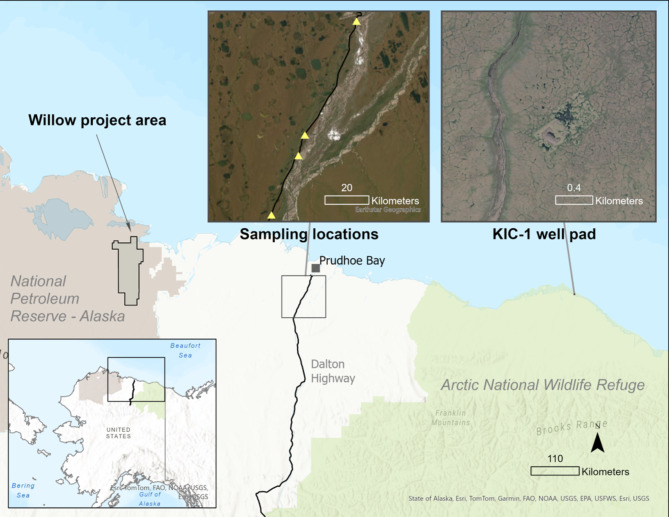
Approximately 8100 km2 of Alaska are leased to the oil and gas industry for exploration and extraction. According to industry estimates, subsurface expansion from these leases could cover up to 130.2 km2 per pad. As industrial oil extraction activities increase across the thawing Alaskan permafrost, impacts on the permafrost environment will include rapid thaw, increased hydrological flux, and the release of climate warming greenhouse gases. Here, we use remote sensing and field observations to provide a first-order comparison of the direct impacts to the permafrost tundra from oil well pads, and the long-term consequences of a legacy oil pads on the warming North Slope of Alaska. We find that oil well pads on the permafrost accelerate permafrost degradation and persist despite remediation.
© 2024. The Author(s).
Conflict of interest statement
The authors declare no competing interests.
Figures


References
-
- Szabo, D. J. & Meyers, K. O. Prudhoe Bay: Development History and Future Potential. in (OnePetro, 1993). 10.2118/26053-MS.
-
- Arctic National Wildlife Refuge, 1002 Area, Petroleum Assessment, 1998, Including Economic Analysis. https://pubs.usgs.gov/fs/fs-0028-01/fs-0028-01.htm.
-
- Fountain, H. Here’s what oil drilling looks like in the Arctic Refuge, 30 Years Later. The New York Times (2017).
-
- Mystery surrounds only oil well drilled in ANWR - Anchorage Daily News.
-
- Jorgenson, M. T. & Jorgenson, J. C. Arctic Connections to Global Warming and Health. in Climate Change and Global Public Health (eds. Pinkerton, K. E. & Rom, W. N.) 91–110 (Springer International Publishing, Cham, 2021). 10.1007/978-3-030-54746-2_5.
Grants and funding
LinkOut - more resources
Full Text Sources
Research Materials
