Review
. 2024 Oct 25;24(1):347.
doi: 10.1186/s12935-024-03528-6.

A review of current developments in RNA modifications in lung cancer

Affiliations
Review

A review of current developments in RNA modifications in lung cancer

Shujun Zhang et al. Cancer Cell Int. .

Abstract

Lung cancer has the highest incidence and mortality rates worldwide and is the primary cause of cancer-related death. Despite the rapid development of diagnostic methods and targeted drugs in recent years, many lung cancer patients do not benefit from effective therapies. The emergence of drug resistance has led to a reduction in the therapeutic effectiveness of targeted drugs, highlighting a crucial need to explore novel therapeutic targets. Many studies have found that epigenetic plays an important role in the occurrence of lung cancer. This review describes the biological function of epigenetic RNA modifications, such as m6A, m5C, m7G, and m1A, and recent advancements in their role in the development, progression, and prognosis of lung cancer. This review aims to provide new guidance for the treatment of lung cancer.

Keywords: Epigenetic; Lung cancer; NSCLC; RNA modification.


Conflict of interest statement

The authors declare no competing interests.

Figures

Fig. 1
Fig. 1
Molecular mechanism of m6A modification involved in progression of NSCLC. A HNRNPA2B1 is increased in NSCLC and regulates lncRNA MEG3 through recognition of m6A, contributing to NSCLC tumorigenesis. B The m6A reader IGF2BP3 recognizes the m6A modification on MCM5 mRNA and increases MCM5 expression, thereby promoting the metastasis of LUAD cells. C Upregulation of the m6A writer METTL3, downregulation of m6A eraser ALKBH5, and upregulation of m6A reader YTHDF1 promote ENO1 mRNA translation by mediating m6A modification, thereby increasing cytoplasmic glycolysis and LUAD progression. D The IGF2BP3-COX6B2 axis mediates TKI resistance in NSCLC by promoting OXPHOS
Fig. 2
Fig. 2
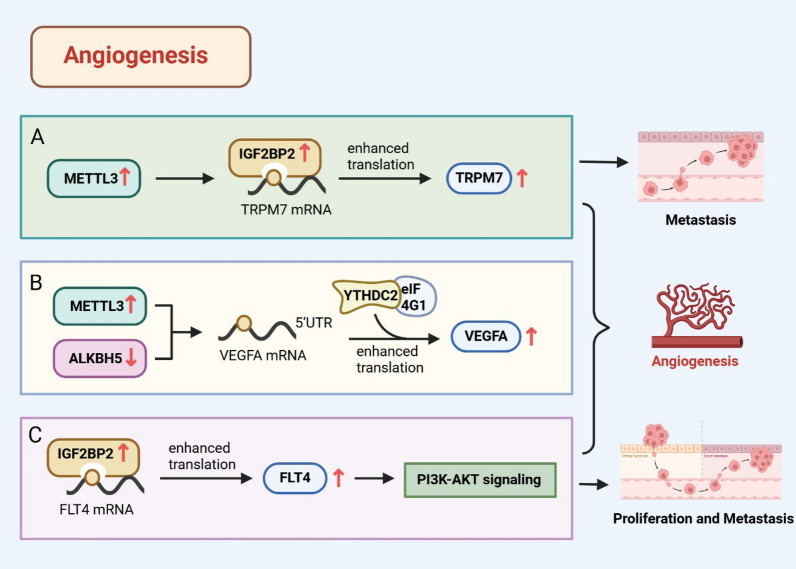
m6A regulatory protein affects lung cancer angiogenesis by regulating the expression of related proteins. A High expression of m6A writer METTL3 and reader IGF2BP2 influence lung cancer angiogenesis and metastasis by modulating TRPM7 expression. B High expression of METTL3 or low expression of ALKBH5 accelerates the angiogenesis of lung cancer by increasing the expression of VEGF-A. C The expression of IGF2BP2 increases in LUAD tumor cells and modulates the expression of FLT4 by mediating m6A modification. This promotes the angiogenesis and metastasis of lung adenocarcinoma by activating the PI3K–AKT pathway
Fig. 3
Fig. 3
Mechanisms of ferroptosis mediated by m6A and m5C modifications in NSCLC. A High expression of IGF2BP3 in LUAD enhances the mRNA stability and expression level of anti-ferroptosis factor through m6A modification, inhibiting iron ferroptosis and promoting LUAD progression. B Exosome miR-4443 negatively regulates METTL3, promoting the expression of FSP1 and regulating iron death by regulating m6A modification. C m5C writer NSUN2 is highly expressed in NSCLC tumor cells, and m5C modification is mediated in the NRF2 mRNA 5ʹUTR region recognized by m5C reader YBX1. The stability of NRF2 mRNA is enhanced, leading to the upregulation of NRF2 expression and inhibiting ferroptosis
Fig. 4
Fig. 4
Molecular mechanisms of m5C modification involved in the progression of NSCLC. A YBX1 recognizes m5C methylation in PFKFB4 mRNA and induces an increase in PFKFB4 expression, thus promoting the progression of LUSC. B NSUN2 enhances the stability of downstream target PIK3R2 mRNA by regulating m5C modification, thereby activating the PI3K–AKT signal and promoting the malignant progression of LUAD. C The NSUN2-YBX1-QSOX1 axis mediates TKI resistance in NSCLC patients. D LINC02159 binds to ALYREF and activates downstream Hippo and Wnt/β-catenin pathways by mediating m5C to upregulate YAP1 expression, contributing to carcinogenesis
Fig. 5
Fig. 5
METTL3 induces m6A methylation of DCP2, degrading DCP2 and promoting mitochondrial autophagy through the Pink1–Parkin pathway, leading to chemotherapy resistance in SCLC

References

    1. Sung H, Ferlay J, Siegel RL, Laversanne M, Soerjomataram I, Jemal A, Bray F. Global cancer statistics 2020: GLOBOCAN Estimates of incidence and mortality worldwide for 36 cancers in 185 countries. CA A Cancer J Clin. 2021;71(3):209–49. - PubMed
    1. Liu Y, Ao X, Yu W, Zhang Y, Wang J. Biogenesis, functions, and clinical implications of circular RNAs in non-small cell lung cancer. Mol Ther Nucleic Acids. 2022;27:50–72. - PMC - PubMed
    1. Torre LA, Siegel RL, Jemal A. Lung cancer statistics. Adv Exp Med Biol. 2016;893:1–19. - PubMed
    1. Dong J, Li B, Lin D, Zhou Q, Huang D. Advances in targeted therapy and immunotherapy for non-small cell lung cancer based on accurate molecular typing. Front Pharmacol. 2019;10:230. - PMC - PubMed
    1. Orsolic I, Carrier A, Esteller M. Genetic and epigenetic defects of the RNA modification machinery in cancer. Trends in Genet TIG. 2023;39(1):74–88. - PubMed

LinkOut - more resources