. 2024 Oct 19;14(10):1332.
doi: 10.3390/biom14101332.

Identification of Multifunctional Putative Bioactive Peptides in the Insect Model Red Palm Weevil (Rhynchophorus ferrugineus)

Affiliations

Identification of Multifunctional Putative Bioactive Peptides in the Insect Model Red Palm Weevil (Rhynchophorus ferrugineus)

Carmen Scieuzo et al. Biomolecules. .

Abstract

Innate immunity, the body's initial defense against bacteria, fungi, and viruses, heavily depends on antimicrobial peptides (AMPs), which are small molecules produced by all living organisms. Insects, with their vast biodiversity, are one of the most abundant and innovative sources of AMPs. In this study, AMPs from the red palm weevil (RPW) Rhynchophorus ferrugineus (Coleoptera: Curculionidae), a known invasive pest of palm species, were examined. The AMPs were identified in the transcriptomes from different body parts of male and female adults, under different experimental conditions, including specimens collected from the field and those reared in the laboratory. The RPW transcriptomes were examined to predict antimicrobial activity, and all sequences putatively encoding AMPs were analyzed using several machine learning algorithms available in the CAMPR3 database. Additionally, anticancer, antiviral, and antifungal activity of the peptides were predicted using iACP, AVPpred, and Antifp server tools, respectively. Physicochemical parameters were assessed using the Antimicrobial Peptide Database Calculator and Predictor. From these analyses, 198 putatively active peptides were identified, which can be tested in future studies to validate the in silico predictions. Genome-wide analysis revealed that several AMPs have predominantly emerged through gene duplication. Noticeably, we detect a newly originated defensin allele from an ancestral defensin via the deletion of two amino acids following gene duplication in RPW, which may confer an enhanced resilience to microbial infection. Our study shed light on AMP gene families and shows that high duplication and deletion rates are essential to achieve a diversity of antimicrobial mechanisms; hence, we propose the RPW AMPs as a model for exploring gene duplication and functional variations against microbial infection.

Keywords: ACPs; AFPs; AVPs; antimicrobial peptides; bioinformatic tools; gene duplication; transcriptome.


Conflict of interest statement

The authors declare no conflicts of interest. P.F., B.A., and A.P. may have a financial interest in RPW AMP(s) patent applications related to drug development.

Figures
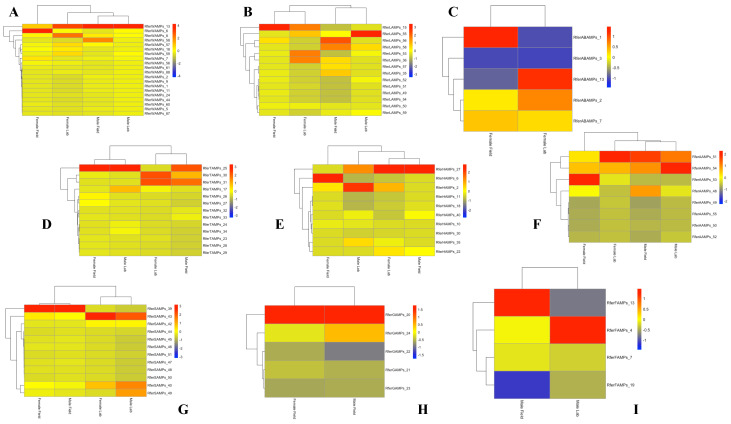
Figure 1
Figure 1
Heatmap showing the expression levels of duplicated genes in the different body parts of Rhynchophorus ferrugineus lab-reared and field-collected male and female adults. The heatmap colors represent transcript abundance in transcripts per million (TPM) from highest (red) to lowest (blue) expression levels. The data represented as log-transformed TPM values were tabulated and converted into heatmaps using R and R Studio software (version 2023.06.2+561). (A) Wings; (B) Legs; (C) Abdomen; (D) Thorax; (E) Head; (F) Antennae; (G) Snout; (H) Gut; (I) Fat Body.
Figure 2
Figure 2
Classification of the 198 total AMPs detected in adult transcriptomes related to their family classification.
Figure 3
Figure 3
Graphical display for the cecropin genes mapped in scaffold_405 (NCBI acc no. JAACXV010000404.1) showing functional cecropins gene length, CDS (coding region) length, and protein length, which was generated using the NCBI graphical sequence viewer available in the Genome workbench. The visual code shows green, red, and purple, indicating gene, coding region, and mRNA, respectively. The line shows the introns and boxes for the exons.
Figure 4
Figure 4
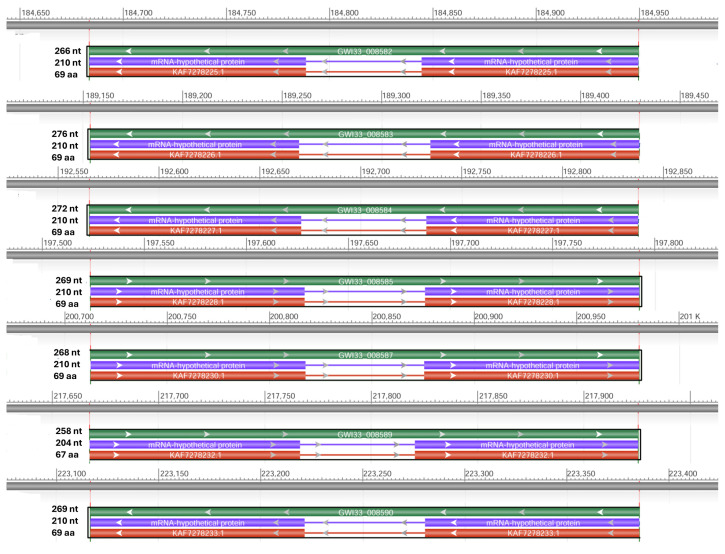
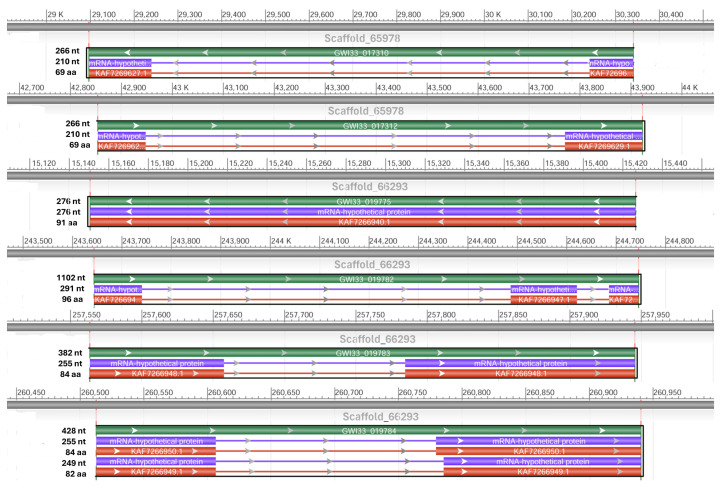
Graphical display for the defensin genes mapped in the six scaffolds (NCBI acc no. JAACXV010014362.1, JAACXV010000413.1, JAACXV010014484.1, JAACXV010014200.1, JAACXV010014575.1, and JAACXV010014362.1) showing functional gene length, CDS length, and protein length generated using the NCBI graphical sequence viewer available in the Genome workbench. The visual code shows green, red, and purple, indicating gene, coding region, and mRNA.
Figure 5
Figure 5
Two allelic variants in the locus tag “GWI33_019784” and deduced amino acids predict 82aa and 84-aa proteins (NCBI acc nos. KAF7266949 and KAF7266950), with a conserved DEFL_defensin-like domain at the C-terminal region. Dots denote identical amino acid residues, and conserved DEFL_defensin-like domain at the C-terminal region are underlined.
Figure 6
Figure 6
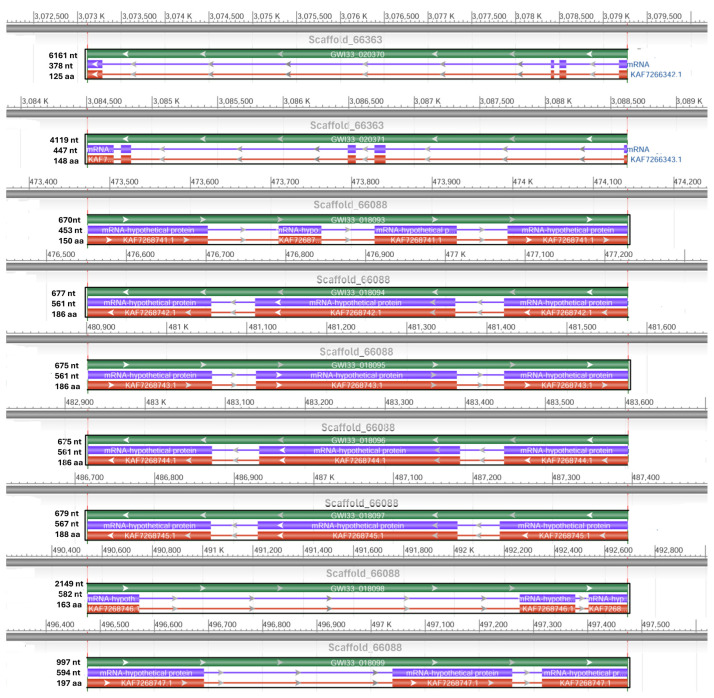
Graphical display for the hypothetical AMP genes mapped in the two scaffolds (66363 and 66088) (NCBI acc nos. JAACXV010014549.1 and JAACXV010014301.1) showing the functional AMP gene length, CDS length, and protein length generated using the NCBI graphical sequence viewer available in the Genome workbench. The visual code shows green, red, and purple, indicating gene, coding region, and mRNA, respectively. The line shows the introns and boxes for the exons.
Figure 7
Figure 7
Graphical display for the lysozyme genes mapped in the two scaffolds (66335 and 66281) (NCBI acc nos. JAACXV010014523.1 and JAACXV010014472.1) showing functional lysozyme gene length, CDS length, and protein length generated using the NCBI graphical sequence viewer available in the Genome workbench. The visual code shows green, red, and purple, indicating gene, coding region, and mRNA, respectively. The line shows the introns and boxes for the exons.

References

    1. Moretta A., Scieuzo C., Petrone A.M., Salvia R., Manniello M.D., Franco A., Lucchetti D., Vassallo A., Vogel H., Sgambato A., et al. Antimicrobial Peptides: A New Hope in Biomedical and Pharmaceutical Fields. Front. Cell. Infect. Microbiol. 2021;11:668632. doi: 10.3389/fcimb.2021.668632. - DOI - PMC - PubMed
    1. Brandenburg L.O., Merres J., Albrecht L.J., Varoga D., Pufe T. Antimicrobial peptides: Multifunctional drugs for different applications. Polymers. 2012;4:539–560. doi: 10.3390/polym4010539. - DOI
    1. Zhang Q.Y., Yan Z.B., Meng Y.M., Hong X.Y., Shao G., Ma J.J., Cheng X.R., Liu J., Kang J., Fu C.Y. Antimicrobial peptides: Mechanism of action, activity and clinical potential. Mil. Med. Res. 2021;8:48. doi: 10.1186/s40779-021-00343-2. - DOI - PMC - PubMed
    1. Mahlapuu M., Håkansson J., Ringstad L., Björn C. Antimicrobial Peptides: An Emerging Category of Therapeutic Agents. Front. Cell Infect. Microbiol. 2016;27:194. doi: 10.3389/fcimb.2016.00194. - DOI - PMC - PubMed
    1. Luong H.X., Thanh T.T., Tran T.H. Antimicrobial peptides—Advances in development of therapeutic applications. Life Sci. 2020;260:118407. doi: 10.1016/j.lfs.2020.118407. - DOI - PMC - PubMed

LinkOut - more resources