


Exploring Angiotensin II and Oxidative Stress in Radiation-Induced Cataract Formation: Potential for Therapeutic Intervention
- PMID: 39456460
- PMCID: PMC11504979
- DOI: 10.3390/antiox13101207
Exploring Angiotensin II and Oxidative Stress in Radiation-Induced Cataract Formation: Potential for Therapeutic Intervention
Abstract
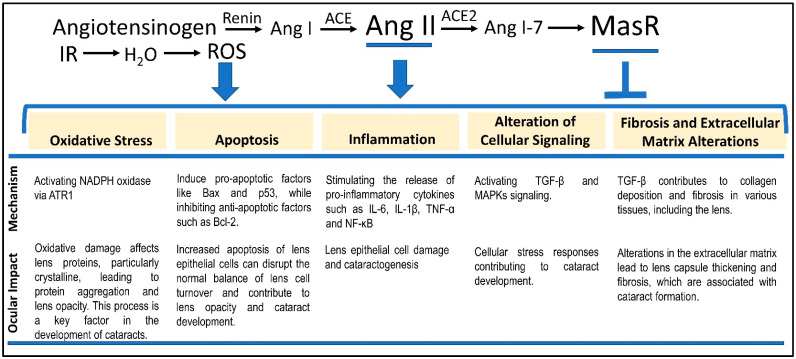
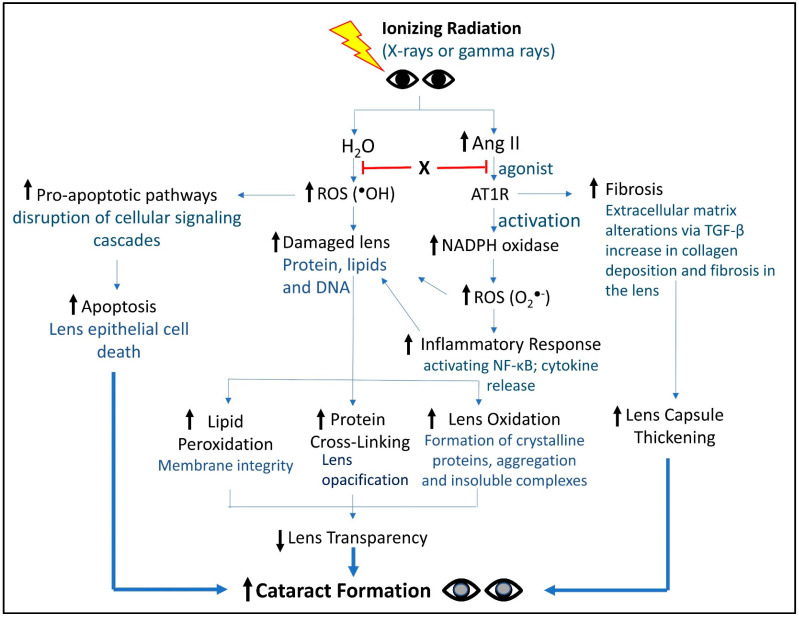
Radiation-induced cataracts (RICs) represent a significant public health challenge, particularly impacting individuals exposed to ionizing radiation (IR) through medical treatments, occupational settings, and environmental factors. Effective therapeutic strategies require a deep understanding of the mechanisms underlying RIC formation (RICF). This study investigates the roles of angiotensin II (Ang II) and oxidative stress in RIC development, with a focus on their combined effects on lens transparency and cellular function. Key mechanisms include the generation of reactive oxygen species (ROS) and oxidative damage to lens proteins and lipids, as well as the impact of Ang II on inflammatory responses and cellular apoptosis. While the generation of ROS from water radiolysis is well established, the impact of Ang II on RICs is less understood. Ang II intensifies oxidative stress by activating type 1 receptors (AT1Rs) on lens epithelial cells, resulting in increased ROS production and inflammatory responses. This oxidative damage leads to protein aggregation, lipid peroxidation, and apoptosis, ultimately compromising lens transparency and contributing to cataract formation. Recent studies highlight Ang II's dual role in promoting both oxidative stress and inflammation, which accelerates cataract development. RICs pose a substantial public health concern due to their widespread prevalence and impact on quality of life. Targeting Ang II signaling and oxidative stress simultaneously could represent a promising therapeutic approach. Continued research is necessary to validate these strategies and explore their efficacy in preventing or reversing RIC development.
Keywords: angiotensin II; lens transparency; oxidative stress; radiation-induced cataracts; therapeutic intervention.
Conflict of interest statement
M.L.B. and D.D. are founders of Trocar Pharma, a company developing radiation mitigators that target these pathways. R.D. is a consultant of Trocar Pharma. D.M. is a board member of ReAlta Holdings, LLC. M.L.B. is a founder of Shuttle Pharmaceuticals and a board member advising ReAlta Life Sciences, Inc. S.R.B is an optometrist employee of Lenscrafters. V.P.K., Y.K., R.D. D.D., and M.L.B. are involved in additional research projects investigating the utilities of the compound X using funding from NIAID and DoD. M.L.B. and Y.K. have been issued a use patent for radiation mitigator mechanisms mentioned in this review. V.P.K. and K.W. declare no financial interest in any commercial product, service, or organization providing financial support for this research.
Figures
References
-
- Vision and Eye Health Surveillance System, CDC. [(accessed on 1 September 2024)]; Available online: https://www.cdc.gov/vision-health-data/case-definitions/cataract.html.
-
- Eye Conditions and Diseases, National Eye Institute. [(accessed on 1 September 2024)]; Available online: https://www.nei.nih.gov/learn-about-eye-health/eye-conditions-and-diseas....
-
- Vigneux G., Pirkkanen J., Laframboise T., Prescott H., Tharmalingam S., Thome C. Radiation-Induced Alterations in Proliferation, Migration, and Adhesion in Lens Epithelial Cells and Implications for Cataract Development. Bioengineering. 2022;9:29. doi: 10.3390/bioengineering9010029. - DOI - PMC - PubMed
Publication types
Grants and funding
LinkOut - more resources
Full Text Sources
Medical
Miscellaneous
