


The Added Value of Controlling Nutritional Status (Conut) Score for Preoperative Counselling on Significant Early Loss of Renal Function After Radical Nephrectomy for Renal Cell Carcinoma
- PMID: 39456613
- PMCID: PMC11506166
- DOI: 10.3390/cancers16203519
The Added Value of Controlling Nutritional Status (Conut) Score for Preoperative Counselling on Significant Early Loss of Renal Function After Radical Nephrectomy for Renal Cell Carcinoma
Abstract
Background and objectives: We aimed at evaluating the impact of Controlling Nutritional Status (CONUT) score on clinically significant decline in estimated glomerular filtration rate (eGFR) in patients with non-metastatic Clear Cell Renal Cell Carcinoma (ccRCC) undergoing radical nephrectomy (RN).
Materials and methods: We retrospectively analyzed a multi-institutional cohort of 140 patients with ccRCC who underwent RN between 2016 and 2018 at three Urological Centers. The CONUT score was calculated with an algorithm including serum albumin, total lymphocyte count, and cholesterol. Clinical and pathologic features were analyzed using Fisher's exact test for categorical variables and a Mann-Whitney U test for continuous variables. To define the independent predictors of clinically significant eGFR decline, univariable (UVA) and multivariable (MVA) binomial logistic regression analyses were performed in order to assess the Odds Ratio (OR) with 95% Confidence Intervals (CIs).
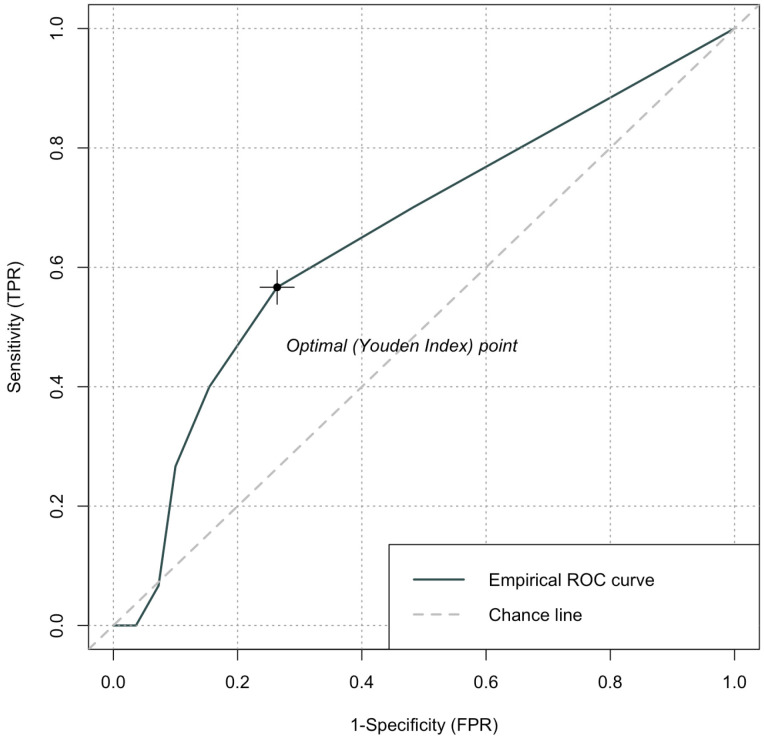
Results: The optimal cut-off value to discriminate between a low and high CONUT score was assessed by calculating the ROC curve. The area under the curve (AUC) was 0.67 (95%CI 0.59-0.78) with the most appropriate cut-off value at 2 points. Overall, 46 patients (32.9%) had a high CONUT score (>2). Statistically significant variables associated with eGFR decline at 24 months were age ≥ 70 (OR 2.01; 95%CI 1.17-3.09; p 0.05), stage II-III chronic kidney disease (CKD) (OR 6.05; 95%CI 1.79-28.3; p 0.001), and a high CONUT score (OR 3.98; 95%CI 1.58-10.4; p 0.004).
Conclusions: The CONUT score is a low-time-consuming, cost-effective, and promising tool able to preoperatively screen patients at risk of developing CKD after a RN.
Keywords: CONUT; Renal Cell Carcinoma; biomarkers; chronic kidney disease; morbidity; nutritional status assessment; radical nephrectomy.
Conflict of interest statement
The authors declare no conflicts of interest.
Figures
References
-
- Traunero F., Claps F., Silvestri T., Mir M.C., Ongaro L., Rizzo M., Piasentin A., Liguori G., Vedovo F., Celia A., et al. Reliable Prediction of Post-Operative Complications’ Rate Using the G8 Screening Tool: A Prospective Study on Elderly Patients Undergoing Surgery for Kidney Cancer. J. Clin. Med. 2022;11:3785. doi: 10.3390/jcm11133785. - DOI - PMC - PubMed
-
- European Association of Urology Guidelines on Renal Cell Carcinoma: The 2022 Update. [(accessed on 20 September 2024)]. Available online: https://www.sciencedirect.com/science/article/pii/S0302283822016761.
-
- Piasentin A., Claps F., Silvestri T., Rebez G., Traunero F., Mir M.C., Rizzo M., Celia A., Cicero C., Urbani M., et al. Assessing Trifecta Achievement after Percutaneous Cryoablation of Small Renal Masses: Results from a Multi-Institutional Collaboration. Medicina. 2022;58:1041. doi: 10.3390/medicina58081041. - DOI - PMC - PubMed
-
- Pecoraro A., Campi R., Bertolo R., Mir M.C., Marchioni M., Serni S., Joniau S., Van Poppel H., Albersen M., Roussel E. Estimating Postoperative Renal Function After Surgery for Nonmetastatic Renal Masses: A Systematic Review of Available Prediction Models. Eur. Urol. Oncol. 2023;6:137–147. doi: 10.1016/j.euo.2022.11.007. - DOI - PubMed
LinkOut - more resources
Full Text Sources
Research Materials
Miscellaneous
