


Efficacy and Potential Mechanisms of Naringin in Atopic Dermatitis
- PMID: 39456844
- PMCID: PMC11507659
- DOI: 10.3390/ijms252011064
Efficacy and Potential Mechanisms of Naringin in Atopic Dermatitis
Abstract
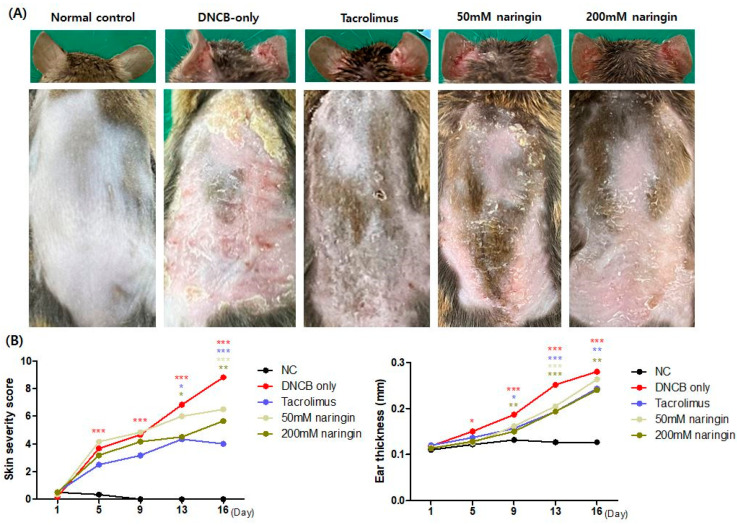
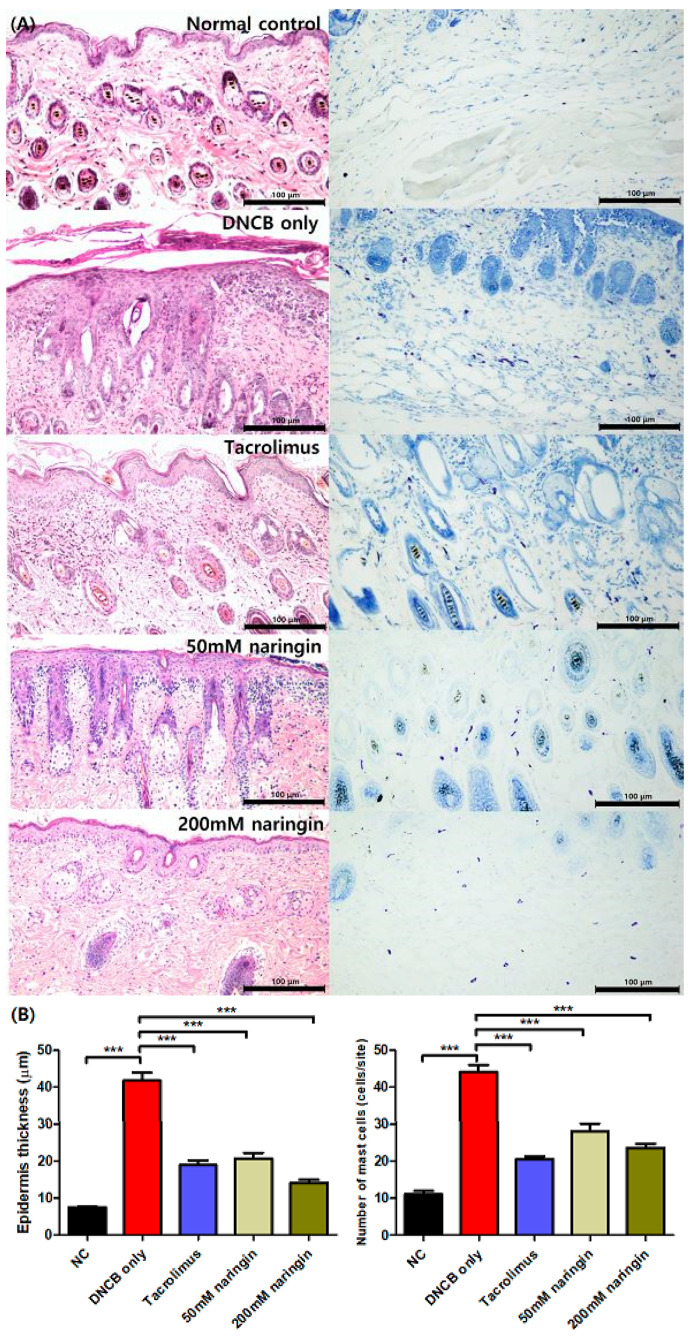
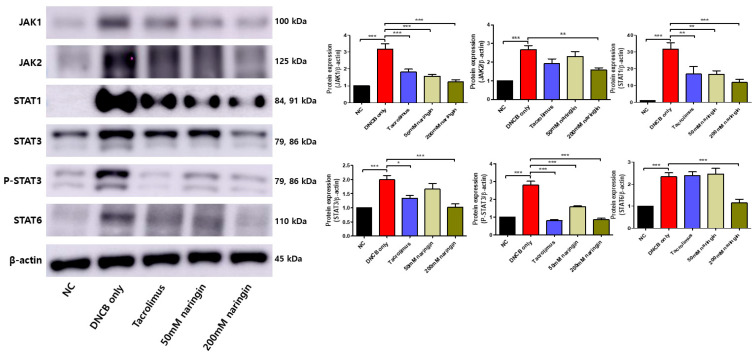
Atopic dermatitis (AD) is one of the most prevalent chronic inflammatory skin diseases. Topical treatments are recommended for all patients regardless of severity, making it essential to develop an effective topical AD treatment with minimal side effects; We investigated the efficacy of topical application of naringin in AD and explored the possible mechanisms using an AD mouse model induced by 1-chloro-2,4-dinitrobenzene (DNCB). Clinical, histological, and immunological changes related to AD and Janus kinase (JAK)-signal transducer and activator of transcription (STAT) signaling proteins in the skin tissues were measured as outcomes; Naringin treatment resulted in a significant improvement in dermatitis severity score and reduced epidermal thickness and mast cell count in the skin (p < 0.05). Naringin also demonstrated the ability to inhibit DNCB-induced changes in interleukin (IL) 4, chemokine (C-C motif) ligand (CCL) 17, CCL22, IL1β, interferon-gamma (IFN-γ), and tumor necrosis factor-alpha (TNF-α) levels by quantitative real-time polymerase chain reaction (qRT-PCR) and IL13 by enzyme-linked immunosorbent assay (ELISA) (p < 0.05). Western blot results exhibited the decreased JAK1, JAK2, STAT1, STAT3, phospho-STAT3, and STAT6 expression in the naringin-treated groups (p < 0.05); The findings of this study suggest that topical naringin may effectively improve the symptoms of AD and could be used as a therapeutic agent for AD.
Keywords: atopic dermatitis; flavonoids; inflammation; naringin.
Conflict of interest statement
The authors declare no conflicts of interest.
Figures

References
-
- Davis D.M.R., Drucker A.M., Alikhan A., Bercovitch L., Cohen D.E., Darr J.M., Eichenfield L.F., Frazer-Green L., Paller A.S., Silverberg J.I., et al. American Academy of Dermatology Guidelines: Awareness of comorbidities associated with atopic dermatitis in adults. J. Am. Acad. Dermatol. 2022;86:1335–1336 e18. doi: 10.1016/j.jaad.2022.01.009. - DOI - PubMed
-
- Roh Y.S., Huang A.H., Sutaria N., Choi U., Wongvibulsin S., Choi J., Bordeaux Z.A., Parthasarathy V., Deng J., Patel D.P., et al. Real-world comorbidities of atopic dermatitis in the US adult ambulatory population. J. Am. Acad. Dermatol. 2022;86:835–845. doi: 10.1016/j.jaad.2021.11.014. - DOI - PubMed
MeSH terms
Substances
Grants and funding
LinkOut - more resources
Full Text Sources
Research Materials
Miscellaneous
